


The tense of a novel might not be something you really notice when you’re reading, or even when you first start writing. But take a step back and assess, and you’ll realize just how important it is.
Do you choose the more familiar past tense, a la once upon a time…? Or do you use the present tense, making your reader feel like the action is happening right now?
Experiment with writing a paragraph of your story in the other tense and you’ll soon notice how it changes the feel of the novel: it can speed up the pace, slow it down, or change the distance your reader feels from your main character. The same can be true of writing in first person rather than third person.
But is there ever a right choice? And is it sometimes okay to switch between the two tenses?
The Novelry editor Nic Caws—formerly a publishing editor at Hachette—delves into some factors worth bearing in mind when choosing the tense for your novel... If you’re struggling to decide on the past versus the present tense, read on!
{{blog-banner-19="/blog-banners"}}
Why is picking a tense such an important choice?
To clarify, when we speak of using past tense or present tense in a novel, we’re talking about the tense your narrator uses to describe the events of the plot. For example, take this passage from Rebecca F. Kuang’s Yellowface:
My boss is annoyed, and the parents who booked me are understandably pissed, but I cannot sit in a windowless room and go over multiple-choice reading comprehension answers with gum-chewing, braces-wearing brats right now. I simply cannot. “Last week I watched a friend thrash around on the ground until she died,” I snap when a student’s mother calls me to complain. “So I think I can take some bereavement leave, all right?”
The protagonist, June, narrates the story in the present tense—i.e., “My boss is annoyed” rather than the past tense, which would read, “My boss was annoyed.” Of course, the tense used in the dialogue naturally varies, and events that happened in the past are described in the past tense. But the main thrust of the story is told in the present tense.
.avif)
Once you’ve decided on the tense for your narrative voice, it’s best to be consistent, as alternating rapidly between the two can have the same disorienting effect as “head hopping.” There are occasions where you might choose to deliberately play with tenses, and we’ll explore some of these, but this should always be a conscious decision to aid your storytelling.
It’s something our writers at The Novelry are always noodling over. In fact, you might find this article on choosing your narrative perspective helpful.
Or if you’re trying to choose whether to write your story in first or third person... we’ve got tips for that, too!
If you’re really struggling to choose the right tense for your novel, you could also consider working one-on-one with a professional editor. The Novelry offers hands-on help from bestselling authors and coaching sessions with publishing editors to help you find your path. Here’s a handy guide on how it all works with us.
The case for past-tense writing
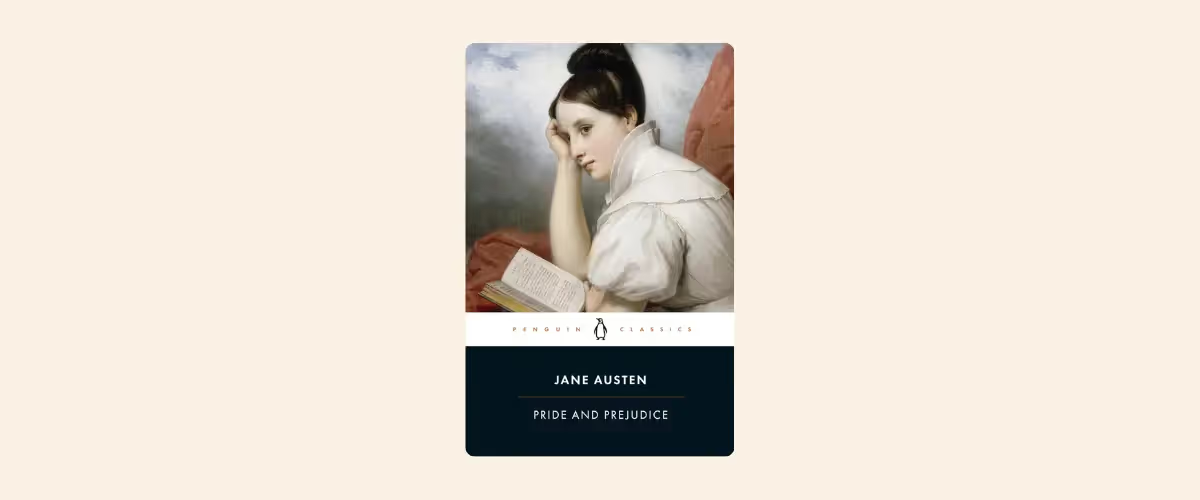
If you choose to write in the past tense, you’ll be in good company. From classics like Pride and Prejudice to Jessica Townsend’s Nevermoor series and Lessons in Chemistry by Bonnie Garmus, past-tense writing is a style many readers are very familiar with.
Some advantages of writing in the past tense over the present tense
- Readers tend to feel very comfortable with this. As a result, they’ll likely find it quite easy to sink into your book.
- The emotions and experiences of the characters are reported back to the reader, rather than us experiencing everything immediately alongside them. This can introduce distance and give your story a more reflective feel.
- You can use the past tense to imply that a character has more knowledge than your reader, giving the impression that your narrator knows the end of the story already, and you, as the reader, are being told it piece by piece, at their discretion.
The past simple and the past perfect
It may be familiar, but it’s important to be aware of the different kinds of past tense and to ensure you’re using them correctly. This means differentiating between your novel’s “now” and your novel’s “past,” just as you would in a story that’s primarily told in the present tense.
This is where the past perfect tense comes into play: when you need to differentiate the events happening in the main timeline from the events that might have happened days or years prior to the plot.
.avif)
The events of the main plot are told in the past simple tense. So, for example, he/she said, walked, picked up a coffee…
But if referring to events that happened a week ago, you’ll want to use the past perfect—e.g., he/she had said, he had walked, he’d picked up a coffee…
But avoid creating confusion
If you don’t differentiate, it can become confusing as to when the events you are describing happened. Consider this passage from Cecile Pin’s Wandering Souls:
His eyes were firmly shut, swollen and blue, his nose and lips a jumble of red, but there was no denying who lay on the ground. They instantly recognised the man they had sat next to in the dockyard for two weeks, the one who had first told them about quarantine and camps, who recommended that they pinch their cheeks and suppress their coughs.
The past perfect, in bold, signals that those events happened a while ago. If the past simple were used—“they sat next to”—it wouldn’t be clear whether they were sitting next to the man in the novel’s “now” or in the past.
.avif)
You can choose to use “had” for every occurrence where the past perfect is needed. However, if you have a long passage focused on a previous event, you might find that including “had” every time becomes a little cumbersome. Some writers therefore choose to use the past perfect tense for the first few instances, and then use the past simple tense.
Cecile Pin does this here:
They instantly recognised the man they had sat next to in the dockyard for two weeks, the one who had first told them about quarantine and camps, who recommended that they pinch their cheeks and suppress their coughs.
The case for present-tense writing
While the past tense might be more familiar, the use of present-tense writing is an increasingly popular choice for novels. Some popular present-tense novels include Yellowface, Emily Henry’s romance novels, like Great Big Beautiful Life, and Rebecca Yarros’s Fourth Wing.
It can also work well in short stories to create a sense of immediacy in a short period, ushering in your reader in the first few pages.
Consider these advantages of the present tense
- Present-tense stories give the effect of the action happening right now, which can lend an immediacy and faster pace to the writing—that can be compelling.
- The present tense closes the distance between the protagonist and the reader. This can mean that the reader becomes more emotionally involved as a result, especially if the present tense is combined with the first-person perspective (read more here about narrative perspective).
- If you want a reader to question whether your narrator will live or die, the present tense feels more suspenseful.
- The present tense lends itself well to literary fiction, which can feel cinematic.

The Housemaid by Freida McFadden is a good example of when present tense helps add urgency to a story, as you, the reader, get to experience each event alongside the character as it’s happening. When you have those dramatic reveals, you are reacting alongside the characters in real time, making you feel more connected to the characters and the narrative as a whole. The present tense allows the voice of the characters to shine through, too, giving an extra voicey quality which makes McFadden’s storytelling so vivid and exciting.
—Sorcha Rose, editor
Genre expectations
A good place to start writing is in the tense that feels most comfortable for you. This will help you hit on your unique author voice. However, it’s always worth considering your genre, as each genre tends to come with certain reader expectations or trends.
Some types of stories also just tend to suit a particular tense, as bestselling author and writer coach Kate Riordan notes below:
Not all readers like present tense, but you can’t beat it for suspense. In a very basic way, past tense in first person signals that the narrator got out alive, which you might not want the reader to take for granted. Beyond that, present tense has the effect of “anything might happen,” which really drives a reader on through each chapter, heart in mouth. In short, it’s great for immediacy and instant empathy with the main character. On the other hand, past—as the traditional choice—automatically has a lovely, comfortable, storytelling vibe which works perfectly for an epic sweeping tale or family story.
—Kate Riordan
Romance
Having edited romance novels for over ten years, I’ve noticed a relatively recent shift—in the last five years or so—toward authors favoring the present tense. I think this is partly because romance readers these days crave an intense emotional experience and a close connection to the protagonist. However, there are still plenty of extremely popular romances told in the past tense.
Writing coach and USA Today bestselling author Libby Page shares more insight from a creative writing perspective:
I have always written in present tense but tried writing my current draft in past tense—but am now switching back to present tense. I felt past made it feel a little too detached, which might work really well for a more literary novel where you want that element of distance, but for the kind of books I write, I want that intimacy and immediacy that comes with the present tense.
—Libby Page
Children’s and Young Adult fiction
Senior editor Simran Kaur Sandhu also had this to say about children’s and Young Adult fiction:
In YA, as with romance, present tense is getting more popular! It’s about a closeness with the protagonist—if you’re going through things at the same time, then you know exactly what they know! In middle grade, simplicity is best, so both tenses are very much used but authors tend to favour past tense as these are the kinds of books kids are used to reading. There’s less of a barrier to getting into the story and that’s all the more important in the current accessibility-centered market.
—Simran Kaur Sandhu, editor
Mixing it up with both past and present tense
While it’s a good idea to be consistent, there are times where it can be fun to deliberately play with tenses—if done in a way that serves the structure of your novel and adds something important to the reading experience.
.avif)
For example, if you’re writing a novel with a dual timeline, then writing the historical (or earlier) timeline in the past tense and the contemporary (or more recent) timeline in the present tense could be a way of pulling them apart. This is the approach Kristin Hannah takes in her novel The Nightingale.
The Novelry editor Sadé Omeje admires the way Elena Ferrante plays with tenses in her Neapolitan Quartet:
The quartet is narrated by Elena and it’s primarily told in the past tense, recounting the friendship and her history with Lila and the neighborhood, and then it also uses the present tense to frame the narrator’s act of writing. I don’t think this could have been written any other way. The tension on the page is established immediately with Elena being an old woman, writing as fiercely as she can everything she remembers about her friend Lila, who has disappeared. It’s like a race against time (and aging) in the present, and yet when she reverts back to the past tense, it’s able to take on a more meandering (but not at all boring) way of storytelling that reflects how long time seems to stretch when we’re younger.
—Sadé Omeje, editor
Use a clever combination of past and present tense as a plot device
Another example might be in a second-chance romance novel, where you tell most of the story from the present tense but include some chapters or scenes in the past tense, to give the reader an insight into the past relationship. Or in a crime novel, where you might want one character narrating the events of an investigation in the present tense, while using the past tense to tell the story of how the crime came to be committed. Your tense choice could actually assist your story.

This is why thinking about tenses as early as possible in the process is important, as Lizzy Goudsmit Kay realized when writing her own novel...
I started writing Seven Lies with a sense of the protagonist and her voice and little else, and I opted for the present tense without giving it too much thought. I quickly decided on a midpoint and then an ending, and I worked chapter by chapter through the story. When I was approaching the last few chapters of the first draft, I realized that my protagonist was narrating the entirety of the book from the last chapter, which meant that everything before that would need to switch into the past tense. Only the ending—the moment from which she narrates the story—would need to be in the present tense. I had to rewrite the majority of the novel. When writing in the past tense, and particularly when using a first-person narrator, it’s useful to interrogate why they’re telling this story and why now. And I’d recommend doing that before you write an entire draft!
—Lizzy Goudsmit Kay
Some common tenses and examples to be aware of
- Present simple: “I sleep.”
- Present continuous: “I am sleeping.”
- Present perfect: “I have slept.”
- Present perfect continuous: “I have been sleeping.”
- Past simple: “I slept.”
- Past continuous: “I was sleeping.”
- Past perfect: “I had slept.”
- Past perfect continuous: “I had been sleeping.”
Over to you!
Generally speaking, it might take a bit of experimentation before you hit on what tense, past or present, will work best for you and your story. The good news is there’s no right or wrong choice, wherever your tense shifts during the writing! Most writers have been through the same thing. But it can help to be aware of certain effects that each of the tenses can create across your entire novel, which can hopefully bring you to the best decision.
Just remember not to feel too tense about it!
.webp)
Tense writing is just one of several things The Novelry’s writing courses can teach you about, whether you’re stuck between past and present, your characters’ voice, or trying to decide between first person versus third person. Get daily guidance and confidence-building coaching, alongside plot and pace, while writing your novel from the first page to the last sentence. Decide which course is right for you here.
.webp)
.webp)