.avif)
How to Make Readers Cry
.avif)






The Finished Novel Course
The complete writing journey. Follow a clear, proven path from first idea to a finished, publishing-ready novel.

What a headline. But stay with us—we’re talking about the good kind of crying. The kind that sneaks up on you mid-page, catches in your throat, and leaves you changed. The kind only a truly powerful story can deliver.
Making readers cry is a fine art, as Libby Page, the USA Today bestselling author of This Book Made Me Think of You (and The Novelry writing coach), discovers in this blog post. Having your reader emotionally invested in your character’s journey is one of the greatest tools a writer can have in their toolbox, and it’s often the difference between a story that’s admired and one that’s truly felt.
So, what makes readers cry? What makes anyone cry? And how do you create emotion without tipping into cliché or contrivance? Grab a tissue and join Libby to explore the answers.
A gentle warning—tears tend to gather around pivotal moments and big plot touchstones, so spoilers lie ahead.
{{blog-banner-2="/blog-banners"}}
The first time a book made me cry
I can still remember the first time a book made me cry. I was eight years old, reading The Butterfly Lion by Michael Morpurgo, a book about a little boy who forms a special bond with a lion cub.
There’s a scene where you think something terrible is going to happen to the beloved lion, and I remember shutting the book and handing it to my sister to read ahead so she could reassure me everything would be okay, while I bawled my eyes out.
Instead of becoming a traumatizing memory, the experience sparked a lifelong love of books that make me cry and eventually led me to want to write books that give my readers a similar experience.
I love reading a good story that takes me on an emotional journey, and there is no greater journey than falling so hard for fictional characters that you weep for them. There is just something so cathartic about feeling tears streaming down your face and dripping onto the page as you’re reading.

As an author, it is the greatest compliment when a reader tells me that one of my books made them cry. I always feel like I should apologize, but I’d be lying if I said that wasn’t my intention! I aim to include at least one scene in every book that invokes tears, and often plan the whole book around that moment. For example, in my book The Lido/Mornings with Rosemary, I had the final lines figured out before I started writing.
In my latest book, This Book Made Me Think of You, I threaded the idea of making readers cry into the concept itself, and on a promotional tour, made several booksellers (and myself) tear up just by describing the premise.
.avif)
Making people cry through the power of words isn’t easy. It requires significant emotional effort on the writer’s part.
Not everyone will react to your story the way you hope they will, of course. But when you do create something that hits the right spot, it can be incredibly rewarding. And it might just be the trick that makes your book linger in the hearts and minds of your readers for a long time.
Why do we read—and write—books that make us cry?
Before we dive into tips on this kind of intimate storytelling, let’s take a moment to consider why we are so drawn to such books.
For me, reading novels that make me cry is a way of connecting with my humanity. The best weepy reads remind me of everything that is good—and everything that is painful—about being human. They might make me feel grateful for my own life by putting me in the shoes of characters who face struggles I haven’t had, or comfort me by showing me people who are going through things that I have experienced.
There is a sense of connection and community in books that makes us cry. You feel connected to the characters, to the author, and to other readers. Did the ending of One Day make you sob, too? Do you still tear up every time you think of that scene in The Railway Children?
If a book can stir within you such a visceral reaction, it is the ultimate sign that you have connected with the protagonist and the storyline. And that can translate into how a book is received.
It is no surprise to me that some of my favorite books that made me cry were also massive bestsellers. If you think of books like The Notebook, Me Before You, One Day, The Time Traveler’s Wife, and The Nightingale, these emotionally resonant stories were huge hits among large audiences, with their universal themes of grief, illness, and lost romances capturing our collective imagination.
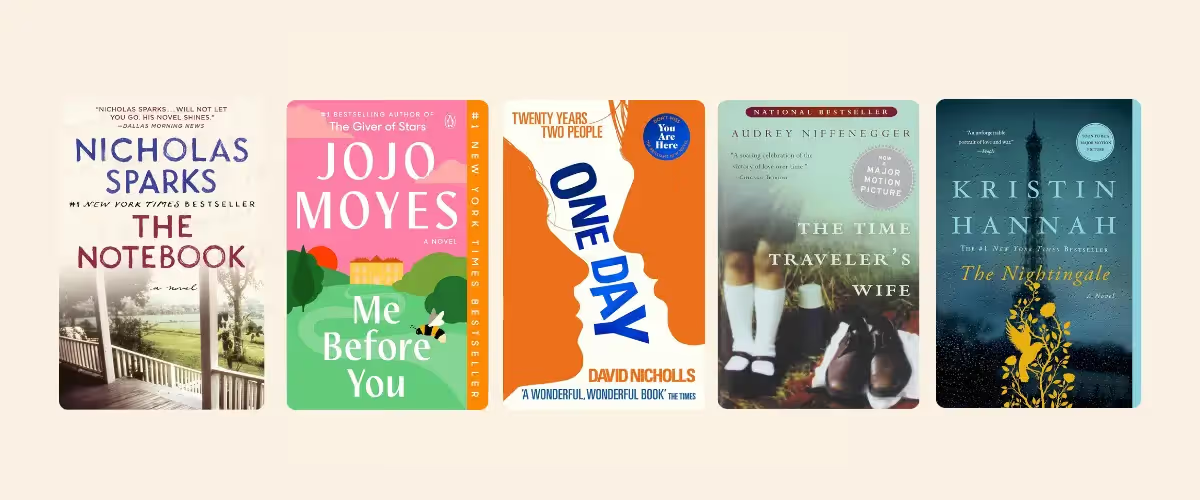
We want to feel moved. And when we do feel moved by a book, we are more likely to rave about it.
In fact, a 2012 study called Sad Movies Don’t Always Make Me Cry found a clear link between sadness and enjoyment for viewers of melancholy movies. The people who felt the saddest after watching a film were also the ones who said they enjoyed it the most.
Why one particular book really made an emotional impact...
I recently asked on social media for people to recommend a book they thought I absolutely had to read. By far the most common response was The Nightingale by Kristin Hannah. Set in occupied France during World War II, it is a harrowing read. At first, it surprised me that so many people would pick such a heavy book as their favorite of all time. But the success of The Nightingale (an international bestseller that has sold millions) proves that so many of us are fascinated by our own feelings, and that we want to tug at our own heartstrings. Perhaps there’s a smattering of morbid curiosity in there, too.
.avif)
People rate books like this because they make them cry, not in spite of it. And while everyone won’t react in the same way, the key to any good story is to find something that reaches people on a deeper emotional level, whether in drama, historical, romance, horror, or beyond.
How to make readers cry in 8 steps
If you are looking to write a story that makes readers cry, there are a number of steps you need to consider so your book hits the right note.
1. Make us believe in your story and your characters
Help your readers believe your story. The best way to do this is through the eyes of your characters. People need to feel that the characters are real in order to cry with them and for them. This comes from bringing the entire story to life vividly on the page, using specific details and exploring all the senses through showing, not telling. All the standard advice on how to make writing feel rich and real applies here.
The characters need to be vividly drawn. They should have thought-through backstories, flaws, and contradictions. Get specific with the character details, for example, by giving them memorable quirks and mannerisms and character traits that feel true. One Day, for example, uses humor to great effect.
“Oh you know me. I have no emotions. I’m a robot. Or a nun. A robot nun.”
―David Nicholls, One Day
Readers will only cry if they believe the characters are real, so if you are aiming to write a book that leaves us all misty-eyed, then you should spend considerable time developing the world and the characters in your world in a way that pulls the reader in, making them feel that they are really there walking side by side, experiencing their pain alongside them.
2. Make us care about your characters
As well as believing in the world you have created in your novel, readers need to root for not just your protagonist, but all the other characters in their orbit. Jo’s story in Little Women cuts all the deeper because of the family around her, and the sorrow she feels (and, in turn, us!) when we learn the fate of Beth.
The characters don’t need to be perfect—think the prickliness of Ove in A Man Called Ove—but they do need to have enough admirable qualities for us to want the best for them, or fear the worst.
.avif)
Ove might be brusque, gruff, and at times outright prejudiced, but he also has principles. We get to see his vulnerabilities through glimpses of his childhood and through flashbacks that show his relationship with his beloved late wife.
He was a man of black and white. And she was color. All the color he had.
―Fredrik Backman, A Man Called Ove
A character needs enough admirable qualities for us to truly care about what happens to them. They can and should have flaws, too; flaws make a character feel more believable and, therefore, more relatable.
It’s not enough to just show a character feeling sad. I don’t think that’s what makes us cry for them. I think we cry when we relate, when we can put ourselves in their position and deeply feel what they’re experiencing with them.
What is the thing that is going to make your reader fall in love with your character(s)? Having a solid idea of this is an important step toward making your readers cry.
3. Make your characters care about something/someone
Once the reader cares about your characters, you need to ensure that your characters care about something too. Deeply. What is the most important thing or person in the world to them? Why does it matter to them? What’s their perspective?
4. Show why this thing is so important
Now it’s time to raise the stakes. It’s not enough to just mention once that a character loves their mum, or their child, or their friend, or their dog. Whatever that thing is, you need to show it, again and again.
Maybe the person the character cares about is the only person who truly sees and understands them, like the way Emma in One Day believes in Dexter even when he makes questionable choices and his life falls apart. Or perhaps their bond is unique, in the way that elderly Bo lives a solitary life with his beloved dog Sixten in When the Cranes Fly South, where Sixten brings warmth and companionship into Bo’s otherwise lonely world.
.avif)
The thing they care about doesn’t have to be an animal or person: in my book The Lido/Mornings with Rosemary, it’s the lido itself that matters so much to octogenarian Rosemary, and we get to see why through flashbacks of her life with her late husband George, learning that the lido isn’t just a swimming pool to her, but the place that holds all her most cherished memories with her husband—the one place where she still feels his presence.
5. Threaten or destroy the thing they care about
Now that you have set up what matters most to your character(s), it’s time to bring it all crashing down. Throw in a setback, devise a rug-pull, kill someone off. Give them something to overcome. The ending of One Day (spoilers incoming!) is so tragic because we know that Emma is the one constant in Dexter’s life, the person who means the most to him (even if he hasn’t always been the best at showing it). The ending is doubly tragic because Emma and Dexter had only just found their happiness before having it snatched away.
“Don't think of me too often. I don’t want to think of you getting all maudlin. Just live well. Just live.”
―Jojo Moyes, Me Before You
In Me Before You (again, spoilers!), Lou loses Will at the point at which he’s come to mean the most to her. In The Fault in Our Stars (a book that made me weep continuously for the final 50 pages), Augustus and Hazel have their first, deeply powerful experience of love, making the loss that follows even more painful. Tears aplenty.
Sometimes tragedy comes in watching a character fight to protect the thing they care most about, like in The Nightingale, where we see mothers doing everything they can to protect their children.
By making a character feel real, making us care, showing what they care about, and then going after that thing—like when Sixten is eventually removed from Bo’s care in When the Cranes Fly South—the author lands an emotional sucker punch that can’t fail to move us.
6. Sometimes less is more
You might be striving for emotion, but it doesn’t have to be overblown. Emotion can lose its impact if you try too hard to force your reader to tears through melodrama. You risk breaking the spell—and then your story might become unbelievable rather than relatable.
Sometimes the most moving scenes are those where something is held back, emotion coming in the restraint or in the moments we don’t see but instead imagine.
Another book that made me cry was The Seven Year Slip by Ashley Poston, a time-travel romance where the main character has recently lost her beloved aunt. Near the end of the book (spoiler!) is a scene where the main character travels back in time to when her aunt was still alive, and her aunt walks through her front door when she’s least expecting it. She thought she would never see her again.

We don’t see the entire scene. There isn’t a big, dramatic reunion across the page with lots of sentimental dialogue. Instead, we are given a glimpse of a brief moment—the moment the door opens and the person the main character so desperately wants to see comes walking through—and it is so much more powerful for it. That subtlety gives the reader the freedom to paint their own picture of the scene, perhaps inserting their own beloved relative into that doorway.
7. Remember: tears can be happy!
When we think of weepy books, we often think of tragedy, but some of my favorite books that made me cry were with happy tears.
To help your reader get that therapeutic release, you need to return to your steps: make us believe in the characters, root for them, and know their deepest yearnings. But if you’re aiming for happy tears, then instead of totally destroying the thing they love, you might threaten it—maybe make us believe they’ve lost it forever, but then give it back! Like in the case of The Railway Children, when Bobbi is finally reunited with her father, or Atmosphere by Taylor Jenkins Reid (spoiler alert!), where we believe everything is lost until the final moment. I finished that book sobbing, not because I was broken-hearted, but with relief.
.avif)
It also makes me cry when good characters who have had a hard time finally find the happiness they deserve, like at the end of The House in the Cerulean Sea by T.J. Klune, a book that made me sob with happiness for the characters and their found family.
8. Dig deep
This final point is perhaps the hardest, but maybe also the most important.
For a novel to feel true, I think it requires honesty and vulnerability from its author.
Where can you find emotional truth in your story, even if the characters are fictional? What does your own heart yearn for? What makes you cry?
The inspiration for my book, This Book Made Me Think of You, came from asking myself what I most longed for: the chance to have one more conversation with someone I loved, but had lost. It’s something I can imagine so many people relating to. Perhaps they find the story painful, yet irresistible. It sparked the idea of a character receiving a gift of books and letters from her late husband after his death, and that these books and letters could be a conversation that continues after death.
“But it’s OK to feel happy and sad at the same time. Very few moments involve just one emotion. That’s life.”
―Libby Page, This Book Made Me Think of You
I wrote the book while dealing with my own grief, and while the events of the story are inventions, the emotions I poured into it are real. There were times when writing it felt tough—where it felt too sad, too raw to crack open my heart in this way, even if writing fiction gave me scope to hide parts of myself within the fabrication of the story.
But I realized this emotional vulnerability connected more powerfully with the readers. I hope it feels true, because it is, even if the characters and the story are entirely invented.
To write authentically, we always have to share something of ourselves. Something real, something vulnerable. That’s what I look for in the books I read and what I try to do in my writing.
.webp)
It takes courage to put pen to paper—and self-belief to keep going. An idea you can’t wait to write is where it starts. What matters next is learning the craft—and seeing it through. At The Novelry, we teach the craft properly. With bestselling authors. With former Big Five editors. With a clear path from idea to submission-ready manuscript. Browse our courses and see your writing future unfold in front of you.
The Finished Novel Course
The complete writing journey. Follow a clear, proven path from first idea to a finished, publishing-ready novel.
.avif)
.avif)


Libby Page
Writing Coach
Sunday Times bestselling author of Up Lit novels including The Lido (USA: Mornings with Rosemary), winner of the WHSmith Thumping Good Read Award.
.avif)
Related Articles
The Secret to Concocting an Agatha Christie-Style Mystery

Women in Historical Fiction: Reclaiming the Stories History Left Behind