

The damsel in distress, the femme fatale, the matriarch, the total badass, the evil queen, the Mary Sue, the manic pixie dream girl, the determined young woman, the strong female character... We’ve all come across these archetypes in our reading, but which literary heroines stand out the tallest among the pages, beyond all these labels?
From Jo March to Jane Eyre, Miss Marple to Scout Finch, these complex women and girls across literature continue to teach us the joys of finding our own path in the world.
To celebrate such inspiring women—even if they are fictional—we asked our writing coaches and editors to unpack the most fascinating female characters they’ve encountered in their reading, be they iconic heroines, villains, or somewhere in between!
What really makes a “strong female character”?
Whether they’re young girls on a journey of self-discovery or highly intelligent women with an inner strength and their own rules that defy societal expectations, which female characters linger long in the mind after the final pages of their stories have been turned?
{{blog-banner-3="/blog-banners"}}
Anne Shirley from Anne of Green Gables by Lucy Maud Montgomery
Chosen by Mahsuda Snaith
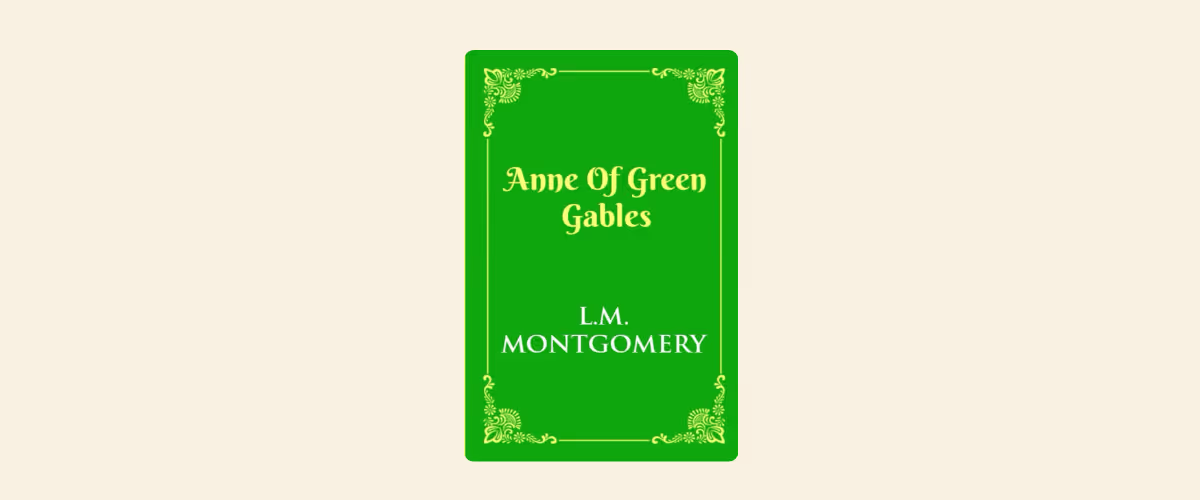
When I was a child, my biggest strength was my imagination. It helped me turn the ordinary into the fantastical and kept me optimistic in the bleakest of times. As a South Asian girl brought up on a council estate in 1990s England, it might seem strange that I’d choose Anne Shirley from Anne of Green Gables as a female literary character that speaks to me, but even though Anne was a white girl living in early 1900s Canada, it was reading about her strong imagination that helped me feel seen.
For those who don’t know, Anne is an orphan sent by mistake to live on a farm in the fictional village of Avonlea (she was meant to be a boy).
A character of sharp intellect, she is a chatterbox with a wild imagination that gets her into continuous scrapes, some of the most memorable being when she tries to dye her red hair and it comes out green, as well as nearly drowning herself when acting out the death of Hamlet’s Ophelia.
“Do you never imagine things different from what they really are?” asked Anne wide-eyed.
“No.”
“Oh!” Anne drew a long breath. “Oh, Miss—Marilla, how much you miss!”
―L.M. Montgomery, Anne of Green Gables
In turn, I would lie in my back garden, imagining myself as Anne Shirley, imagining myself as Ophelia. It appears that fiction can be infectious.
Apart from her wild imagination, another thing I shared with Anne was a deep yearning to be a writer. Seeing her submitting to magazines and getting multiple rejections before finally getting published (in a similar way to L.M. Montgomery, the author of the books) gave me hope that I, too, could one day get published.
And despite negative bias about gender and upbringing, I did get published, just like Anne. For these reasons, I will always think of Anne Shirley as a secret cheerleader for all women and young readers who want to write. And for that, I will be eternally grateful.
Duchess Radley from We Begin at the End by Chris Whitaker
Chosen by Tash Barsby
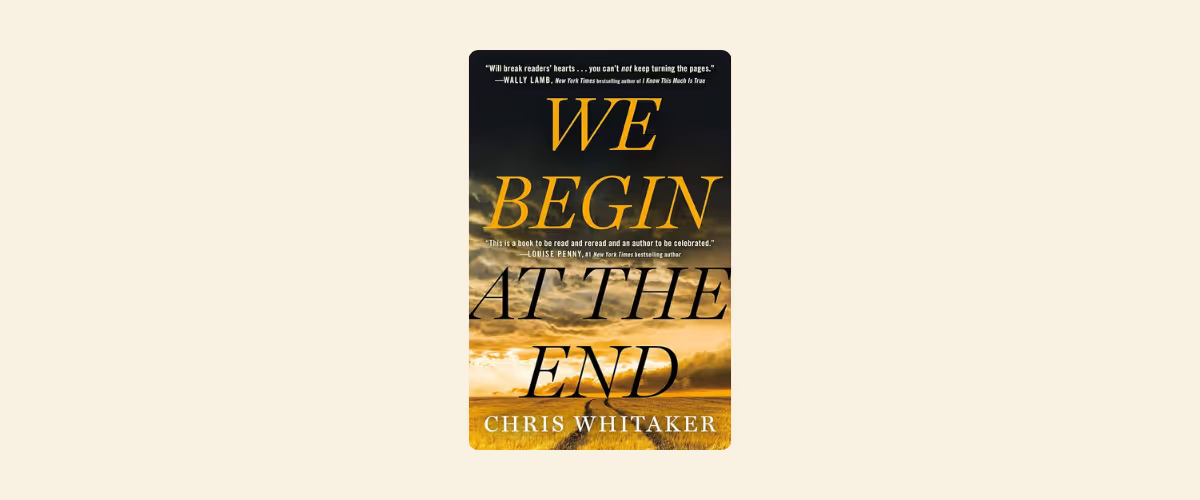
Chris Whitaker has become a favorite author of mine for many reasons, but creating the character of Duchess Radley—the thirteen-year-old protagonist of We Begin at the End—has to be number one.
Duchess is a self-proclaimed outlaw, which pretty much tells you everything you need to know about her—she’s spiky and tough, hardened by a life taking responsibility for her young brother and her beloved but troubled mother.
“All these people,” Duchess said. “They spend a lifetime looking to the sky and asking questions. Does God intervene, and if he doesn’t, why do they still pray?”
“Faith. The hope that he will.”
“Because otherwise life is too small.”
―Chris Whitaker, We Begin at the End
Watching her grow from a spirited but angry and distrustful young girl to someone who learns to be emotionally vulnerable, to forgive those who should have done more for her all along, to allow herself the freedom to simply be a child, has to be one of the most heart-wrenching but satisfying arcs I’ve ever read.
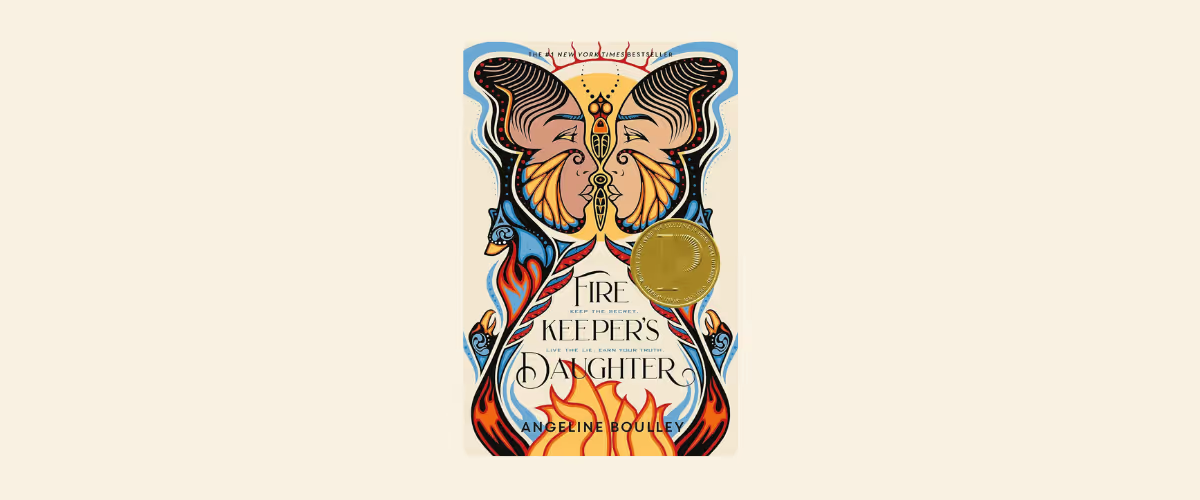
Daunis Fontaine from Firekeeper’s Daughter by Angeline Boulley
Chosen by Alice Kuipers
There are as many female characters I’ve loved in books as there are incredibly strong women who have influenced my own writing life. Which is to say: lots!
From Jo March in Little Women, Sethe in Beloved, Anna Karenina in—well, Anna Karenina!—to The Narrator in The Yellow Wallpaper, Ruth Galloway in the book series by Elly Griffiths, and the female detectives in Tana French’s Dublin Murder books, I’m endlessly admiring and falling in love with these women.
But when I pick one character who I want to hang out with over and over again, I choose Daunis Fontaine in the brilliant Firekeeper’s Daughter by Angeline Boulley. I read this terrific YA novel as I was starting to write my first adult crime mystery (having written YA fiction for years).
“My whole life, I’ve been seeking validation of my identity from others. Now that it’s within my reach, I realize I don’t need it.”
―Angeline Boulley, Firekeeper’s Daughter
What I saw in Daunis was a vivid, strong female character who was searching for her own identity and this incredible balance of adult and teen that works so well in this novel. I loved how the thriller elements of this book kept me turning the pages, and how Daunis is so quick to act (even when it gets her into trouble).
Daunis is clever, curious, and entirely believable. I loved the balance of the political and the personal elements in this book and I love a feisty character who keeps trying to uncover secrets even as danger mounts. She’s flawed but with a beautifully human spirit.
I’ve gone over and over this book to remind myself of the importance of having a main character who has agency, one who acts and changes the course of the story for herself and for everyone else. As Daunis discovers herself in the world, we discover her too—and I love getting to hang out with her on the page!
Elizabeth Bennet from Pride and Prejudice by Jane Austen
Chosen by Sarah Turner

No literary character is as fully formed and alive in my mind as Elizabeth Bennet. I was 11 when I first read Pride and Prejudice, and Lizzy’s determination, wittiness, and badass defiance ignited something in me that felt new and intoxicating.
I’m certain the “girl power” posters on my bedroom wall in the height of Spice Girls mania meant more to me because Jane Austen had paved the rebellious way. For me, Lizzy was the original Spice Girl, and if there had been an Elizabeth Bennet poster in Just Seventeen magazine, I would have displayed it proudly next to Geri.
Lizzy is, of course, deeply flawed. Despite her intelligence and integrity, her prejudiced and misguided early assessment of Mr. Darcy proves she is fallible, just like the rest of us. We witness her making the wrong decisions in her own life before figuring out the right ones, and we root for her because the characterization is so strong and we genuinely care about the outcome, as though she were our friend.
“You mean to frighten me, Mr. Darcy, by coming in all this state to hear me? But I will not be alarmed though your sister does play so well. There is a stubbornness about me that never can bear to be frightened at the will of others. My courage always rises with every attempt to intimidate me.”
“I shall not say that you are mistaken,” he replied, “because you could not really believe me to entertain any design of alarming you; and I have had the pleasure of your acquaintance long enough to know that you find great enjoyment in occasionally professing opinions which in fact are not your own.”
―Jane Austen, Pride and Prejudice
It helps that the double act with Darcy—and some of the best flirty banter of all time—provides the quintessential enemies-to-lovers arc, but Elizabeth Bennet is a fierce and brave main character without a man, and this is, I think, the bedrock of her charm.
There is a moment in the book where she says, “My courage always rises with every attempt to intimidate me,” making it clear she will not be unsettled by Darcy or his social standing. I often think about this boldness and when faced with a modern conundrum, find myself wondering, what would Lizzy B do? She would have courage and gumption and principles, of course, and she would teach us all a thing or two.
Elizabeth Bennet is more than a character to me. She exists, she is real, and I’m so very grateful 11-year-old Sarah made her acquaintance.
Kidan Adane from the Immortal Dark Trilogy by Tigest Girma
Chosen by Krystle Appiah
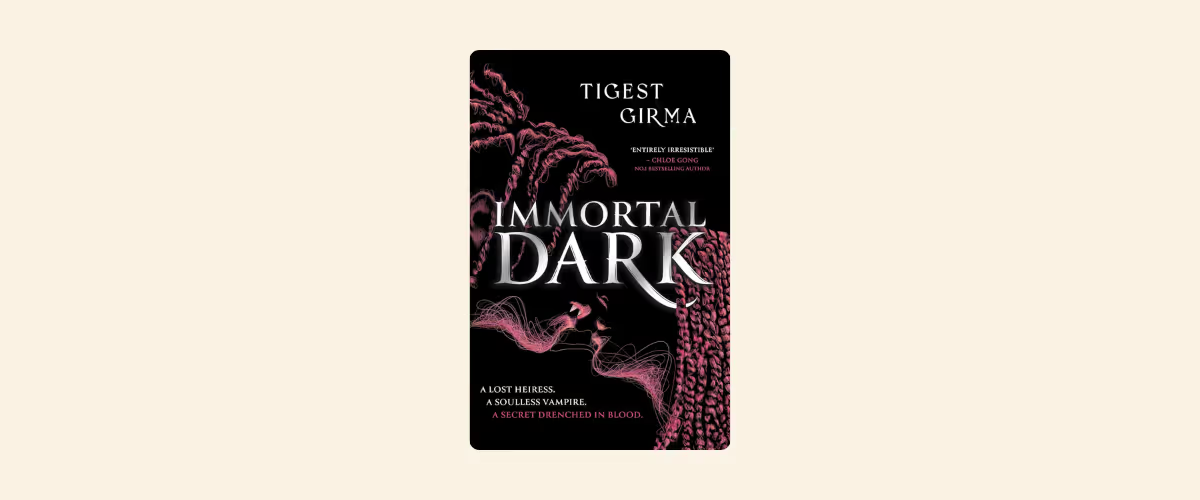
At the start of Immortal Dark, protagonist Kidan Adane is awaiting trial for murder; her sister June is missing, and Kidan is certain a vampire took her.
Like Gone Girl’s Amy Dunne, Grace in How to Kill Your Family, and other morally gray anti-heroines, Kidan has one clear goal worth killing for: to find her sister. But to do that, Kidan will have to return to Uxlay, an elite magical university where vampires live alongside humans, and play by their rules to claim her inheritance and have any hope of finding June.
Kidan Adane was a murderer. She waited for the prickle of remorse she should have felt at those words. She even pinched her mouth and scrunched her nose, trying to force emotion out of herself. But just like that fiery night, she failed to cry.
―Tigest Girma, Immortal Dark
Kidan could easily be described as ruthless, calculating, obsessive, and vengeful. And though there are glimpses of softness and warmth, and she’s motivated by a deep desire to protect, Kidan is a young woman who embraces darkness.
Some writers would shy away from this, but Kidan holds her own among monstrous vampires. She’s formidable, unforgettable, and a young woman whose bad side you would not want to be on!
Sabriel from The Old Kingdom series by Garth Nix
Chosen by Katalina Watt
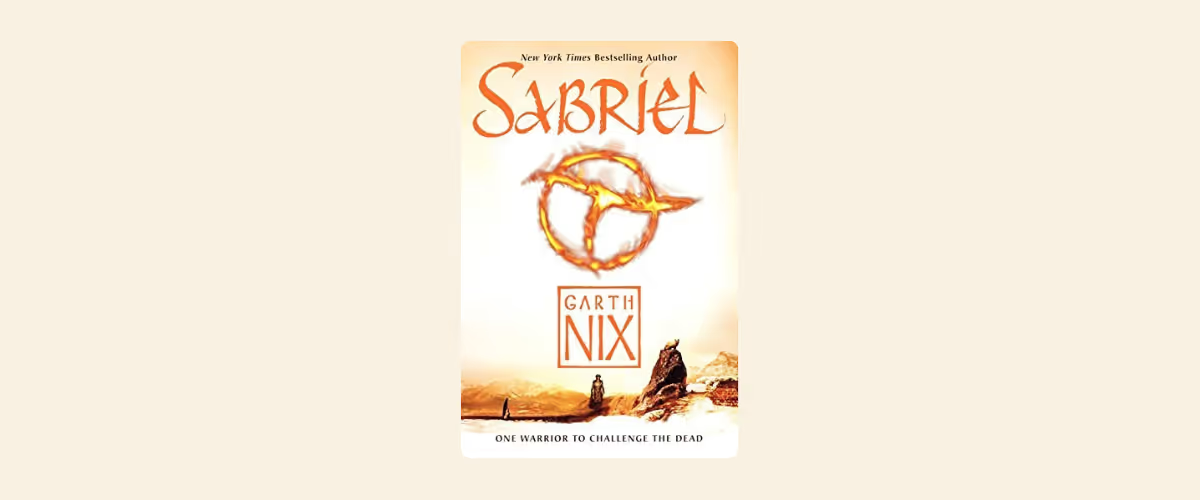
At 18, Sabriel follows a cryptic letter from her estranged father, leaving education and everything she knows. She discovers that not only is there a magical world across the Wall, but she’s the next Abhorsen, a revered necromancer and defender against the dead.
The position comes with great expectations from the kingdom she must protect, as well as deadly power. Sabriel is a go-getter from the start, incredibly smart and resourceful without sacrificing her generosity, femininity, or sexuality. She’s competent and quick to learn magic, can hold her own against the snarky cat-creature Mogget, and is brave in the face of great unnatural evil.
“Does the walker choose the path, or the path the walker?”
―Garth Nix, the Old Kingdom series
The first book is a wonderful foundation of her nuanced character as she goes on to be an inspiring queen and ruler of The Old Kingdom, as well as a wife and a mother.
Nix’s Sabriel was one of the first female role models I had in fantasy growing up, and her unapologetic confidence, competence, and compassion is something I try to instill in my own character writing and use as a tool for my own life.
Lyra Silvertongue from His Dark Materials by Philip Pullman
Chosen by Katie Khan
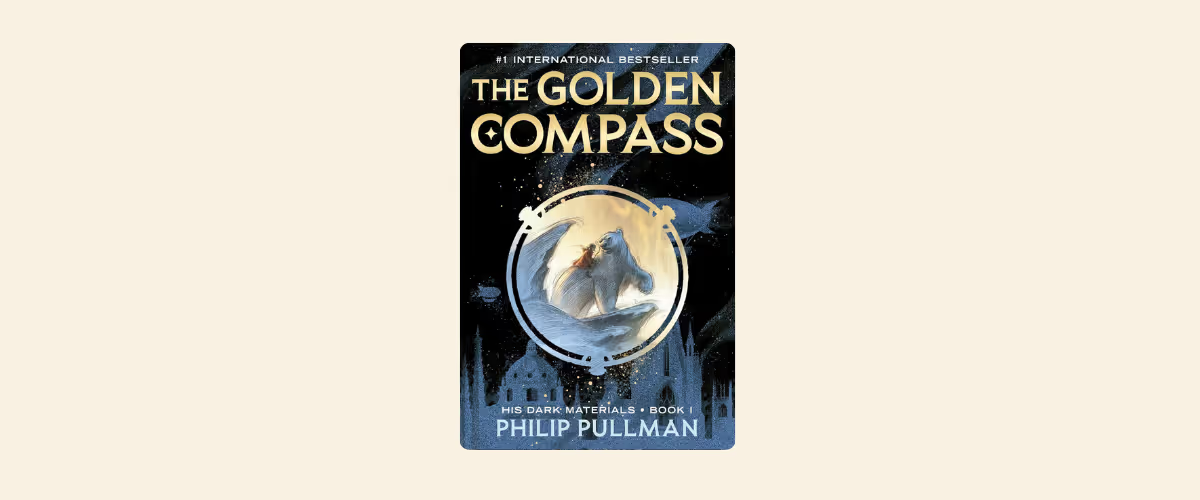
The first time we meet Lyra Belacqua—later Lyra Silvertongue—in Northern Lights, the first book in Philip Pullman’s His Dark Materials trilogy, the 12-year-old sneaks into a wardrobe alongside her daemon, the shape-shifting Pantalaimon, where she spies on a presentation given by her uncle to the Scholars at the all-male Oxford college where Lyra has been raised.
From her hiding place, she witnesses powder being poured into her uncle’s drink and bursts forth, knocking a glass of poisoned wine from his hand, setting in motion an adventure bigger than she—and the reader—could ever have expected.
What is it about Lyra that’s stayed with me since I first read this fantasy trilogy some 30 years ago? Well, there’s her delightful bluntness and fearlessness, for one; Lyra clambers over the Oxford rooftops, befriends an armored bear, survives a world of soul-sucking specters, masters the mystical alethiometer (the “golden compass” in the U.S. edition), and escapes the villains of The Magisterium multiple times across the series.
She’s a gifted storyteller, often saving her own skin through an elaborate web of lies, which garners her the surname “Silvertongue.” But I think Lyra’s memorability, for me, might come from something deeper in Pullman’s writing, something observable and true.
As a young girl surrounded by boys and men, there’s a visible edge to Lyra she wears like a blade. Around other children she is blunt and fierce, waging war on the town children and playing “kids and Gobblers” with Roger and the college kids.
And yet, when Lyra meets the glamorous Mrs. Coulter, Lyra becomes more malleable, dressed up like a doll, wooed at first by the older woman’s sophistication—something Lyra lacks—until the girl realizes it’s a front, and her own sharp edge returns.
Lyra behaves differently around different people, which feels genuine for children of this age; there’s a duality in how she presents herself to other children versus to adults.
As a reader, you can viscerally feel her clamping down on her true human nature around Lord Asriel, Mrs. Coulter, and many of the adult characters in the story.
When she likes and trusts someone—really trusts them, like Will, or Iorek Byrnison—her fierce blade transitions into fierce loyalty.
Lyra looked up at the blazing sky. She was aware of how small they were, she and her dæmon, in comparison with the majesty and vastness of the universe; and of how little they knew, in comparison with the profound mysteries above them. “We could,” Pantalaimon insisted. “We came all this way, didn’t we? We could do it.”
―Philip Pullman, Northern Lights
With her daemon Pantalaimon, we see yet another side of Lyra. Daemons, in this world, are an external manifestation of a human’s soul. And so there’s an intimacy between them, written with the shorthand of siblings; Lyra and Pan interact the way a brave older sister might with a more risk-averse younger brother. Cajoling. Persuasive. Bossy, sometimes. Loving.
Most importantly, Lyra changes across the trilogy—you can’t tell me the Lyra taken in by Mrs. Coulter at the start of the series is the same person taking down The Authority by the end!
Personally, I’ve always chafed at the phrase “strong female character,” but with Lyra, I adore that she’s wily and fearless. But, as a 12-year-old, occasionally led by characters who seem more sure-footed than she is—in this world, adults—until she sees through their veneer to the truth of the person within. Lyra Silvertongue is fully rounded; like the universe she inhabits, her character contains multitudes.
Is your main character a strong female heroine?
Consider joining The Big Idea course to help bring her to life.
You’ll learn exactly how famous authors found their ideas and built them into stories that moved readers everywhere. By the end, you’ll have a polished outline with a powerful plot. You’ll find your voice. And you’ll leave with the book you were meant to write—a story readers will love.
.webp)
So! There’s a few feminist icons to get you inspired. As a female-led company, strong female literary characters are hugely important to us at The Novelry! Whether it’s Katniss Everdeen in the Hunger Games series or Hermione Granger in Harry Potter, or the works of Virginia Woolf or Margaret Atwood, celebrate your inner heroine with us on Instagram, Threads, and Facebook, and tell us about the female literary character that YOU can’t stop thinking about on #InternationalWomensDay.
.webp)
.jpg)