.avif)
%20(1).avif)
Dystopian fiction imagines worlds where something has gone deeply wrong—where systems fail, power is abused, and ordinary lives are impacted and reshaped by extraordinary circumstances. These stories are often rooted in very real fears about our society, technology, and the environment, sounding an eerie alarm bell to humanity to turn back before it’s too late. (It certainly isn’t lost on fans of this genre that science fiction writers accurately predicted multiple aspects of our current world many decades ago.)
By inviting readers to question the state of the present as much as the potential futures ahead of us, dystopian novels are incredibly prescient. They are loaded with questions about human life, about our fears and expectations for how we live and how we can survive. This can make them too disconcerting for some readers, while for others they provide food for thought and important lessons to heed.
What always remains true about dystopian literature is that it offers writers a rich space in which to explore big ideas through intimate, human stories. In this article, editor Natasha Qureshi explores what defines this subgenre and highlights some favorite dystopian novels, taking both readers and writers by the hand into this deep exploration of dystopian worlds.
Over to Natasha...
{{blog-banner-3="/blog-banners"}}
Everyone, deep in their hearts, is waiting for the end of the world to come.
―Haruki Murakami
From the classics to modern masterpieces, dystopian books have long been a subgenre of science fiction that has fascinated humankind. It’s a genre that imagines the worst, world-ending scenarios, from natural or nuclear disasters, apocalyptic (or post-apocalyptic) ends, or oppressive regimes that depict a future or alternative world that is characterized by dehumanization, injustice, and suffering. Oftentimes, these novels are a reflection of our current times and a way for us to look at the worst-case scenarios to make sense of our present.
.avif)
Dystopian novels can also sometimes have a science fiction element, perhaps featuring aliens, AI, or zombies. They may be an allegory for mass illness, the fear of the unknown, dictatorship, and the uncertainties surrounding technological advancement.
But why are we so intrigued by these imagined dark futures?
.avif)
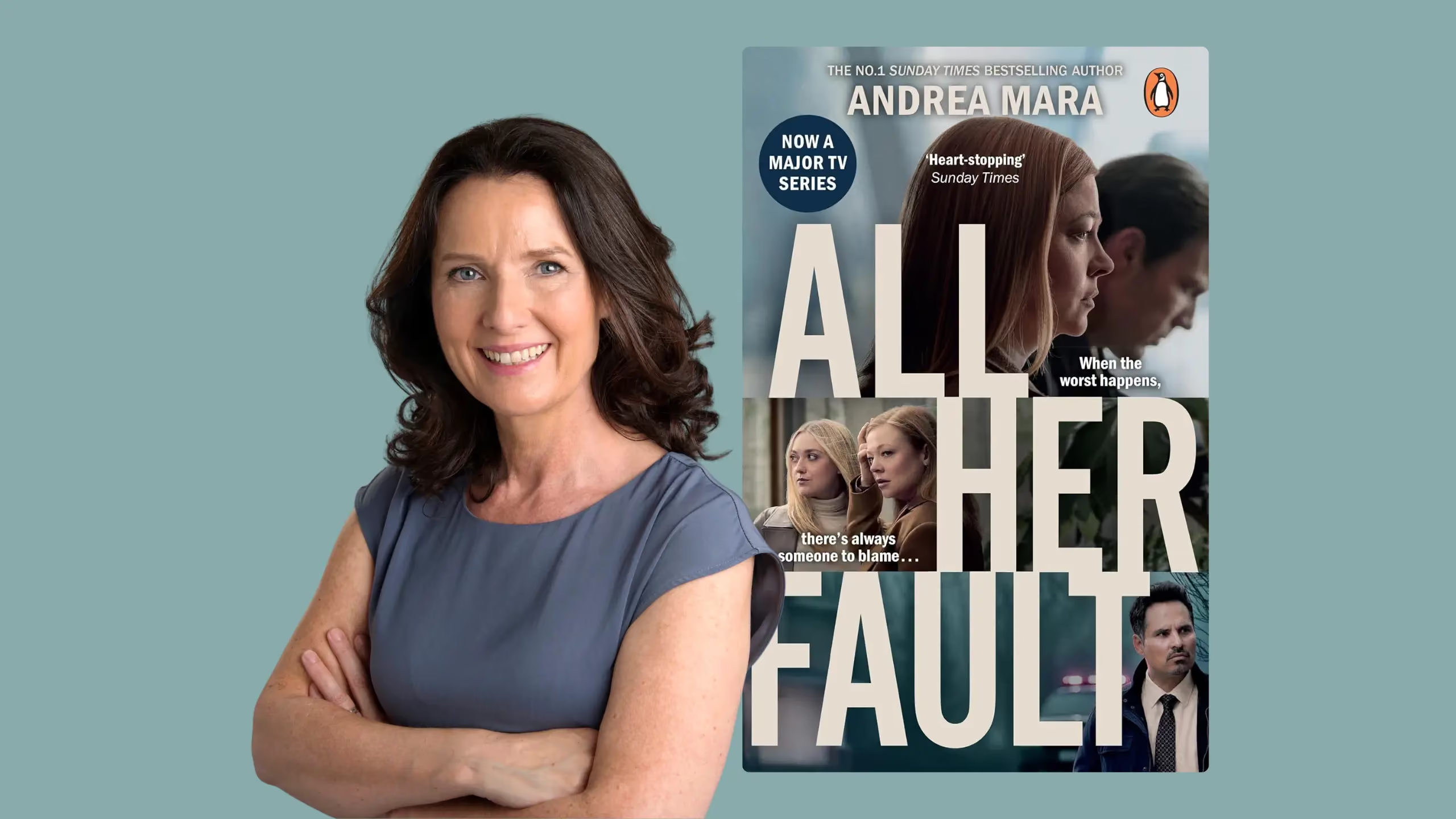
Author of Dark Lullaby, Polly Ho-Yen, explains that when the circumstances that surround us become overwhelming, so dystopian fiction can provide us with a route forward.
Imagining what your characters would do in an impossible situation forces you to ask what you would do, how far you would go and, ultimately, who you might need to become.
—Polly Ho-Yen
Resilience in the face of great adversity is a powerful theme, and it’s an incredibly useful approach to thinking of how a character’s internal journey will develop throughout a story.
Let’s explore the defining features of dystopian fiction one by one, highlighting some of the greatest works in the subgenre along the way. This will provide you with a practical guide to dystopian fiction, some recommended reads if you’re looking for them, and some top tips and elements to focus on if you’ll be writing it yourself in the near future.
Dystopian literature explores problems and issues
These novels take our worst fears about the apocalypse, climate disaster, civil war, and the landscape of the future, where nothing has worked out well for humanity. The central fear that is evoked in novels like the ones below? Well, it’s that it feels like it could actually happen.
As Ray Bradbury said of science fiction, the genre “pretends to look into the future but it’s really looking at a reflection of what is already in front of us.”
A dystopian future can amplify and address trends we see in our modern world. For inspiration, look at an issue in our society and consider the consequences if left unchecked—for example, the very real risk of humanity going to war over limited resources, extreme weather events or rising sea levels that could lead to population displacement, or the loss of biodiversity that could lead to mass food shortages.
Polly Ho-Yen explains that:
Placing your story in reality and then giving it a hard (or gentle) push over the edge into fiction is an incredibly useful tool. It floods your prose with plausibility but gives you a safe distance to explore what’s happening.
—Polly Ho-Yen
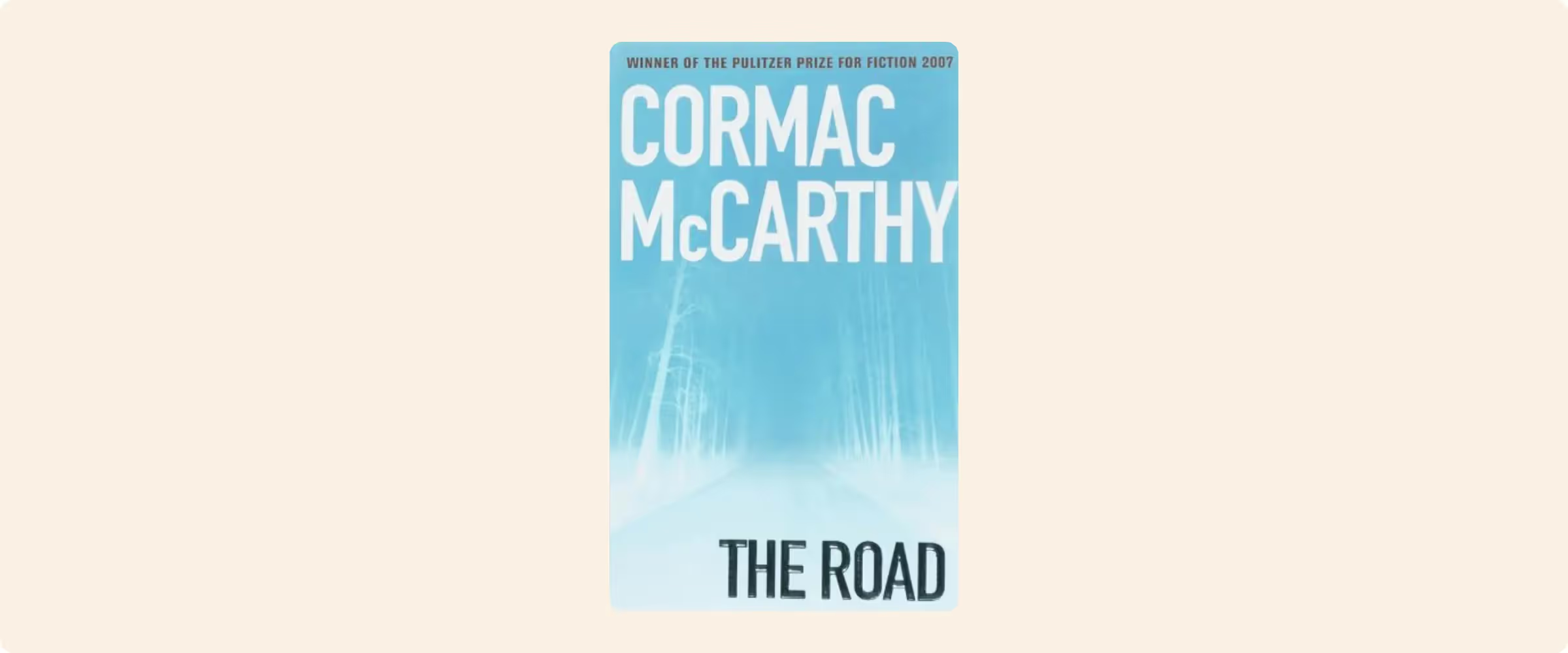
1. The Road by Cormac McCarthy
In this post-apocalyptic novel, a father and son travel across an endless road through America, which has been ravaged by an ambiguous climate disaster. Along the way they come across other survivors—some of them fellow scavengers trying to make the best of life, others more threatening in their quest for survival.
2. Wool by Hugh Howey
Originally a novella, Wool is the first in a series of three novels in total, recently televised by Apple TV as Silo. In this series, Earth has been devastated by climate change, which has made the air toxic and uninhabitable, so humanity has moved into underground silos.
.avif)
3. Station Eleven by Emily St. John Mandel
This novel explores the aftermath of a flu pandemic that has wiped out civilization through the lives of an interconnected group of characters. Originally published in 2014, just six years before the global outbreak of Covid-19, it later became a dark lens on what life was like in a post-pandemic community.
.avif)
4. The Mountain in the Sea by Ray Nayler
This story follows a neurologist studying hyper-intelligent octopuses in a world where the oceans are unethically fished to the brink of disaster, with themes of consciousness, language, and intelligence. Set in a near-future world, it’s a transfixing read for anyone who is intrigued by the notion of sentience, and how far mankind might go to stay in control of the planet.

Cause-and-effect in dystopian books
Now that we have our disaster, we can consider what could make it worse. Here, we need a logical cause-and-effect that feels plausible for a future scenario. This can also reflect real-world historical events, lessons that have been ignored, or histories that have been rewritten.
For example, a democracy led by an unelected figurehead who removes or alters historical records in order to alter the truth and manipulate future generations. Or how climate change and resource scarcity might give rise to an ethnostate destroying all records of a civilization to justify their colonization of the land.
As in Wool by Hugh Howey, the crumbling of a democratic society may feature some form of erasure of the past, censorship of the present, and a scenario that unravels gradually and feels believable.
Protagonists also often feel themselves being watched both in the outside world and at home, often by totalitarian governments via futuristic technology. As Polly Ho-Yen examines, in dystopian novels:
We witness the surveillance of the protagonist and their allies as they try to resist the tyranny that looms large in dystopian stories; it becomes a many-faced yet faceless character all of its own.
—Polly Ho-Yen
5. Fahrenheit 451 by Ray Bradbury
In this classic work of dystopian fiction, book burning is justified to maintain social happiness by enforcing conformity and eliminating any poetic elements that could foster unhappiness or discord of any kind.
%20(1).avif)
6. The Giver by Lois Lowry
Conformity is achieved by the gradual erasure of history, memory, and human emotion to eliminate pain, conflict, and choice. The Giver is a tight examination of a controlled society, exploring what it means to live life according to the rules in an attempt to create a perfect world.
.avif)
The dystopian protagonist
Now that you have a plausible scenario, your novel needs a protagonist.
Creating this protagonist will depend on what you want readers to take away from your novel. For example, will the hero triumph against the odds, as a story of resilience and humanity persevering in the face of adversity? Or will they fail, leaving only the warning to remain? This will then form the foundation of who your character is, as well as their motivations and goals.
The key here is that the characters feel relatable. The average reader isn’t going to know the steps it takes to save the world from an overthrow of a government, cure a bubonic plague, or build a time machine. Therefore, we need protagonists who are written with goals that feel relatable, e.g., saving their family, a need for survival, or a desire to find hope. This allows readers to connect with a protagonist emotionally.
As Polly Ho-Yen explains:
Imagining what your characters would do in an impossible situation forces you to ask what you would do, how far you would go and, ultimately, who you might need to become. Through the dystopian genre, a professional writer accesses this agency.
—Polly Ho-Yen
Support is likely offered from a resistance group to aid the protagonist in their quest, usually a misfit alliance of those also on the fringes of society and fighting back against the system. However, it is important that these resistance groups don’t become caricatures and that their cause is given depth.
- What are they resisting?
- Why does it matter?
- Who are they?
7. V for Vendetta by Alan Moore and David Lloyd
A brilliant graphic novel that depicts a fascist, homophobic, and white supremacist regime in a future United Kingdom. The central vigilante, V, uses his intelligence, charisma, and deep-rooted sense of justice—and violent methods—to expose the totalitarian regime and inspire the nation to fight back against oppression. By using the Guy Fawkes mask, he is a symbol of hope and rebellion.
.avif)
8. The Children of Men by P.D. James
As global infertility gives rise to an authoritarian government, our protagonist, Theo Faron, becomes disillusioned and accepts the new order. However, his life changes when he meets a pregnant woman. In this dystopia, Theo is cynical and disillusioned and his flaws are relatable, and yet he chooses to fight for a better future and a glimmer of hope.
.avif)
From dystopia to utopia
Every dystopia is someone’s utopia. When the world faces a problem, and the cause-and-effect leads to a new status quo in an effort to rebuild civilization, most of the time what initially emerges is a utopia—a set of grounded principles intended to do good.
For example, We (1921) by Yevgeny Zamyatin features a world where everyone lives in glass boxes for homes, so order and civility are visually maintained. In Lois Lowry’s The Giver, everyone is the same and without difference, so there is peace and no conflict.
But what are the hidden costs? What is the price we pay for a reality with this kind of peace, and how can it be dangerously manipulated?
A major twist in any novel reveals the truth. It was all a lie. The twist in a dystopian book is crucial to our protagonist’s journey. Now they know the truth, they are no longer passive citizens.
To maintain order, we need control. For complete safety, we live in a surveillance state. Any deviation risks conflict.
Here, the twist serves as a powerful literary tool to explore the deep theme of power.
The antagonists in these novels also become complex secondary characters that aren’t just faceless organizations or corrupt governments. Dystopian books ask us to consider those who preach the words of the regime and remain ambivalent so that their community’s patch of peace isn’t disrupted, or those who uphold law and order. These characters are indoctrinated into the fallacy of a greater good, and the mask of utopia is just a dystopia in disguise.
9. Brave New World by Aldous Huxley
Utopia is crafted using genetic engineering and the elimination of family, art, and free will. The populace is kept docile via drugs. Everyone is happy and conflict-free, but at what cost? Despite being written nearly a century ago, Brave New World remains a sharp view on not just a totalitarian government, but what happens when that government convinces its citizens that their suppression is a good thing.
.avif)
10. Delirium by Lauren Oliver
The utopia offers safety and peace by eradicating our most human element: our intense passion. Set in a world where love is considered to be a disease, the cause of all of humanity’s wars and violence, Delirium is the first book in a trilogy.
Themes in dystopian fiction
A popular theme in dystopian literature is the theme of oppression and control. This is usually represented by the power imbalance created by governments, technology, or a terrifying natural disaster that is out of our control. Readers will resonate with a story when it provokes interesting thematic resonance; we want to see our social structures and our human nature tested.
Another way to look at how a character views the world—as a utopia or a dystopia—is through the placement of power. Where the power lies and, importantly, what you imagine power looks like in the reality of your story, is key to whether your character’s world is experienced as a utopia or a dystopia.
11. The Handmaid’s Tale by Margaret Atwood
This modern feminist classic hauntingly explores themes of gendered oppression and bodily autonomy. The messages of The Handmaid’s Tale have reached even bigger audiences since its award-winning television adaptation.
(It’s not the only one, either: many of the titles in this article have also appeared on screen: The Giver became a movie in 2014, Station Eleven was a miniseries on HBO Max, the bleak post-apocalyptic journey in Cormac McCarthy’s The Road was portrayed on film in 2009—and, of course, you won’t be surprised to find a hugely successful film franchise that has impacted audiences of all ages across the world a little further down this list.)
.avif)
12. Parable of the Sower by Octavia E. Butler
This book (and its sequel, Parable of the Talents) examines the rise of fanatical, fundamentalist religion as a response to societal collapse, and its resulting tyranny. Originally published in 1993 and set in what was then the near-future 2020s, this powerful novel has become somewhat eerie to read now, during the time period of its imagined setting.
.avif)
13. A Touch of Jen by Beth Morgan
A critique of wellness culture, social media obsession, and the commodification of personality. This novel takes the elements of social voyeurism and fixation, desire, and class division to terrifying depths.
.avif)
Brave new world: dystopian settings
The setting is one of the most important parts of your dystopian novel and will be a manifestation of the ideals, flaws, and conflict within your world.
The setting could be an isolated region, cut off from the outside to mark authoritarian control, physically isolating the protagonist and the reader. It could be a city landscape with signs of past wars, plague, and environmental damage—a sign of the previous society’s erasure. The setting could also be a source of conflict. Perhaps the elites live in a privileged ring above the Earth or are separated from those less fortunate via districts where resources become increasingly scarce.
This environment will also help to shape your protagonist; if they grew up in the slums of a corrupt world, what has this done to them? How has this formed their outlook on the world? Is their desire to conform or to rebel?
Your setting is a way to isolate the world and your reader so they can feel that sense of dread, hopelessness, and oppression.
14. The Warehouse by Rob Hart
The entire novel takes place within a warehouse, creating a claustrophobic setting between the corporate employer and employee—a symbol of isolation, the lack of personal freedoms, and constant surveillance.
.avif)
15. Divergent by Veronica Roth
Books that sit on the Young Adult branch of the dystopian bookshelf focus on teenage protagonists as they navigate their way through oppressive societies. In this series, society is divided into rigid, personality-based factions that suppress individual complexity and divide society physically.
.avif)
16. Uglies by Scott Westerfeld
A class divide is established as Uglies live in dull dorms, and Pretties live in luxury. A dark look at the ideology of what is considered good and beautiful, and the seemingly inevitable outcomes for children growing up in such a society.
.avif)
The ending
Like with any story, there will be an ending—but in dystopian fiction, it won’t entirely be a happy one.
When the dust settles after the revolution, a new set of principles is usually established, and a new utopia appears. Perhaps this time, as with most times, people aim to avoid repeating the mistakes of the past. However, humanity is inherently fearful, so a dystopian novel may end with hope but also with uncertainty.
The ending isn’t there to solve all the world’s issues and wrap them in a neat little bow, as this would fundamentally defeat the point of critically examining our society with a more complex lens. Instead, dystopian fiction often functions as a cautionary tale with a bittersweet ending, aimed at warning us to constantly stay vigilant to the rise of unilateral power.
As Polly Ho-Yen concludes:
In the way that our dreams and nightmares show us that we can survive the worst of things, writing dystopia can do the same.
—Polly Ho-Yen
17. Do Androids Dream of Electric Sheep? by Philip K. Dick
In a world where the line is blurred between the real and the robotic, the protagonist finds a robotic frog and decides that instead of despairing that it is not real, he instead accepts a new reality.
%20(1).avif)
18. The Hunger Games by Suzanne Collins
A defining example of the Young Adult vein of dystopian fiction, the ending of The Hunger Games offers a bittersweet hope—the next generation does not have to endure the same violence as those before and, for now, the world remains at peace. Fans of the series may be delighted by the latest addition to the Hunger Games canon, Sunrise on the Reaping, but likely less delighted by news events that evoke all-too-real comparisons to the books.
%20(2).avif)
19. 1984 by George Orwell
One of the most well-known examples of dystopian fiction, this timeless classic ends with the protagonist, Winston Smith, being brainwashed and becoming submissive to Big Brother.
.avif)
20. Never Let Me Go by Kazuo Ishiguro
A society that exploits a cloned underclass ends with the clones accepting their fate as organ donors.
%20(2).avif)
So, why write dystopian fiction? In short, as Polly Ho-Yen perfectly summarizes:
If you write dystopian fiction, you can help to envisage a truly brave new world in which we avoid the very plagues you set loose upon your dystopian society.
—Polly Ho-Yen
The foundation of dystopian fiction is that there is no roadmap to a perfect society, as all the books on this list demonstrate.
Instead, as a species, we must remain vigilant to the warning signs of fascism and the rise of unilateral control of power. Otherwise, we will, as we all know, be doomed to repeat history.
Do you have the next big dystopian book in you? Writing a novel requires judgment—and method. We teach both. With bestselling authors. With former Big Five editors. With a clear path from idea to submission-ready manuscript. Finish what you start. Look at our courses and see which one is right for you.
.avif)