
.avif)
Suspension of Disbelief: The Vital Sign of a Good Book







The Finished Novel Course
The complete writing journey. Follow a clear, proven path from first idea to a finished, publishing-ready novel.
For as long as stories have been told, in any genre, fiction readers have been asked to suspend disbelief. But what is suspension of disbelief, and what does it mean for writers? If we want readers to believe anything we write, how do we walk that fine line of shocking and surprising them without evoking doubt?
Never fear! Writing coach Amanda Reynolds is here with an explanation of suspension of disbelief and some crucial advice on how authors can handle this key element of storytelling...
.avif)
From the great quests and fantastical journeys of classic stories to modern takes on chilling murder, devastating loss, and atypical behavior, readers must believe in the unbelievable in the same way audience members are expected to go along with the plot in a TV show, a movie, or at the theater. So, how do authors achieve that high-wire act between plausibility and disbelief while crafting exciting and propulsive tales?
Suspension of disbelief: definition and explanation
There is always an element of ‘suspension of belief’ that we ask our readers to buy into when we begin crafting a fictional story. Readers will implicitly recognize that the story is not real, just as we all instinctively know the difference between a documentary telling a true story and an acted drama.
The root of these imaginings is found in the emotional connection we make to the characters’ experience of life. Their hopes and fears, their need for love and human connection. These commonalities resonate and make us feel seen in our own experience, albeit in a different and likely less dramatic way. They are emotionally resonant because they ring true. We have all loved and lost; been afraid, fierce, and scared. Grounding our fiction in these emotional truths of life ensures that even as we ask our readers to suspend their disbelief, they still feel that connection.
Not many of us have experienced the extremes that the siblings go through in My Sister, the Serial Killer by Oyinkan Braithwaite, but we have felt the frustrations and fears of needing to protect a loved one that push us into uncomfortable compromises.
But why do readers enjoy this vicarious journey into an often extreme alternate reality, and how can we, as authors, key into that and use it to our advantage?
{{blog-banner-8="/blog-banners"}}
Why readers need to suspend disbelief
The ability to suspend disbelief and push ourselves, within the safe form of a fictional narrative, into areas outside our experience allows us to work through some of our deepest fears and thoughts. Much like the willingness to ride a rollercoaster or watch a scary movie, it’s a way to ‘go there’ while knowing that we are still safe. Readers love to live a thousand lives. They want to be surprised, shocked, uplifted... To experience all the extremes of emotion.
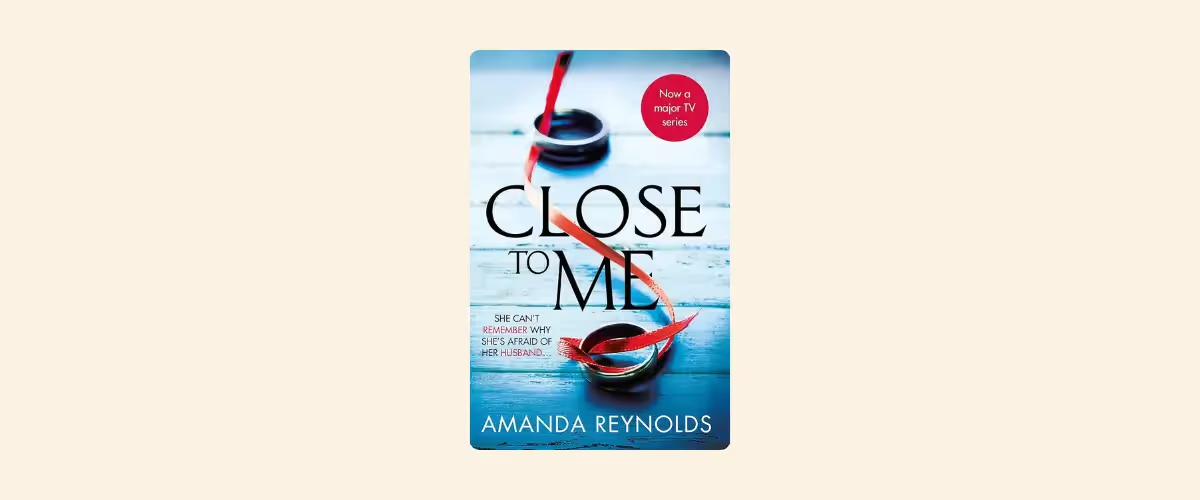
Example: Close To Me by Amanda Reynolds
As an author of psychological thrillers, I take my readers into dark, dysfunctional, and often extreme relationships, but the parts of my books that readers connect to are still the universal truths of life.
For instance, in my debut, Close To Me, there is a scene—White Lotus-style—of the married couple, Jo and Rob Harding, on a couples holiday in a Caribbean resort, which exposes their different responses to their recent empty nest syndrome. A reader got in touch with me to say her children were still young, but it had made her cry to think about the time they would leave home, something she’d never thought about before. It was a moment of connection and conscious thinking for her, based on a fictional experience of fictional characters in a fictional situation. The conceit that Rob is lying to Jo, reinventing their past for his own needs, provides the suspense and high stakes of the story, but the fact of children growing up grounds the story in reality.
When willing suspension of disbelief fails
If readers are so willing to suspend disbelief, what can jar them out of that? What do authors need to be careful of as we walk that line between fact and fiction to create a propulsive but plausible read?
Plot holes
Plot holes will always be problematic, as they remind the reader that every word, scene, and idea has been crafted by an unseen hand and that, unfortunately, that safe pair of hands has let them down. As soon as the author is doubted as a guide, they lose credibility and risk losing the reader’s interest. Any dropped stitch is a worry, because the reader has taken the trouble to read everything, and for them, each plot point is important—or could be. If they get to the end and the story doesn’t feel resolved or logical, their willing suspension of disbelief will no longer exist.
Deus ex machina and foreshadowing
Deus ex machina, a Latin term meaning ‘God from the machine,’ can sometimes be a reason for this. It references the idea of an unexpected power or event turning up at the eleventh hour to save the day with a previously unmentioned and often contrived device or means of resolution.
For example, if the robot is going to solve the murder, we have to have hints to the robot’s existence and prowess before the final chapter. This is known as foreshadowing and is a handy tool to deploy in ensuring suspension of disbelief is established and maintained. The breadcrumb trail of clues ensures all actions feel plausible and possible. (The person who dives into the sea to save our hero from drowning was once a lifeguard, for instance.)
These clues can be dropped in early and very subtly, but readers will note and recall them later, believing in a plot that works because of those foreshadowed events.

Losing poetic faith
In his Biographia Literaria (1817), the English poet and philosopher Samuel Taylor Coleridge said that a story needs to be true enough (‘a semblance of truth sufficient’) to produce ‘that willing suspension of disbelief for the moment, which constitutes poetic faith.’
Readers are more than capable of critical thinking, evaluating story situations for logic, reasoning, or lack of—it’s human interest. If they question something in a story that is never addressed in a satisfactory way by the author, they may start to lose their ‘poetic faith’ in that story.
Whenever a question pops into our mind as the author, you can bet it will occur to the reader, too. This means fiction writers need to address those questions on the page, or the willing suspension of disbelief will begin to waver. Why doesn’t person A just tell person B what they did, for example? The best way to answer these questions is to look at the character’s motivations for keeping a secret and, if need be, up the stakes to make it believable.
Example: Yellowface by R.F. Kuang

In the smash hit number 1 bestseller Yellowface by R.F. Kuang, we learn early on that the main character has far too much to lose to admit that they have stolen the manuscript of their ‘best friend’ and passed it off as their own. Not only have they lied to everyone they know, including the publisher who has given them a hefty advance they cannot afford to repay, but they could well be implicated in murder!
Establishing such high stakes and raising them chapter by chapter, as the first lie leads to others and gets deeper and deeper, ensures suspension of disbelief. There is no way the protagonist can simply admit what she’s done, and we believe that. It may not be what we would do, but we understand why she does what she does, however outlandish.
How character motivation invites willing suspension of disbelief
Establishing motivation early on and demonstrating it to the reader is vitally important for credulity, ensuring each action and reaction is robust through cause and effect. It makes sense of decisions, however warped or extraordinary, and supports suspension of disbelief. In The Great Gatsby, Gatsby loves Daisy, so he mounts an audacious campaign to get rich and win her back. Rebecca was the beautiful first wife of Max de Winter, and her presence is everywhere in the marital home, Manderley, overshadowing the second wife, who feels compelled to uncover the past.
.avif)
The Novelry team on suspension of disbelief
As my fellow coach Mahsuda Snaith explains:
The set-up for the world of your novel can really help with suspension of belief. In my novel, How to Find Home, the main character sees fantastical situations (such as fireworks exploding across the ceiling in a flat and her running and then flying over a bridge). So, to begin with, I got her to clearly say she had a vivid imagination, but after a while these things just happen and the reader is left to wonder if she really believes the things she sees or if they might be happening.
—Mahsuda Snaith
Nic Caws, one of our fiction editors, says:
While we don’t want to bend facts beyond belief, I think it’s important to make sure plausibility doesn’t impede plot. In the romance genre, a reader will often embrace suspension of disbelief for the sake of plot, lovable tropes, or the fantasy being presented to them. I mean, how many hot, young billionaires who care about saving the planet are there really? Likewise, how many eligible dukes were there in the Regency period? And how many hotels in the middle of nowhere would seriously only have one bed for the night? Romance readers will often accept these things with delight. It’s about the fun and the fantasy. On the other hand, they can be surprisingly strict on detail—i.e., have your Regency heroine wearing a white wedding dress while she’s marrying her duke, and you’re likely to get someone writing in about historical accuracy...
—Nic Caws
It’s important to ensure your story is king while walking the fine line between plausibility and a propulsive plot. Bend the facts a little to eliminate the dull and unnecessary, but make sure your reader is onboard and willing to suspend disbelief so you, the author, remain a safe pair of hands.
While raising the stakes and taking the ordinary into the extraordinary, we ground the reader by using emotional truth and logic to ensure they understand the characters’ choices in these incredible situations, and that just maybe, they would do the same in that extraordinary situation.
Write your novel with coaching from Amanda Reynolds
If your book is crime, suspense, or a psychological thriller, why not benefit from some personal authorial guidance from Amanda as your own wise and insightful writing coach?
Wherever you are on your writer's journey, we can offer the complete pathway from coming up with an idea through to ‘The End.’ With personal coaching, live classes, and step-by-step self-paced lessons to inspire you daily, we’ll help you complete your book with our unique one-hour-a-day method. Learn from bestselling authors and publishing editors to live—and love—the writer's life. Sign up and start today. The Novelry is the famous fiction writing school that is open to all!
The Finished Novel Course
The complete writing journey. Follow a clear, proven path from first idea to a finished, publishing-ready novel.
.avif)
.avif)


Amanda Reynolds
Writing Coach
The number 1 bestselling author of suspense novels including Close To Me, adapted for television by Channel 4.
.avif)
Related Articles
The Secret to Concocting an Agatha Christie-Style Mystery
.avif)
How to Write Intimacy
%20(1).avif)