

AI in Fiction: Bringing Artificial Intelligence to Life in Your Writing
.avif)






Mention the words ‘artificial intelligence’ and ‘fiction’ in the same breath, and you’re likely to find a discussion about the ethics of using generative AI to write a book, or a neat list of iconic AI characters and fictional robots in science fiction. But there’s a whole other sphere in which AI relates to fictional stories—and that’s in its presence in the narrative itself.
Perhaps your characters are using AI, they become influenced by it, or maybe they’re even facing it in battle. Maybe AI is a character in its own right within your story. If you’re thinking about this subject as a writer, you might be wondering what kind of role AI could (or should) have in your novel, and how best to approach it.
In this article, Katalina Watt delves into the impact of AI in fiction, sharing top takeaways from one of our recent live workshops with two AI experts: S.J. Bennett, previously of the Alan Turing Institute and now a Postdoctoral Research Associate at Durham University, and Aditi Surana, a Marie Curie Fellow within the EU’s Innovative Training ‘DCODE’ Network.
You’ll learn about the opportunities and thorny ethics AI can present, the fictional use of AI for plot and character, insights into current AI research and where it might go in the future, and how we can weave AI into our stories without getting overly technical about it.
.avif)
It’s about more than science fictional AI
Artificial intelligence is no longer something that resides only in the realm of science fiction stories, where humanoid robots reject human authority and essentially assume control.
AI is here, it’s real, and many writers are wondering how they can best integrate real-world questions and developments in artificial intelligence into their writing while getting the details correct.
Today, AI is a rapidly evolving area that is becoming part of our everyday lives, so it’s only natural that AI is having more of an impact and influence on literature than ever. While imaginative writers have woven artificial intelligence into their stories for many years before it had really been born, its influence can be found in the storytelling and character development of contemporary novels.
Our AI expert guests, S.J. Bennett and Aditi Surana, pose several questions you can ask yourself as a writer in order to avoid common pitfalls and marry real-life research with the speculative imagination. Let’s take a deeper look...
{{blog-banner-23="/blog-banners"}}
Have you defined your terms and parameters?
The term ‘artificial intelligence’ is a broad umbrella term with a variety of different meanings. It’s sometimes considered a ‘suitcase word’—a term coined by American computer scientist Marvin Minsky in his 2006 book The Emotion Machine. By this, Minsky meant terms that have a multitude of different meanings packed into them. (Anecdotally, when I used an online search engine to find a definition of ‘suitcase word,’ the algorithm had difficulty differentiating between Minsky’s term and the physical luggage container.)
Artificial intelligence itself is a term coined by Professor John McCarthy during a 1956 academic conference, two years after the death of Alan Turing, a mathematician, computer scientist, and foundational thinker surrounding AI. The Turing test, also known as the imitation game, tests a machine’s ability to exhibit intelligent behavior equivalent to a human.
As writers, it’s important for us to remember that AI was originally designed to recreate the human brain before it evolved to become a tool for automating labor, and is now often synonymous with technology as a wider concept. Fictionalized accounts can help frame technical work and vice versa, with an intriguing symbiosis between real scientific developments and our imagined stories.
.avif)
What is AI lending to the human narrative in your story?
S.J. Bennett and Aditi Surana encourage writers to consider what the inclusion of AI adds to the human narrative of a novel.
For example, there are fascinating examples of artists utilizing AI in their projects through large language models and data sets, such as Myriad (Tulips).
This lies in stark contrast to the cognitive dissonance of certain tech companies claiming to democratize creativity, but in fact taking inspiration from fictional warning signs—such as Elon Musk and his suggestion that the Cybertruck is ‘what Bladerunner [sic] would have driven,’ and Mark Zuckerberg’s love of the metaverse, akin to the cyberpunk dystopia of Ready Player One by Ernest Cline.
.avif)
When OpenAI debuted its new voice interface program, ChatGPT-4o, it quickly drew comparisons with Her, the 2013 Spike Jonze film in which Joaquin Phoenix’s character falls in love with a program voiced by Scarlett Johansson. OpenAI encouraged the comparison—both in the flirty voice agent’s design, which sounded suspiciously like Johansson, and by CEO Sam Altman. Johansson addressed the controversy, with murmurings of future legal action, before OpenAI withdrew the AI voice.
.avif)
An amusing viral tweet by Alex Blechman in November 2021, less than a year before Musk would buy and irrevocably change the platform formerly known as Twitter into what we now know as X, later became a meme and has become shorthand for the phenomenon of unheeded warnings serving as real-life inspiration:
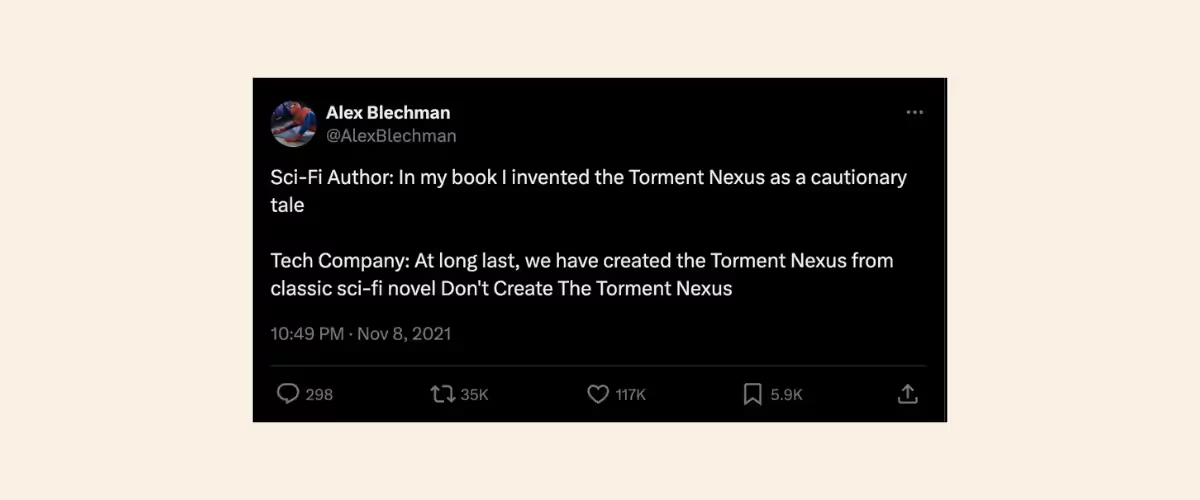
One of our expert speakers, S.J. Bennett, poses a brilliant question to writers when considering how to include AI characters and themes in our work:
Creativity is in the process and is in response to contingency and experience. If you’re not conscious and self-aware, can you truly be creative?
—S.J. Bennett
Why are you anthropomorphizing this AI?
There are common tropes to be seen when AI appears in fiction. These most often involve a false binary of AI being subservient or antagonistic (often in the form of a smart machine, simulated reality, or AI consciousness in a robotic body) versus being the savior of humanity.
An example of this might be M3GAN from the 2022 eponymous comedy-horror-science-fiction film, whose murderous dance sequence from the movie’s trailer went viral. This embodies S.J. Bennett’s idea that ‘AI as the villain’ can be enjoyable ‘in a camp way.’
.avif)
Are there any racial or gender dynamics that could subconsciously be at work?
When writing about AI in fiction, it’s useful to consider the huge amounts of hidden human labor, data, and natural resources necessary to execute ‘automation’ and how this human labor can also feed subconscious biases.
For example, the 2014 film Ex Machina includes themes and images of women’s bodies as disconnected from their sense of self, autonomy, and agency. There is a further element of racial and cultural dynamics between white women’s bodies and Asian women’s bodies, which the film does not fully interrogate.
.avif)
Our AI experts suggest the following examples of nuanced representation, which can be a helpful starting point for considering racial and gender dynamics:
- The 2016 movie Arrival, which is adapted from the 1998 short story entitled ‘Story of Your Life’ by Ted Chiang
- The novel Noor (2021) by Nnedi Okorafor
- And an interesting example which reflects the technological and socio-political conversation at its time of publication: The Stepford Wives (1972) by Ira Levin
.avif)
How do you quantify what’s ethical/beneficial for some versus others?
One consideration for writers, suggests Aditi Surana, is the concept of ‘platform decay,’ popularized by author Cory Doctorow—the pattern in which two-sided online products and services decline in quality over time, degrading their initially high-quality offerings to attract users to eventually maximize profits for shareholders.
AI should be used as a means, rather than an end, and ‘large centralized models’ and generative AI are the major areas of concern for researchers and creatives.
These potential ethical and practical conundrums are useful concepts for writers to consider in terms of character motivations and choices, especially when there is latent potential for censorship and narrative control.
Aditi’s vision is for a ‘ground-up’ building approach and for using AI where it is helpful rather than Silicon Valley’s disruption-first approach.
.avif)
Such visions for artisanal representations of AI, which are reminiscent of the early internet, include:
- The Wayfarers series by Becky Chambers, which has a subplot about the ship’s AI transferring into a human body-kit, trying to understand the various human and alien experiences of life
- Kazuo Ishiguro’s novel Klara and the Sun (2021) and, more tangentially, his earlier work Never Let Me Go (2005)
.avif)
Science fiction author and writing coach L.R. Lam summarizes the conundrum:
AI is a tool like any other, and there’s a lot of potential but lots of things to consider—and we often say ‘tools not rules’ at The Novelry!
—L.R. Lam
Thinking about the AI revolution in terms of ‘What if?’
S.J. Bennett and Aditi Surana also suggest writers form a ‘Black Mirror writing group,’ inspired by the anthology television show Black Mirror, which explores themes of technology and society in the near future. Writers could try using concepts from the show as prompts for writing exercises, such as:
- How would an AI detective solve crimes?
- Could a character love an AI?
.avif)
Further reading on AI narratives
- The 2023 film The Pod Generation
- The 1973 Ursula Le Guin short story ‘The Ones Who Walk Away from Omelas’
- The essay ‘Technosymbiosis: Figuring (Out) Our Relations to AI’ in Feminist AI: Critical Perspectives on Algorithms, Data, and Intelligent Machines (2024) edited by Jude Browne
- The essay ‘ChatGPT is Mickey Mouse’ by Luke Stark
- The non-fiction book Electric Dreams: Sex Robots and the Failed Promises of Capitalism (2024) by Heather Parry
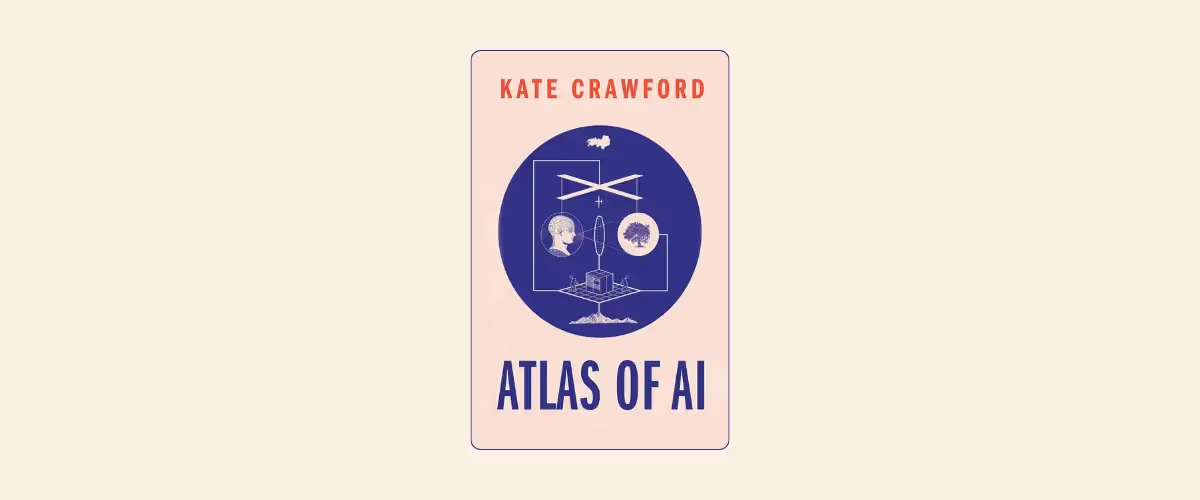
- The non-fiction book Atlas of AI: Power, Politics, and the Planetary Costs of Artificial Intelligence (2020) by Australian academic Kate Crawford
S.J. Bennett is a postdoctoral research associate in data justice and global ethical futures in the department of geography at Durham University, and was previously a researcher in public policy at The Alan Turing Institute, co-organizing the AI Ethics and Society group in Edinburgh.
Aditi Surana is an early-stage researcher and PhD candidate at Design Informatics and the School of Design at the Edinburgh College of Arts. She is also a Marie Curie Fellow within the EU’s Innovative Training ‘DCODE’ Network.
Wherever you are on your writing journey, we can offer the complete pathway from coming up with an idea through to ‘The End.’ With personal coaching, live classes, and step-by-step self-paced lessons to inspire you daily, we’ll help you complete your book with our unique one-hour-a-day method. Learn from bestselling authors and publishing editors to live—and love—the writing life. Sign up and start today. The Novelry is the famous fiction writing school that is open to all!
.avif)
.avif)


Katalina Watt
Writing Coach
Instant #3 Sunday Times bestseller, Royal Society of Literature Awardee, UNESCO Writer in Residence, and Hugo Award finalist with a decade of experience in the book industry.
.avif)
Related Articles

Women in Historical Fiction: Reclaiming the Stories History Left Behind

Subverting the “Chosen One” Trope
%20(1).avif)