

Subverting the “Chosen One” Trope







Every main character must have a destination. But in many beloved books, it goes deeper than that, where the main character has a destiny. Perhaps it’s a prophecy to be fulfilled, or a special power only they possess, or a legendary weapon or artefact they discover. It’s something known as the “Chosen One” trope, where the chief protagonist has a special something that propels the story forward.
In today’s blog, it is The Novelry editor Simran Kaur Sandhu’s destiny to unpack this trope, and examine why this particular device continues to inspire us. Simran also turns the trope on its head and discusses how to subvert it. After all, everything in creative writing can be challenged, which is why we love it so much!
The Finished Novel Course
The complete writing journey. Follow a clear, proven path from first idea to a finished, publishing-ready novel.

What does it mean to subvert a trope?
Before reading this, be sure to look at our “What is a trope” blog for some beginner tips.
To subvert a trope is to take a familiar storytelling convention that the audience is set up to expect and to flip it, twist it, or somehow play with it so your reader is surprised by what you give them—and delighted to be engaging with a beloved trope in a fresh way.
The key to doing this is to know the trope that you’re subverting so well that you set things up perfectly to genuinely surprise your audience, rather than letting them down. You have to deliver what they would expect from the trope, and more, to be truly successful.
Here are some examples of classic tropes across literature and their classic subversions:
- The Damsel in Distress trope: instead of the prince rescuing the princess, she rescues herself (or the prince) in a powerful way.
- The Butler Did It trope: the author may set up the butler as the prime suspect, but he turns out to be innocent.
- The Just One Bed trope: instead of there being only one bed for two romantic interests to share, forcing them to be close together, there may be two and they choose to share one, or there may be one, but it’s by design.
A classic subversion of the Chosen One Trope, for example, is the reluctant Chosen One—a protagonist that pushes against their destiny, believing they are unworthy or are happy with their life as it is. Aragorn from Tolkien’s The Lord of the Rings fits this description beautifully. Arguably, however, this subversion has also become popular in the cultural consciousness, so successfully that it’s now part of the wider trope.
%20(1).avif)
So, if you want to take this road, you have to find a way to do it in a new and exciting way. Or perhaps there are other ways for you to play with this trope that could offer a lot more creativity and higher stakes! And in order to do that, you must first understand what the trope is, what makes it so appealing, and how to take what you want and leave what you don’t need from it.
What is the Chosen One trope?
The Chosen One trope is a narrative trope that you will often find in fantasy and sci-fi stories written for any age, but it is especially popular in the middle-grade and Young Adult markets.
It usually follows an inevitable hero—the protagonist—who discovers they are a prophesied or promised savior of a group of people or the world, often by way of access to some kind of extraordinary power, abilities, or a special lineage.
The character’s destiny or gifts are often unknown at the beginning of the plot—or presented to the audience through dramatic irony—and once these have been revealed to the protagonist, they have to deal with the weight of those expectations as they face a flaw that is stopping them from accessing that destiny.
The trope is often rooted in religion, mythology, or folklore, and can be comparable to the religious concept of a “messiah” as Frank Herbert grapples with in Dune.
.avif)
There are so many elements within this trope that sit within the structure; often the Chosen One will reject their destiny as they grapple with their flaw, then they will often chafe against people’s expectations of how they should act or who they want them to be. You can see why this is such a popular trope for younger readers. Growing up and trying to be your own person while struggling with the expectations of everyone around you is a universal experience!
The challenge is to present this experience and widely recycled story in a new and fresh way that will keep readers interested—and catch an agent’s eye.
We hope this blog will give you some pointers on what to keep and what to play with.
Some examples of Chosen Ones you may be familiar with
Middle Grade:
- Harry Potter from Harry Potter
- Percy Jackson from Percy Jackson and the Olympians
- Lyra Belacqua from His Dark Materials
- Amari from Amari and the Night Brothers
Young Adult:
- Alina Starkov from Shadow and Bone
- Celaena Sardothien from Throne of Glass
- Simon Snow from Carry On
- Tris Prior from Divergent
- Andrew “Ender” Wiggin from Ender’s Game
Adult Fiction:
- Paul Atreides from Dune
- Rand al’Thor from The Wheel of Time
- Luke Skywalker from Star Wars
.avif)
The Chosen One trope structure
Greatness is a transitory experience. It is never consistent. It depends in part upon the myth-making imagination of humankind. The person who experiences greatness must have a feeling for the myth he is in. He must reflect what is projected upon him. And he must have a strong sense of the sardonic. This is what uncouples him from belief in his own pretensions. The sardonic is all that permits him to move within himself. Without this quality, even occasional greatness will destroy a man.
—Frank Herbert, Dune
One of the many reasons why people find this trope a little tiring is the very same reason why it’s so enticing for readers and writers alike: it comes with a firm structure. It’s got clear peaks and troughs, with a simple tension between what should happen, and what may happen.
If we were to look at a Chosen One trope through an act-by-act structure...
Act 1
The Chosen One has the potential to be great, but their flaw is preventing them from fulfilling their prophecy or chosen future. Often at this stage, the Chosen One doesn’t know they’re special, and is feeling undeserving of something more.
Act 2
Someone who believes in the Chosen One reveals their potential to them or simply offers them an opportunity to learn how to use whatever special magic they’ve been born with, or that may be hidden within only them, potentially without them finding out that they are a Chosen One. But their flaw remains unchallenged and the Chosen One is not totally convinced this is the right decision for them or something they can live up to. However, they take the opportunity.
Act 3
The Chosen One is usually a little unwilling to engage with their destiny because they don’t believe in themselves due to their flaw—but the opportunity they’ve been provided with means they get to make friends, meet a romantic interest if it’s YA, and generally orbit around their flaw, which makes them think they don’t have to face it. However, any attempts to truly get in touch with their special “Chosen One” quality ultimately fail because of this aversion.
Act 4
This is usually when the prophecy is kickstarted a little earlier than planned, or something catches the Chosen One and their friends by surprise. And because the Chosen One hasn’t faced their flaw and cannot yet access what they need to succeed, someone gets hurt or the place they have come to love gets destroyed.
Act 5
This failure forces the Chosen One to face their flaw, finally accessing the magic or special skill only they have, which allows them to defeat the enemy, rescue loved ones, accept their romantic partner, and—if they haven’t been told yet—confirm that they are in fact the special Chosen One and that the world is now their oyster. After experiencing some sort of major sacrifice, or a life-or-death confrontation, the Chosen One is finally whole.
It’s a great structure, one filled with the potential for high stakes and true emotional growth for their characterization. However, in this market, the familiar has also got to surprise us or show us something we didn’t know we liked in order to really stand out from the crowd.
Why do we keep returning to the Chosen One trope for our main characters?
There is a reason why we come back to this story over and over again, and why it’s so prevalent in some of the biggest stories in the world. Those reasons are important to understand if you want to subvert the Chosen One or give us a new take on it, because you need to make sure you’re still delivering these things in order to be gaining readers from this trope—otherwise, we might suggest leaving it altogether!
.avif)
As readers, we are drawn to stories that feel familiar. It’s often why people like specific genres. The Chosen One trope is a wide enough story concept or plot device to be repackaged and reformulated in a million different ways, which keeps it in our social consciousness.
The wand chooses the wizard, Mr. Potter. It’s not always clear why. But I think it is clear that we can expect great things from you.
—Garrick Ollivander, Harry Potter and the Sorcerer’s Stone
There are key moments readers of these stories are looking forward to getting to, so by working with the trope and giving us the kind of huge world-ending stakes, giant adventures, and big action scenes they have come to expect from these stories, you’re writing for a built-in audience who will be determined to finish the story if it doesn’t complete in one book.
This trope allows the reader to envision themselves as someone with a secret specialness that sets them apart from the crowd—something all young escapist readers are searching for on the pages of their soon-to-be favorite books. We all wanted to discover we had a magical destiny when we were trapped revising for exams or left behind on the playground. It’s a simple concept that works really well for this age range for all of these reasons.
For writers of children’s fiction, using this trope doesn’t just connect to the universal truth of growing under expectations, but it also allows the characters to bypass “safe adults” in the story world, upping the stakes massively by putting the fate of everything on a child rather than a qualified grown-up. This situation often comes with real danger, which is usually not considered suitable in contemporary stories for younger readers.
If we take our analysis a little further on why this story appeals to adult readers too, the idea of destiny is very enticing and can help people feel surer in the choices they’ve made: that the life they’re in is the one they were supposed to have, or that if things aren’t perfect, fate will intervene—or if they are grappling with what they can do to make their own destiny, making themselves feel more powerful or in control. In many Chosen One stories, the character struggles with the responsibilities of destiny, the question of whether they’re the right person to do the great things they’re doing, if they have the power to make change, and if they are really doing the right thing.
As the world gets more and more unsure, we tend to turn to concepts like destiny (or, indeed, tarot and astrology, as we’ve seen lately!) for certainty. The same can be said for escapist fiction. What books (or genres) are popular at any given time can sometimes be a reflection on real-world events.
Natasha Qureshi’s piece on dystopian fiction is a great example of this.
Examples of fresh takes on the Chosen One trope across genres
Now we know what works well about the Chosen One trope, it’s time to look at some examples that subvert it. These stories either take everything we come to expect from the trope and invert it, completely surprising us at every turn, or they experiment with everything we expect with this trope, examining it and changing it at certain moments in order to deliver a new take on an old trick.
.avif)
My favorite example of a series that plays with the Chosen One concept really well, but very much subverts it at the end, is Rick Riordan’s Percy Jackson and the Olympians.
While Percy is the powerful demigod that an ominous prophecy foretells will either end or save Olympus, as we get to the final book of the epic adventure it becomes clear to us that it’s got nothing to do with how powerful he is, or his lineage.
Right from the beginning, Percy chafes under the concept of “fate,” pushing others to think for themselves and question what they are told—and not taking himself or the situations he finds himself in very seriously. This allows for a funny and colloquial voice that feels fresh with a Chosen One narrative. Rick Riordan spends the bulk of the five-book series exploring Percy’s reluctance to be the Chosen One, but then, midway through, he introduces a younger, more vulnerable character, Nico, who could also be the Chosen One, and Percy decides to step up to the role in order to protect that younger child. With this act, Percy proves that even if destiny and the fates are in control, the Chosen One has the agency to make it come true to protect others.
Continuously, Riordan plays with the concept of destiny, laying on challenges that force Percy to confront his own toxic masculinity, the idea of what a “hero” is and what a “monster” is, and complicates the line between good and evil continuously.
Every book comes with a prophecy, so Percy’s “Chosen One” foretelling isn’t that special, and Percy regularly learns that him being a big strong hero usually isn’t what people need. It’s the time he spent with humans and with his mum, learning emotional intelligence and being a kid in the way other demigods aren’t allowed, that makes him the Chosen One.
As the final twist is revealed to us (spoiler alert!), we find out that the only way for everyone to win is for Percy to understand the importance of not fighting. His decision to listen to the advice he’s been given to “yield” despite his ego and desire for revenge, and let his Chosen One foil, Luke, leader of the bad guys, take out Kronos and himself, also lets Luke redeem himself and end the war he started.
In the end, Percy wasn’t really the hero at all. It was Annabeth and Luke and their bond. He’s celebrated as a hero, and he’s certainly powerful, but what makes him stand out is who he is. It’s that he’s able to listen, learn, and fight for people to be treated well that makes him the true Chosen One—not his power.
It feels like it’s hitting all the themes we’ve come to love and expect from a Chosen One structure, but it’s still surprising and fresh!
To explore some other brilliant iterations of the Chosen One trope, we asked our editors and writing coaches to give us their favorite examples.
Writing coach Bea Fitzgerald’s pick
Un Lun Dun by China Miéville (2007)
.avif)
Un Lun Dun is London by way of Alice in Wonderland and the city of UnLondon is in trouble. Only the prophesied hero can save it, and when Zanna and her friend Deeba fall through a portal, it’s clear Zanna is the hero foretold. Until... she fails. Someone has to save it, and Deeba is picking up that mantle—whether the world wants her to or not.
This is an ode to the sidekicks, a bright shining light on the idea that we can all choose to be heroes. But what makes this so particularly compelling is the way the narrative and the world created resists Deeba becoming the Chosen One. This is not her story. And through the pages, you can feel her fists curling in tight, demanding that it become hers anyway. The tenacity is laced in the writing, the world-building, and of course in Deeba’s character herself—a lead character you cannot help but root for, as clearly no one else will.
Editor Elizabeth Kulhanek’s pick
The Scholomance series by Naomi Novik
%20(1).avif)
I really love how Naomi Novik’s Scholomance series subverts the Chosen One trope! The protagonist, El, is the opposite of a Chosen One—she’s an antihero who’s ostracized at school because of her destructive magic and a dark prophecy about her destiny.
What I think is particularly well done is how convincingly the odds are stacked against El. Her world has a strict social hierarchy to protect magic users from deadly creatures that prey on them, and being on the outskirts means that she is struggling for her survival more than others—so the temptation to use her dark magic feels very real and urgent. Everyone already believes the worst of El and how things would be much safer if she just gave in and used her magic for destruction. So the push-and-pull between her survival instinct and moral compass makes for a really compelling hero journey.
Writing coach Ella McLeod’s picks
A classic Chosen One done well: Luke Skywalker from Star Wars
So I’ve just finished a first-time watch-through of Episodes I–IX of the Star Wars films, but I’ll save my controversial opinions on why the prequels are actually excellent for another time. For now, I want to draw your attention to our boy Luke Skywalker. Luke is a classic Chosen One—in many ways he’s Just Like Everybody Else. A farm boy, a dreamer, an everyman.
Of course, down the line, we learn that he isn’t an everyman at all. He’s the son of the series’ most iconic villain and the “force is strong with him.” It’s that duality that makes Luke as the Chosen One so compelling—he’s relatable, but also, his destiny was fated. It had to be him, it was always going to end this way. So how can we keep the perfect contradiction of these two realities alive, while adding that special sauce to our stories?
A subversive Chosen One: The Principle of Moments by Esmie Jikiemi-Pearson
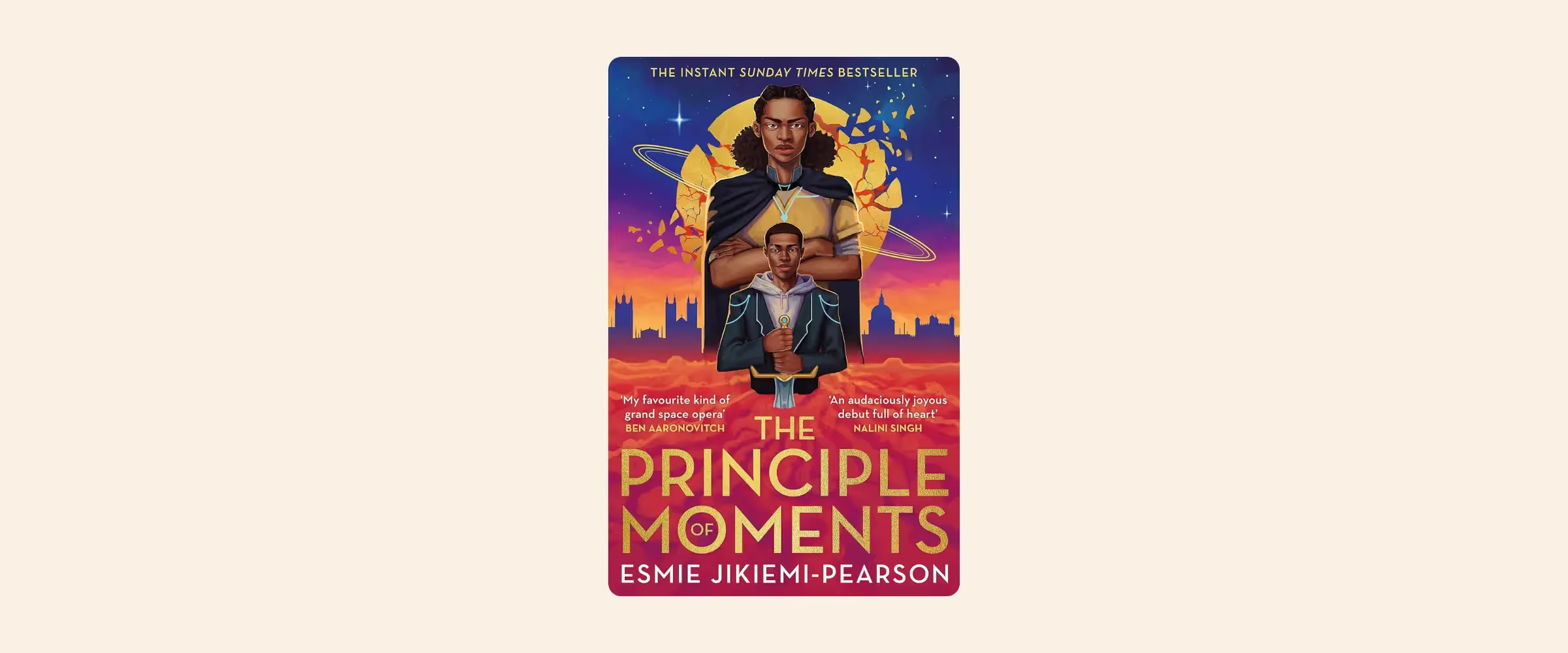
Esmie Jikiemi-Pearson does an excellent job of subverting the Chosen One Trope in her debut The Principle of Moments by having three Chosen Ones. The Chosen One always has a squad—but what happens when the whole squad is similarly subject to destiny? Is the burden shared or is the intensity of the pressure heightened? Or... both?
A subversive Chosen One: Ninth House by Leigh Bardugo
Ninth House by Leigh Bardugo is interesting as it sets up being the Chosen One almost as a curse; being unique has made things incredibly difficult for the protagonist, Alex. Ninth House has got all the trappings of dark fantasy academia, with a person to whom the supernatural world is unknown coming into that knowledge alongside the reader, but Bardugo lingers on the injustice of Alex being left alone to deal with the consequences of her powers. Without the knowledge and protection of the superworld she comes to inhabit, young Alex’s status makes her highly vulnerable. She is singled out, marginalized, an addict. What a terrible burden to be the Chosen One.
Writing coach Kate Dylan’s pick
The Final Strife by Saara el-Arifi
%20(1).avif)
The Final Strife turns the trope on its head by taking the character’s reluctance to make good on their destiny to the next level. Sylah isn’t just reluctant, she’s an addict. She’s actively rejecting her destiny—and even when (on a whim) she decides to embrace it, her addiction means she misses the chance. As a reader, this is funny, intriguing, and confounding all at once. It keeps you turning the page to see how the author will then get the story back on track, and how the other characters in the novel step in to fill the role the main character accidentally abdicated.
Editor Natasha Qureshi’s pick
She Who Became the Sun by Shelley Parker-Chan
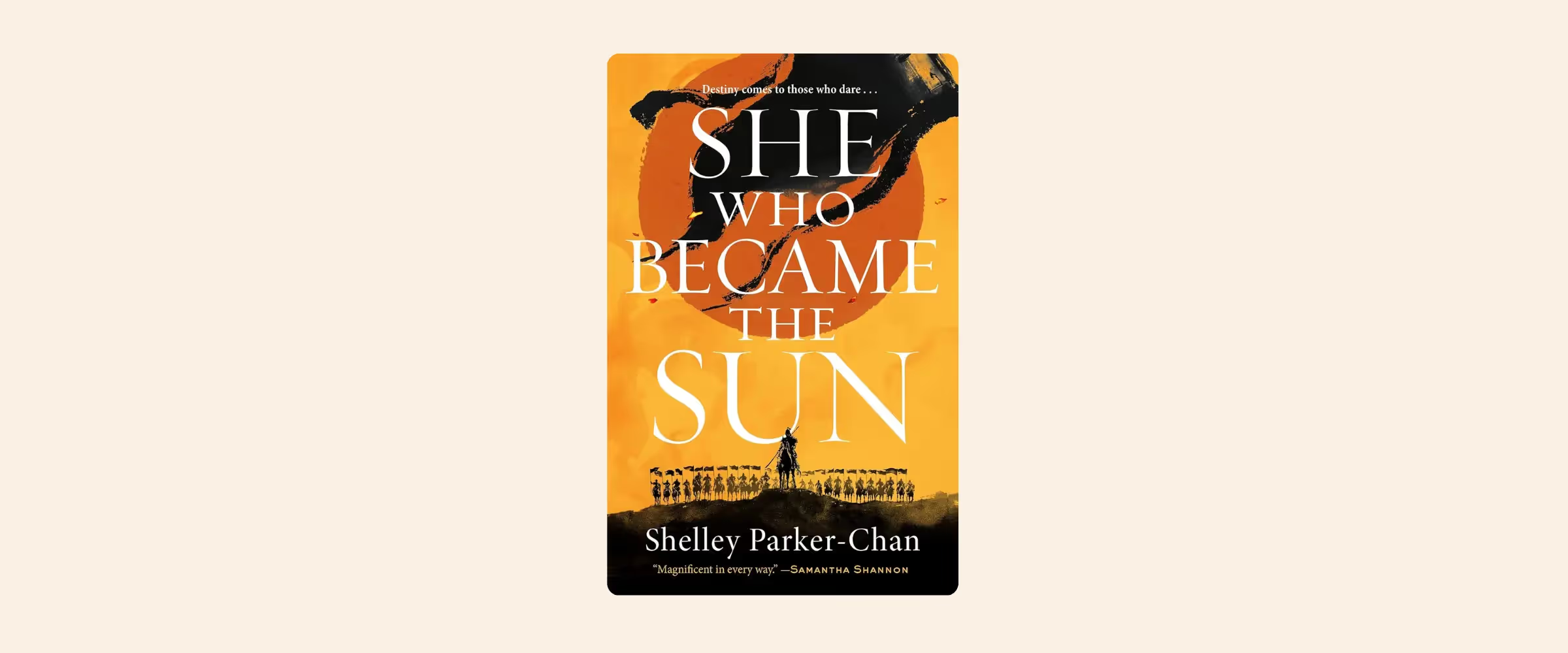
In She Who Became the Sun, the protagonist subverts a destiny that was meant for another and steals it for themselves. Our Chosen One was never actually chosen. This is the ultimate story about taking agency of your destiny. Being chosen isn’t a birthright. It is something that you have to defy the gods and the universe for, in order to prove that you deserve it!
Questions to ask yourself when using the Chosen One trope in your own creative writing
So, we know what the trope is and why it’s important, and we’ve looked at some interesting ways authors have played around and subverted it through classic and contemporary literature. Now it’s time to think about the trope in your novel and determine if you can use this trope to your advantage.
First, be sure this route actually makes sense for your overall message. If your story is about agency and forging your own path, you may find that it grinds against your protagonist taking a path that’s been laid at their feet by destiny or parents.
How to subvert expectations
- Draw on the power of your characterization. If the average Chosen One is a good person but a reluctant hero, how can you turn it on its head in your writing? Could they be a bad guy or a troubled teen who is forced into revealing their heart of gold?
- Draw on your wider cast. Is your protagonist the person who has to be the Chosen One? What happens if they are actually the best friend of the Chosen One? The frenemy? Their worst nightmare? Your plot might be all the richer for picking the unexpected.
- Engage with the trope with skepticism. Your characters will at some point have come across Chosen One narratives in their life through pop culture if your novel is set in the modern world. Let them actually engage with the fact that they’re living through this themselves and point out (either through dialogue or even by breaking the fourth wall) how ridiculous it is that an entire civilization is pinning their hopes on one person who is definitely not the best-qualified person to do the job.
- Stay playful with how your chosen one fulfills their journey. Let them fail! Let them get in trouble. Sometimes a “Chosen One” can get away with too much. What if your Chosen One has actually done something extremely hard to forgive? That’s far more interesting than letting them coast by.
.avif)
Top tips when working with the Chosen One trope as a plot device
- Does your Chosen One walk the walk? When writing a Chosen One, make sure that they actually are all the things that you, the author, are claiming they are. Nothing pulls a reader out of a book more than being told repeatedly that the evidence of a Chosen One’s chosen nature is, for example, their fierce intellect, and then having to read about them making all sorts of stupid choices or very basic analysis! How does your character’s personality match up to their actions?
- Think about how your character is “chosen”: Why are they the Chosen One? Was there some sort of ancient prophecy? Did other characters decide them to be so? Did they achieve a marvelous feat, creating high expectations? Did some sort of event occur, giving them this new status? Are they from a family of Chosen Ones? Have they earned their status, or was it thrust upon them?
- Does your Chosen One have flaws? Just because this character is special in some way doesn’t mean they’re perfect. Harry Potter had anger management issues, while Lyra Belacqua could be impulsive and rebellious. What difficulties does your Chosen One face? Make sure they have layers so we can root for them, rather than risking a Mary Sue issue. Do they have a “real life” outside of their “Chosen One” life?
- How does your Chosen One cope with being the Chosen One? Do they rise to the challenge or suffer terrible setbacks? Do they reject their status or take it in their stride? Are they self-aware of their status or blissfully ignorant? Do they get high on their own supply? Do they get tempted by the dark side? Is their true nature unveiled? Be mindful of their hero’s journey. Don’t make it easy for them!
- How is your Chosen One supported? Is there another character who could’ve been the Chosen One? Who stands by them in their everyday life? Does your main character have a network of supporting characters who help them learn along the way? A mother or father figure? An important relationship? Is there a wise older figure guiding them? The Chosen One’s community is just as important as their own individual story. It is important to acknowledge that no matter how many advantages one person may have, true greatness comes from working together.
The Novelry takes writers from book idea to book deal, helping them gain confidence, find their stories, inspiration, and the drive they need to finish their books. Discover your writing community and which course might work for you, from editing your manuscript to developing your big idea.
The Big Idea
Our ultimate writing course for beginners.
For those writing fiction for the very first time.

.avif)
.avif)


Simran Kaur Sandhu
Editor
Simran Kaur Sandhu was an Editor of middle-grade and Young Adult fiction at Macmillan Children’s Books, home to authors including Hilary McKay, Meg Cabot, Judy Blume, and Eva Ibbotson. With prior experience at HarperCollins, Profile Books, and Serpent’s Tail, she worked with award-winning authors including Tomi Adeyemi.
.avif)
Related Articles

Women in Historical Fiction: Reclaiming the Stories History Left Behind
.avif)
How To (Really) Write a Novel in 90 Days
.avif)