
%20(1).avif)
Fantasy writers know the feeling: you’ve built an entire world, filled it with magic, mystery, and wonder—and somewhere along the way, you’ve lost sight of the story itself.
If that sounds familiar, you’re in excellent company.
We recently sat down with Cassandra Clare—the internationally bestselling author behind The Mortal Instruments and The Infernal Devices—to talk about the craft of urban fantasy. Few writers have done more to show us how magic can exist alongside the everyday, tucked into city streets, hidden behind familiar doors, or waiting just beneath the surface of ordinary life.
Urban fantasy offers a unique kind of enchantment. Instead of inventing a world from scratch, you’re transforming one readers already know. A subway tunnel becomes a portal. A historic building hides a secret society. A city block suddenly feels charged with possibility.
But as Cassandra reminds us, the magic is only half the story. The most memorable fantasy novels are grounded in something deeply human—characters we care about, emotions we recognize, and conflicts that feel real, no matter how fantastical the setting.
Drawing on insights from a recent Q&A with The Novelry, here are five of Cassandra Clare’s most valuable lessons for writers looking to bring magic into the modern world.
What exactly is involved in urban fantasy novels?
Urban fantasy is a fusion genre, often featuring outcasts and rebels, and a supernatural underworld. The feel of urban fantasy is known to borrow from the likes of detective fiction, horror, or historical, and tends to orbit contemporary issues, usually fused into magical allegories. Other fantasy subgenres, such as paranormal romance, can often cross the streams with the urban fantasy genre.
The likes of werewolves and vampires or other supernatural beings often creep up, of course. The vibe is usually very atmospheric, perhaps set in a real city, with underground magic systems steeped in rules and costs. Think Buffy the Vampire Slayer or the Mercy Thompson series, or Cassandra’s very own The Mortal Instruments series. A supernatural world often lies in the underbelly of these grittier stories, full of secrets, mysteries, and darkness.
.avif)
And now, here are some tips from Cassandra on how she writes them:
1. Decide between an open or closed magical world
When you’re in the early stages of idea formation, there are a few questions you’ll need to ask yourself to establish the foundation of your story.
For Cassandra, the first question is fundamental: is this magical world open, or closed?
In an open fantasy, the magical details are, as the phrase suggests, out in the open—ordinary folks can see it and are perfectly aware of its existence. (For example, as Cassandra points out, True Blood creates a storytelling rule where the supernatural elements are normalized. Everyone seems to know about vampires and werewolves.)
In a closed fantasy, the magic is kept secret, only revealed to a select few. (Think Harry Potter, Twilight, etc.) The normalcy of the human world continues, existing alongside an ulterior, fantastical reality.
.avif)
Cassandra’s preference?
I knew I wanted to create a closed fantasy world, because I really loved the idea of a secret society of people, where their society was fun, interesting, but also kind of a mess. I wanted to deal with the idea of that world having its own sort of politics and government, and how that would work—telling stories about power and agency, standing up to authority, in that world.
It would be really hard to switch from open to closed, or closed to open, because it affects everything that the characters do.
I try to make big picture decisions like that [first]—because it shapes the characters.
—Cassandra Clare
So, what’s your preference? Are you inclined to navigate a closed fantasy world, where the stakes are immediately higher for all your characters who risk being discovered, or are you intrigued by the clash of societies in a more open, epic fantasy, and the subsequent power dynamics that emerge? If you’re creating urban fantasy novels, it could go either way, but it usually infuses present-day elements.
As Cassandra says, it’s difficult to switch once you’ve made your decision. Choose wisely before you move on to the next stage of your world-building.
2. Choose your setting—and fall in love with it
You’ve established whether your fantasy world is open or closed. Now—where is it? How can you choose your setting when the possibilities are boundless? Do you want to travel to other worlds or populate one you know with other beings? Are we in the real world or somewhere else entirely?
Cassandra’s iconic The Mortal Instruments series is primarily set in New York, a city renowned for artistic inspiration. What made her settle on the Big Apple over anywhere else?
I was obsessed with it—you know, how you get when you first move to New York.
And I was really fascinated by the history. I was passing the big library on 42nd Street, and I had the mental image of the stone lions getting up and wandering into the crowd, and I was like, oh... something about a magical New York really works for me.
—Cassandra Clare
If you’re creating urban fantasy, you’ll likely have a city or town in mind, rather than supernatural forests or folkloric backdrops. For Cassandra, the decision to write a reimagined New York City was born from this instinctive pull.
{{blog-banner-7="/blog-banners"}}
It’s the perfect excuse to flaneur: wandering around busy streets, observing local life, listening, and see if the statues come to life around you. Often, the solution to our writing roadblocks lies in returning to our instincts.
3. Uncanny details are best delivered subtly
Part of the appeal of the urban fantasy genre is its potential for the uncanny: introducing a strange otherworldliness to an otherwise familiar setting like New York. If you’re writing historical urban fantasy stories, for example, you have a whole extra layer of potential to bring to the page.
As a literary and aesthetic concept, the uncanny can be difficult to pin down. What details inspire a sense of the uncanny? What would a character notice about their surroundings that would suggest something being different or amiss?
For Cassandra, subtlety is key:
So, in order to indicate the things that are uncanny or off... if you’re trying to create just a sense that this isn’t quite normal, that there is something going on under the surface—you want to create it in the little things that are seen out of the corners of the eyes of characters.
Keep it small, keep it overheard, keep it corner-of-the-eyes. You are seeing the world and its strangeness, but strangeness just out of the corner of your eye.
—Cassandra Clare
Opening your novel with your protagonist realizing “hmm... something’s not quite right here...” is a surefire way to pull your reader into your world where the magic lurks just beneath the surface.
While it’s tempting to include big, climactic reveals, breadcrumbing is often a more satisfying method of reveal—and a more gratifying experience for your reader. Maybe it’s a fantastical word the reader doesn’t know, woven into an otherwise normal conversation. Maybe it’s a seemingly innocuous moment, but written in a dreamlike tone. Find your own ways to celebrate strangeness in your writing.
4. Reveal your fantasy tropes gradually: use the iceberg paradigm
You have a clearer idea of your world; you know its systems, its quirks, and all the little details that add to its verisimilitude. You’ve put in all this hard work to figure it out, and, of course, you’d like to share it with people. But how can you invite your reader into your magical narrative without distracting them with too much exposition, explaining your fantasy rules without detracting from the main story?
How do you know when you’ve explained too much about your setting, versus not enough?
Cassandra’s method is visual.
Try to think of it as the iceberg paradigm. You know all of this stuff: you’re only going to show about 10% of it, the way that 90% of the iceberg is underwater and we only see 10%.
What is going to draw people into the story is the characters. People care about people more than anything, which makes sense—we read to understand things about ourselves and about other people. We read to get a better grasp on humanity and how it works in different situations, and so that’s what we’re invested in.
I would always say, up front: don’t explain every situation. Put your characters in situations where you know what’s going on. Give enough information not to be confusing. A confused reader is a bored reader.
And as we go on with the story, we get more and more of the world.
—Cassandra Clare
This isn’t to say you can’t go big and bold with your world-building.
Being ambitious with vivid descriptions, sweeping settings, and grand heroes and villains is encouraged! But, to avoid slipping into too much telling, stay grounded in your characters’ experience of the world. As they grow and change, so does their understanding of their surroundings. Your reader stays invested—and, gradually, you get to reveal a little more of your iceberg.
.avif)
For example, even if you’re writing something with supernatural elements, such as paranormal romance, think of the things that make that romantic relationship relatable to any reader. Keep finding the human connection, even in something beyond human.
5. Write thoughtfully—consider the importance of inclusivity in urban fantasy books
We’re often told to stick to what’s familiar and write what we know for a more convincing, authentic story. But sometimes, what “we know” isn’t representative of the vibrant diversity found in contemporary cities, and among our readership. It’s important to be mindful of inclusivity—especially in urban fantasy—and to recognize where your writerly blindspots are.
I think that, with my earlier books, I did kind of stick closer to the things that I’m more familiar with and more experienced with. And then I started to realize that the books had this big fan following, and the big fan following was extremely diverse, and came from all sorts of backgrounds—all sorts of ethnicities, sexualities, neurotypicality, or divergence. I think when you’re in that position, and it is important to you to make everybody feel like they can be part of your world, that is something you’re going to have to do.
—Cassandra Clare
Are you writing about a lived experience that’s different from your own? Cassandra recommends this approach to write with respect and consideration:
Go to people in that community and you talk to them. Here is what I have learned and put together. Can we talk? Is this what you would want to see? Does this seem realistic? Is there something I could potentially write that would be a problem?
And conversely, what would you like to see? Reach for the community that exists, talk to them about what you’re doing... You can reach out as somebody who is going to engage their services as a sensitivity reader, and unless the person otherwise knows you... say, “I’m happy to pay you for your time.” You don’t want to expect anybody to do that stuff for free. That’s it. Talk to people in that community. And then once you are done, and you have gone for it and written it, I would have somebody from that community read it over.
—Cassandra Clare
There are plenty of resources available online to use for your research—and you might like to join a writing group, too, for support and advice from fellow aspiring novelists. You can read our recent blog about the joys of writing networks here.
Cassandra Clare’s top tips for writing urban fantasy
- Decide between an open or closed fantasy world: this will help you understand which magical elements to weave into your story, whether you want to create parameters within a mundane world or ascend into the high fantasy genre.
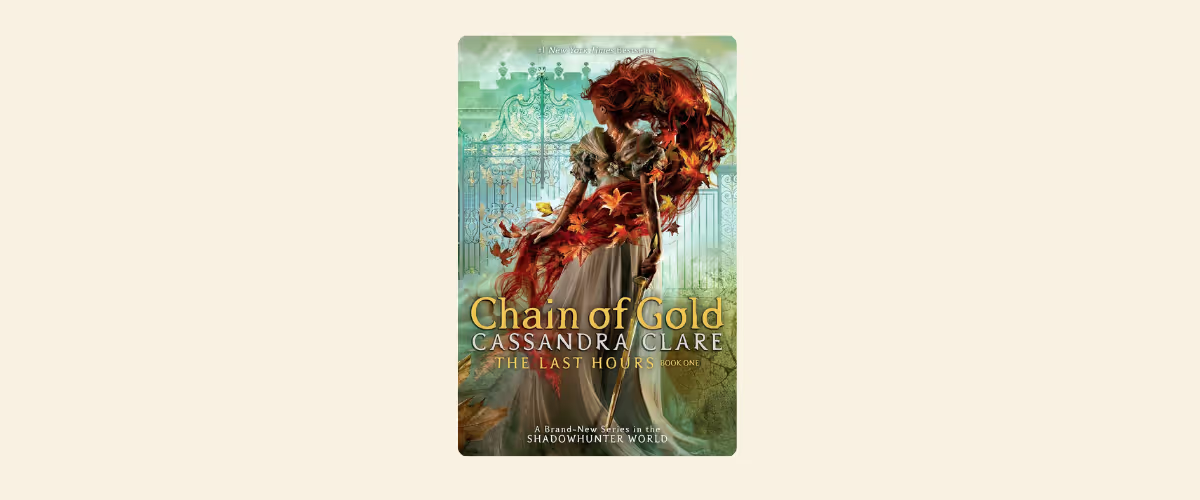
- Choose your fantasy setting: do you want to create an edgy, mysterious world inspired by a real-life location (Cassandra’s book Chain of Gold is set in a fictionalized Edwardian London) or do you want to craft something from scratch?
- Focus on uncanny details: pepper your plot with fun, magical minutiae that make “normal” things seem a little bit “off.”
- Reveal your world gradually: do you have a fantasy language? Paranormal beings? Traditions beyond our own? Don’t overwhelm your audience too quickly with a lore overload, but eke the details out for your reader.
- Consult people directly to write thoughtful, inclusive fiction: make sure your characters are speaking to your readers, sharing common themes from other cultures. Your story will be all the richer for it.
- Consider a visual: creating a detailed map of your urban setting can help in plotting the story and understanding where different characters and factions interact within the world. It’s also a great place to hide easter eggs. Cassandra uses maps to great effect in her fantasy book, Sword Catcher.
We loved hosting Cassandra Clare —and we can’t wait to welcome our next series of guest authors. Find out more at our guest events page.
If you’re looking for more advice on creating fantasy stories...
- You may also love reading our recent discussion with Holly Black, the “Queen of Faerie,” who discusses stake-raising in fantasy books.
- Or if you need a little push in the right direction, this selection of fantasy writing prompts might be the perfect challenge.
We’ll leave you with this inspirational line from one of Cassandra Clare’s books...
“One must always be careful of books,” said Tessa, “and what is inside them, for words have the power to change us.”
—Cassandra Clare, Clockwork Angel
Through expert courses, one-to-one coaching with bestselling authors, and a vibrant global community, we guide writers along a clear, proven path from first idea to a finished, submission-ready novel. Which course is right for you?

.webp)
.jpg)