
.avif)
Why Your Novel Needs a Big Edit: Introducing The Big Edit Challenge 2026







Join The Big Edit Challenge by June 1, free for those who are signed up to The Big Edit or The Finished Novel Course. If you're already a member, you can go to The Novelry Live now to RSVP for the challenge events.
The question naturally inspires further questions. How much work is involved in making a manuscript better—or even good enough to publish? How many edits should you plan to do? And where do you even begin?
In this article, The Novelry managing director, Lizzy Goudsmit Kay—previously a senior commissioning editor at Penguin Random House—breaks down your editing journey into four clear layers, and outlines what you should do with your writing in each stage.
Plus, if you’ve got a complete draft of your novel and you’re wondering what to do next, we might just have the perfect solution for you.
Today, we’re announcing The Big Edit Challenge: a nine-week program designed to kickstart your editing with events, industry panels, group study sessions, and even a Pitch Party (!) where you could get the opportunity to show your work to a literary agent.
The Big Edit Challenge is included free when you enroll in The Finished Novel Course or The Big Edit course. You’ll find more details about our landmark editing course on The Big Edit course page, but if you’re looking for a year’s worth of support with one-on-one advice on your story from a professional editor (of bestselling and award-winning books, no less), and detailed guidance on how to review, revise, and refine your manuscript to the highest publishing standards, there’s never been a better time to join.
So, whether you’re on your first novel or your twentieth, editing is key to shining up your story. It’s as integral to the writing process as brushing your teeth. Let’s hear from Lizzy on how you can apply the four phases of editing to your book, plus exciting details on our challenge taking place across June and July—sign up by June 1 to take part.
{{blog-banner-35="/blog-banners"}}
When do you start the editing process?
When a sentence feels clunky? When a chapter falls flat? When you finally finish your first draft? When your word count falls off a cliff? Perhaps it’s all of the above. The editing process can be different for everyone, but it’s smart to have a plan for when it’s right for you to move to the next stage.
Kill your darlings, kill your darlings, even when it breaks your egocentric little scribbler’s heart, kill your darlings.
—Stephen King, On Writing: A Memoir of the Craft

And what does your edit look like?
Many writers start editing at a decorative level—polishing sentences to balance texture and fluidity, refining awkward dialogue, tackling paragraphs of exposition, and so on.
It’s not unusual to work in this way, spending months improving your prose only to discover that something still doesn’t work despite all that hard work.
And that’s because an edit rarely starts with the words.
If you’ve been doing draft after draft, revision after revision, with the sense that you’re doing a lot of work without making much progress, keep reading! Writing novels is a marathon, not a sprint.

The four layers of editing
A strong edit happens in stages.
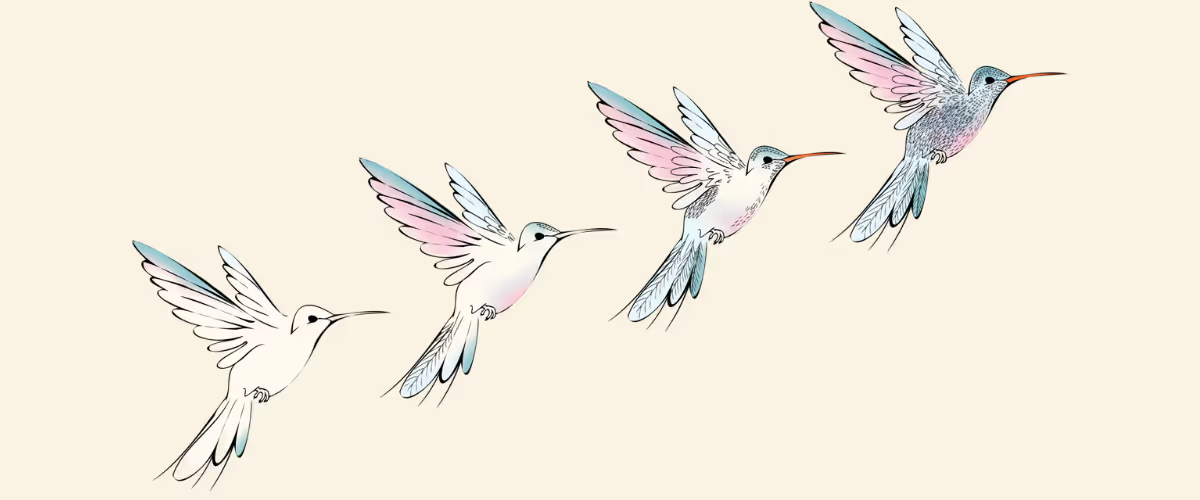
At the center of your book is the idea, which is essentially the premise that gives your narrative its energy. Around that sits the story itself: the characters, the stakes, and the overall narrative arc. Then comes structure, the way that your story unfolds. Finally, language: the sentences themselves.
Many writers collapse these different layers into one.
They polish sentences while adjusting character motivations. They refine dialogue and details without fully interrogating the relationships between characters. They tweak the pacing without strengthening the stakes.
And the result?
An everything-edit that attempts to tackle it all but doesn’t significantly shift any individual layer. Which means that another edit is required for the good of your novel. And, because you aren’t tackling the layers separately, it’s another everything-edit that never quite moves your manuscript forward in a meaningful way.
When you separate the layers, you’ll find that your editing process becomes far more effective.
So, how do you fix this problem?
By separating the layers and tackling one at a time.
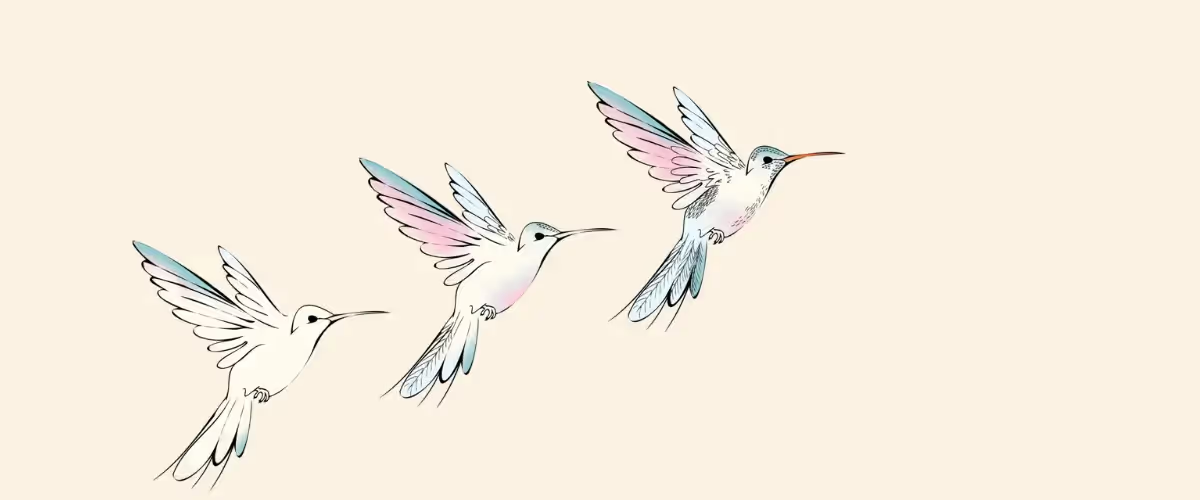
Start every edit with one simple question: What does my manuscript need?
Idea Development
Is your premise strong enough to sustain your story?
If the idea isn’t compelling—maybe it’s not ambitious enough, or it feels derivative—then no amount of editorial polish is going to transform the reading experience.
Story Development
Does your story fully deliver on that idea?
Does the protagonist undergo meaningful change? Does the story have enough plot and conflict? Are your character arcs moving naturally? Does the narrative move toward a satisfying conclusion?
Structural Editing
Does the execution work on the page?
This is the moment to examine pacing, character motivations, relationships, and the overall architecture of the narrative.
Line Editing
You have the right story, but are you telling it in the right words?
Now’s the time to refine each line for clarity, rhythm, voice, and style.
Becoming a reader of your own work
Each layer requires a different kind of thinking, and knowing where to focus isn’t always easy. One of the most powerful skills you can develop is the ability to read your own work objectively.
This means stepping away from the sentences on the page and asking the difficult questions:
- Is my premise sufficiently compelling?
- Is the story dynamic and engaging?
- Is the execution delivering my premise and story in an impactful way?
These questions aren’t always comfortable, but they are nonetheless essential for the editing process. If you can answer them clearly, your editing will become more intentional and transformative, helping to bring your vision to reality.
Instead of rewriting endlessly, you’ll be implementing changes that actually move your manuscript forward.
Introducing The Big Edit Challenge 2026
Here’s the rub: this kind of clarity is difficult to reach on your own—especially when you know your manuscript so well.
That’s why we’re introducing The Big Edit Challenge.
It’s designed to help you identify exactly what your manuscript needs and kickstart your editorial journey.
Throughout June and July 2026, you’ll be guided through the four layers of editing:
- Idea development
- Story development
- Structural editing
- Line editing
You’ll be editing alongside a community of writers who are asking the same questions as you (from proofreading to punctuation!) and learning how to read their own work critically. You’ll be able to create an editing plan that works for you, while enjoying friendly advice, sage writing tips, and a fresh perspective. By the end, you’ll have a clear editorial roadmap for the next stage of your writing journey. And then that big picture edit will begin to reveal itself.
Find comfort with our online writing community
You’ll also find support and motivation in our private members’ online community, with daily guidance from our editorial team and answers to any questions that pop up throughout the process. Copy-editing is a fine art in and of itself, and your writing will only blossom all the more once you realize your inner editor.
Challenge events
You can expect:
Charmaine Wilkerson—author of New York Times bestseller, Black Cake—in conversation with her editor, revealing how they shaped her debut into a Read with Jenna pick, a Barack Obama selection, and an instant bestseller that became an Oprah Winfrey series on Disney+.
Live writing classes with bestselling authors and Big Five editors
Join New York Times bestselling authors and editors from Big Five publishers for a series of in-depth conversations.
- Welcome to The Big Edit Challenge: Meet the editorial team and explore how to approach the challenge with clarity and purpose. We’ll guide you through the process so that you can make the most of every stage.
- Becoming a Reader of Your Own Work: Join our writing coaches as they share practical strategies for reading your work with a fresh perspective.
- Structural vs Line Editing: Learn how to identify what your manuscript needs next—and how to make the bold changes that will move your story forward.
- How to Polish Your Pitch: Strengthen the concept at the heart of your manuscript and learn how to articulate it with clarity and precision.
Industry panels
Hear directly from industry professionals and discover what makes a manuscript stand out—and how to position your work with confidence.
- Literary agents: Hear from our agency partners, including WME, Sterling Lord Literistic, and Greene & Heaton, as they share what makes a submission stand out—and how to craft a compelling pitch.
- Professional editors: Join industry editors from Penguin Random House and Hachette as they explore the importance of developing a clear editorial vision for your manuscript—and how to achieve this.
Group study sessions
Join our award-winning writing coaches and professional editors every week for guided sessions that take you from idea development through story development and into the heart of structural and line editing.
- Idea and story development: Why is change essential to every story? What transforms a static idea into a dynamic one—and how do you know when you’re ready to move toward structural editing?
- Structural editing: Learn how to shape your novel with intention, building a structure that supports tension, escalation, and narrative payoff—and how to recognize when it’s truly working on the page.
- Line editing: Refine your prose at the sentence level, developing dialogue that feels natural and precise while avoiding common pitfalls—like repetition—and preserving your unique voice.
Interactive craft workshops
These warm and collaborative sessions are designed to give you practical tools you can immediately apply to your own work.
- The Hook: Share your pitches and explore how to develop a compelling idea—and translate it into a powerful opening that draws the reader in.
- The Reading Workshop: Share your work in a supportive environment and receive thoughtful, constructive feedback.
Pitch Party 2026
We’ll be hosting our most exciting Pitch Party yet. Share your pitches on our community space, and fourteen of these will be randomly selected to receive thoughtful, constructive feedback from our editorial team! And, for the first time, we will then be inviting all writers to rework their pitches (whether or not you were selected initially!), and the best eight will be invited to meet directly with a literary agent to share their opening pages, a synopsis, and their polished pitch—and to receive real, professional feedback.
What is The Big Edit course?
If writing is the heart, editing is the head. With The Big Edit, you’ll be taught all aspects of the process, from interrogating the structure and shape of your story to developing your technical writing skills on a sentence-by-sentence level and learning how to create a pitch-perfect submission package.
You’ll work one-on-one with an expert publishing editor with experience at one of the Big Five publishers—Penguin Random House, Hachette, HarperCollins, Simon & Schuster, and Macmillan.
The course covers everything from the developmental edit to the nuances of line editing, moving all the way through to writing your pitch letter, synopsis, and—yes!—your first three chapters.
Join The Big Edit Challenge and transform the way you edit!
If you’ve been circling an idea... starting and stopping... wondering whether you’re really a writer... You’ve come to the right place. At The Novelry, we turn instinct into craft—with bestselling authors, former Big Five editors, and a proven method that takes you from first spark to finished manuscript. Grow into the fiction writer you’re meant to be. Decide which course to take today.
.avif)
.avif)


Lizzy Goudsmit Kay
Managing Director and COO
Lizzy Goudsmit Kay is Managing Director and Chief Operating Officer of The Novelry. Previously she was Senior Commissioning Editor at Transworld Publishers (Penguin Random House), home to authors including Kate Atkinson, Dan Brown, Lee Child, and Paula Hawkins. She is also a bestselling crime novelist.
.avif)
Related Articles
%20(1).webp)
Dear Writer, This is Why You Need a Deadline
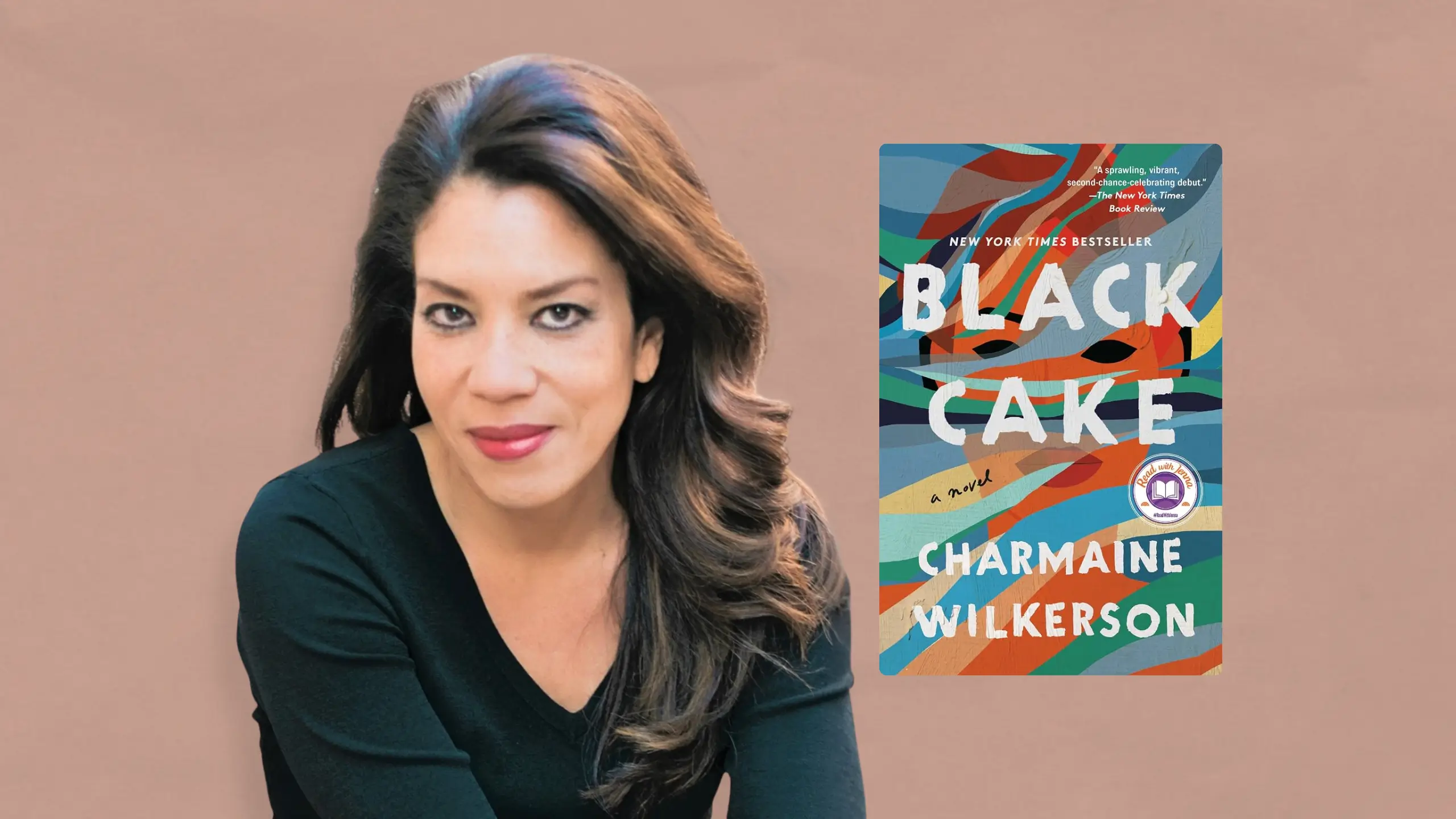
How Black Cake Author Charmaine Wilkerson Wrote a Smash Hit Picked by Oprah
.avif)