
Why Your Novel Needs a Big Idea: Introducing The Big Idea Challenge 2026







If you’re lucky enough to land upon a strong, simple, engaging idea for a novel, it’s very tempting to thank your lucky stars and start writing. But before you put pen to paper or open your laptop, let’s take a moment.
There’s an important difference between an idea that feels manageable—something that clearly lends itself to a story—and an idea that feels demanding. And you’d be forgiven for thinking that you want the former. But you don’t.
Because a simple idea leads to a simple story. And a big, bold, ambitious idea? Well, that leads to a big, bold, ambitious story.
What does a big idea really look like?
A big idea isn’t just a dramatic premise or a high-concept hook, although these—in the right genre—are powerful ways to apply pressure to your story. A big idea is what elevates your narrative from something readable, maybe even enjoyable, to something unforgettable. Here are a few classic examples:
The Children of Men by P.D. James
What if women stopped having children?
Sophie’s Choice by William Styron
What if a mother was forced to choose between her children?
Wrong Place, Wrong Time by Gillian McAllister
Can you stop a murder after it’s happened?
Me Before You by Jojo Moyes
What if making the person you love happy means breaking your own heart?
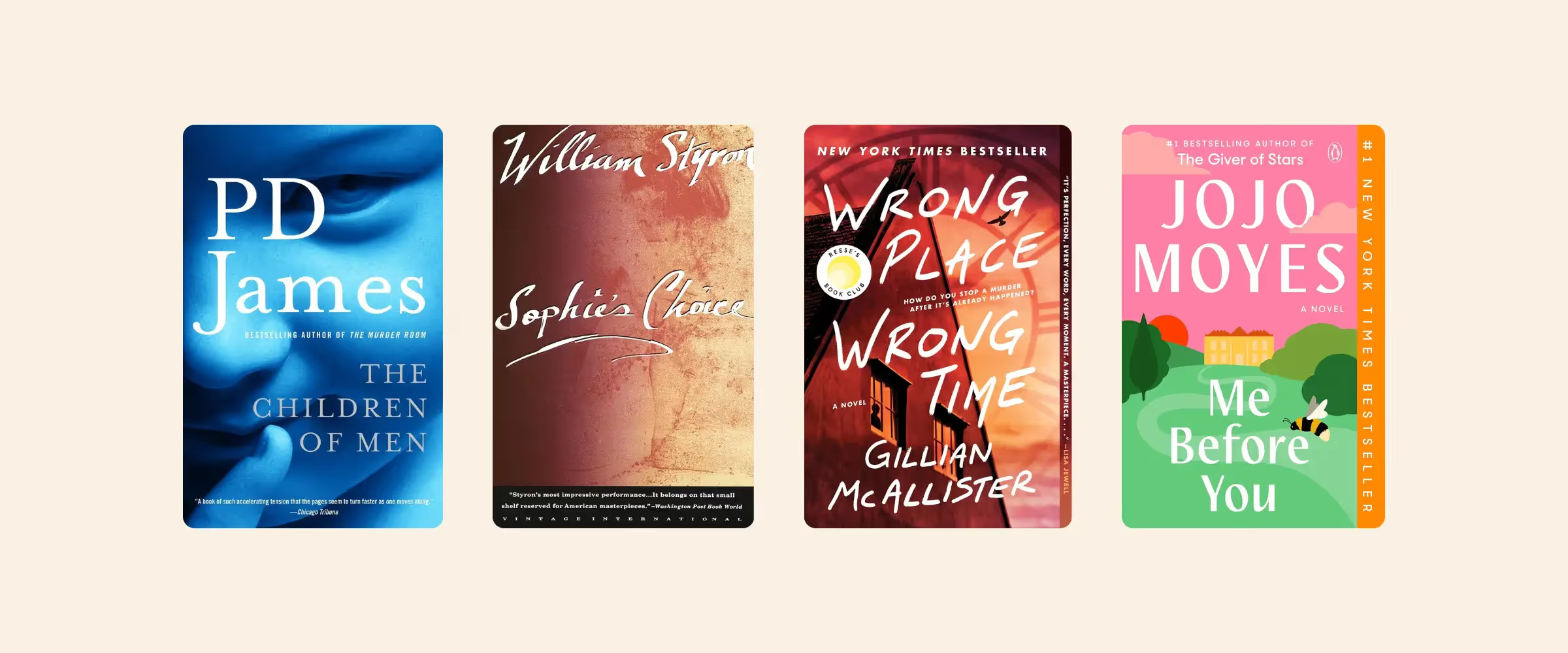
All of these examples share one essential ingredient: high stakes.
A big idea doesn’t necessarily require loud or spectacular stakes. Some of the best stakes are emotional, moral, or psychological. But it’s key that your protagonist stands to win or lose something of real significance.
All of these examples share another ingredient, too: an idea that, in its execution, is stretched even further. The questions listed above could exist in hundreds of different novels with different genres, different time periods, and different characters.
But the writers chose to push those ideas beyond their most obvious shape, asking more of them at every stage and refusing to let them become small or contained.
P.D. James, for example, stretched her idea into a story that centers on societal collapse. Gillian McAllister wrote an ingenious brainteaser that increased its stakes by focusing on a mother’s love for her son.
How does a small idea become a big idea?
A big idea doesn’t just give your protagonist something to do; it gives them something to lose, protect, or destroy. It applies pressure over time, forcing action, choice, and consequence until the very last page. Let’s take a look at an idea:
A successful surgeon begins to doubt her career after a patient dies on her operating table.
It’s serious and emotional, setting up a narrative that will focus largely on guilt and recovery. It has the key ingredients: a protagonist, a catalyst, a conflict. But it’s also a bit... small.
We can take that simple idea and stretch it, for example, by applying a psychological pressure:
She gradually becomes convinced the death wasn’t an error but a moment of deliberate inaction—but why?
We could apply a structural pressure:
She then discovers that several similar “failures” have been quietly buried by the hospital board, who seem to know more about her supposed “mistake” than they’re willing to share.
We could apply a personal pressure:
When she learns the patient was connected to someone she loves, she must decide between telling the truth and risking her career or keeping silent and risking her marriage.
It is this creative process of continually applying pressure to your idea that will elevate it into something remarkable. It isn’t enough do this once. A big idea forms over time, through the process of pushing at your story from every angle, putting pressure on the character, the setting, and the stakes until it feels truly ambitious.
{{blog-banner-14="/blog-banners"}}
Why is it essential to be ambitious?
1. You bring your best writing self to the page.
A big idea is a challenge that you, the writer, must rise to meet. You want to make the writing difficult in the right way—by creating a story that demands precision and focus. You have to really wrestle with a big idea. You have to solve its problems and tussle with its characters and bring your ingenuity to the structure and plotting.
2. You can create a narrative that is truly unique.
A simple story can lean on the familiar, relying on tropes and stereotypes. A bold idea requires originality. As you apply pressure to your idea, you expand your plot and characterization, you finesse your setting and structure—you build something better. If you want to write a story that really engages readers, then your best bet is to be ambitious from the very beginning.
3. You give the story space to surprise you.
Ambitious ideas create space for discovery. When an idea is bold and interesting, it opens up possibilities that you simply can’t predict at the outset—think shifts in structure, unexpected character developments, moments of emotional or thematic depth that emerge only in the process of translating the idea onto the page. Writing becomes less about executing a plan and more about responding intelligently to the story as it unfolds. At the center of your novel, you want a story idea that keeps you curious, challenged, and responsive from the beginning to the end.

What is The Big Idea from The Novelry?
It’s our answer to all of the above.
This is a course that will walk you step by step through the power moves behind the books you love—from The Great Gatsby to The Godfather, from The White Tiger to The Secret History, from Normal People to Life of Pi—and, more importantly, show you how to translate those moves onto a blank page of your own.
Because here’s what we see again and again: writers don’t struggle because they can’t write, but because their story isn’t yet ready for the page. Our editorial team recognize the signs immediately: stakes that could be higher, a premise that could be richer, an idea that hasn’t yet been pushed far enough.
The Big Idea has been designed to solve that at the source. You’ll learn how to test your premise from every angle, apply the right kind of pressure in the right ways, and make the bold decisions that turn a promising concept into a story with real weight.
How do you ensure that your final draft is ambitious and distinctive? You start with a big idea.
What is The Big Idea Challenge?
We’re launching The Big Idea Challenge for 2026 on Monday, March 2.
For the entire month, you’ll outline your story alongside a community of writers who are asking the same questions as you and learning how to apply pressure to their idea, too. You will be supported not only by your peers, but also by our team of award-winning and best-selling writing coaches and editors.
Across the month, you’ll take part in a series of dedicated events designed to help you test, stretch, and strengthen your idea before you commit it to the page.
You can expect:
Live writing class with Yann Martel (Life of Pi)
- Join Yann Martel, the Booker Prize-winning and international bestselling author of Life of Pi, for an inspiring conversation about writing beyond the expected—beyond familiar structures, safe choices, and the limits we place on our own imaginations.
4 group study sessions
Join an award-winning writing coach to focus on four key elements of your story with expert guidance, lively conversations, and invaluable tools for building your big idea.
- Voice: What makes your voice uniquely yours? Why you, and why this story?
- Movement: Explore the push and pull between animation and stagnation, asking what makes a story move and what causes it to stall.
- Treatment: Focus on the underlying logic that holds your story together, starting with the big question—what are we reading to find out?
- Putting Plot to Paper: When do you start putting your plot on paper—and how do you do it?
2 panel events with New York Times bestselling authors
Join New York Times bestselling author Heather Webb and a panel of our incredible author writing coaches for deep dives into:
- Ambition: Why does ambition matter at the beginning, when your idea is still a seedling and there’s so much still to do? Because a small idea begets a small story. And a big idea? A big story.
- Setting: Where should you set your story, and why does it matter? How do writers choose their settings, seasons, and timings?
Editorial workshop
Join three of our publishing editors (who have all worked at Big Five publishers) to explore how outlining clarifies your central question, strengthens the stakes, and prevents the most common problems they see in later drafts—and for a discussion on how good outlining can save months of rewriting.
Accountability group
You’ll also find support and motivation in our private members’ online community, with daily guidance from our coaching team and answers to any questions that pop up throughout the process.
We know, from our many years of experience, that writing a novel is rarely quick or easy. But the more compelling your idea—and the more supported you feel while shaping it—the more likely you are to reach the finish line and to finish strong.
Join The Big Idea Challenge to find support, momentum, and a community of cheerleaders who want to see your story succeed.
You’ll leave with a novel you can’t wait to write.
.webp)
Join The Big Idea Challenge and come up with an ambitious novel idea you can’t wait to write. Get motivation and support with group study sessions, panel events hosted by bestselling authors, plus a live writing class with Booker Prize-winning author, Yann Martel (Life of Pi). Sign up by March 1 to take part.
The Finished Novel Course
The complete writing journey. Follow a clear, proven path from first idea to a finished, publishing-ready novel.

.avif)
.avif)


Lizzy Goudsmit Kay
Managing Director and COO
Lizzy Goudsmit Kay is Managing Director and Chief Operating Officer of The Novelry. Previously she was Senior Commissioning Editor at Transworld Publishers (Penguin Random House), home to authors including Kate Atkinson, Dan Brown, Lee Child, and Paula Hawkins. She is also a bestselling crime novelist.
.avif)
Related Articles
The Secret to Concocting an Agatha Christie-Style Mystery
%20(1).webp)
Dear Writer, This is Why You Need a Deadline