.avif)
Behind the Pages: A Conversation with NYT Bestselling Author Kate Quinn
.avif)






Can you remember the last historical fiction novel you read where the characters felt real, the time period came to life, and the sense of place was palpable?
Yes, historical fiction needs to be accurate and authentic, but it also needs compelling characters and an engaging story.
So, how do authors strike the right balance on the page?
In this article, author Kate Quinn shares her tricks of the trade. Kate is the USA Today and New York Times bestselling author of historical fiction books, including the four-book Empress of Rome saga (Mistress of Rome, Daughters of Rome, Empress of the Seven Hills, and Lady of the Eternal City), and the Borgia Chronicles duology (The Serpent and the Pearl and The Lion and the Rose), which is set in the Italian Renaissance era.
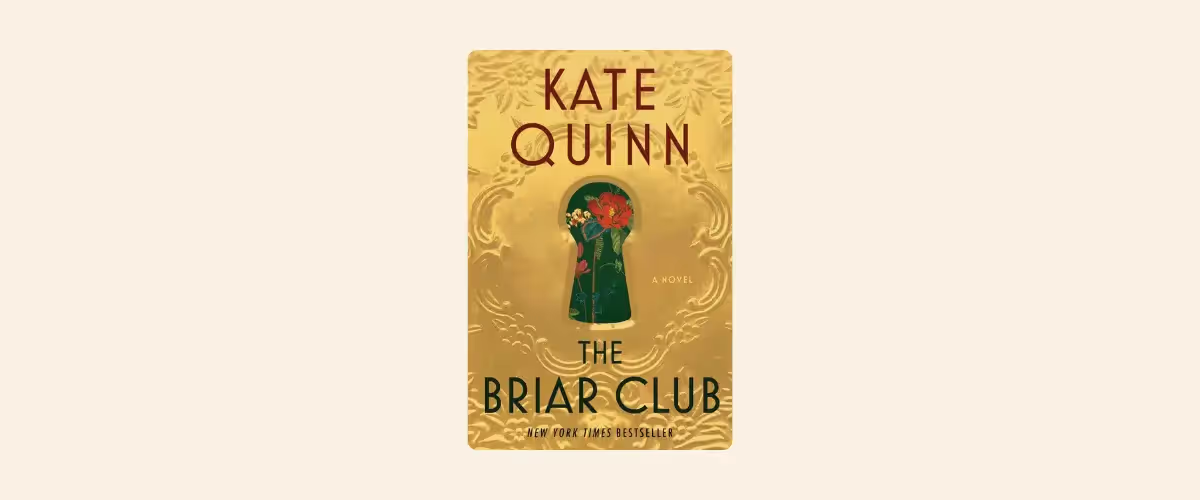
Kate turned to the twentieth century with the Reese’s Book Club pick The Alice Network, the New York Times bestsellers The Huntress, The Rose Code, and The Diamond Eye, as well as the highly acclaimed The Briar Club. Kate is also a co-author in several collaborative novels, including The Phoenix Crown with Janie Chang, and Ribbons of Scarlet with Stephanie Dray, Laura Kamoie, Eliza Knight, Sophie Perinot, and our very own writing coach, Heather Webb. All have been translated into multiple languages.
If you’re writing historical fiction, read on to discover how to turn research into compelling, bestselling books, and in Kate’s own wonderful words, explore ‘the life, the laughter, and the humanity that runs through our common past.’
.avif)
As an author, where do you find inspiration for your chosen topics?
Generally, the spark will be when I find a woman or group of women in history who have done something truly extraordinary, and think ‘Wow, how did I not know about this?!’ and then go down a rabbit hole. That’s almost always how my books originate.
What’s your favorite era of history, or one that you wish more people knew about?
England under the reign of Elizabeth I was my first passion. I’m not sure I’ll ever write about it though, since so many novels have already been written about her.
{{blog-banner-9="/blog-banners"}}
How did you get started in your writing career?
My mother was a librarian with a degree in ancient and medieval history—that sparked my interest in both books and in the past, and the past was where I gravitated as soon as I began writing stories of my own.
I wrote my first short story at age 7 (all about the assassination of King Edward II of England, which I read about in my Kings and Queens of England paper doll book!) and my first novel at age 10 when I first learned to type.
Could you tell us about a challenge in your writing life and how you found your way through it?
After finishing the Empress of Rome series and my Italian Renaissance novels, I wanted to write another Renaissance tale, but no one wanted it—it was refused everywhere, because the era wasn’t popular with readers. I realized I needed to pivot to something fresh and completely different, and that was very scary because a pivot like that has no guarantee of working. But the book that came out of that decision to change lanes was The Alice Network—my breakout book.
.avif)
What’s been your favorite piece of research for your books?
Going up in a WWII-era biplane so I could get the feel of open-cockpit flying—that was research for The Huntress, which is about the all-female regiment of night bomber pilots who flew little crop-duster biplanes against Hitler’s eastern front, and were nicknamed the Night Witches. I’m someone who white-knuckles when a 747 banks, so I wasn’t expecting to enjoy flying in such a flimsy little plane, but I adored it.
.avif)
Is there anything you had to leave on the ‘cutting room floor’ which you wish you could have included in your books?
I would have liked to include the Kinsey Reports in my 1950s-era book, The Briar Club—those were such social bombshells that dropped in America, it would have been fascinating to delve into. But I just didn’t have the space for it.
What is the best piece of writing advice you’ve been given?
My first agent told me that in her experience, 50 per cent of new writers sink themselves right out of the gate because they are unable or unwilling to make the changes to their beloved stories that will make those stories publishable. Which isn’t to say you must take every bit of editing advice you are given, but when a change is requested, you have to ask yourself: ‘Is this a hill I’m willing to die on?’ It’s okay to have hills where you draw that line, but you also need flexibility and a willingness to make changes and work with others. (To read more about editing from the perspective of an author of historical fiction, try this wonderful article from Stacey Halls.)
.avif)
Writers of The Novelry can now enjoy a writing class with Kate Quinn in their Catch Up TV Libraries. We thank Kate Quinn for spending time with our writers and for offering her generous insights.
If you’d like to join us for our next live session with a professional from the publishing industry—including other bestselling authors, literary agents, editors from major publishing houses, and more—sign up to write with us at The Novelry, the world-class novel writing school where you’ll find classes, coaching, and community to help you get started and type all the way to ‘The End.’
.avif)
.avif)


The Novelry
Founded by award-winning author Louise Dean, The Novelry is the fiction writing school with courses, coaching, and community to help you create, write, and finish your novel. Our graduates’ novels have gone on to become New York Times and Sunday Times bestsellers, as well as Reese’s Book Club and Read With Jenna picks.
.avif)
Related Articles
The “Fizzy Feeling” of Writing a Hit: Andrea Mara’s Top Tips
The Secret to Concocting an Agatha Christie-Style Mystery