.avif)
A Master Storyteller’s Writing Advice: Stephen King
.avif)






There’s no denying the impact Stephen King has made on modern storytelling.
His influence on contemporary literature is profound. Across more than 60 novels, countless short stories, multiple novellas, and a swathe of television and movie adaptations, King has reshaped the landscape of horror while also proving himself to be a master of suspense, fantasy, drama, and thriller alike.
His stories have led readers into worlds where the everyday becomes the uncanny, introduced us to small-town characters who feel as real as old friends (or creepy neighbors), and provided heartfelt explorations of friendship and hope.
With October 2025 marking the 50th anniversary of King’s beloved second novel, ’Salem’s Lot, it’s the perfect moment to look back at his extraordinary body of work. In this article, New York Times bestselling author and The Novelry writing coach Tara Conklin revisits the author’s work and the books that have inspired writers and captivated readers across generations.
Whether you’re a long-time reader and fan, a casual admirer, or a writer who considers his craft advice essential reading for every first draft, this reflection on Stephen King’s work and teachings has something for everyone. Remind yourself of old favorites, rediscover forgotten works, and learn his essential tips on the writing process.
.avif)
Revisiting the terrifying and wondrous world of Stephen King’s books
One of the great joys of my tweens and early adolescence was reading the work of Stephen King. This was the 1980s, when parents let their kids ride bikes without helmets, roam the neighborhood until dinner time, and (at least in my house) spend hours ensconced in stories about murderous vampires and prom queens covered in pigs’ blood.
Would a parent today let their 11-year-old read ’Salem’s Lot? As a parent myself now, I suspect the answer is no. But that would be a shame. I won’t go so far as to say that Stephen King made me want to be a writer—that was the product of a mad soup with countless different ingredients—but King showed me, like no other writer before or since, the power of a story well-told.
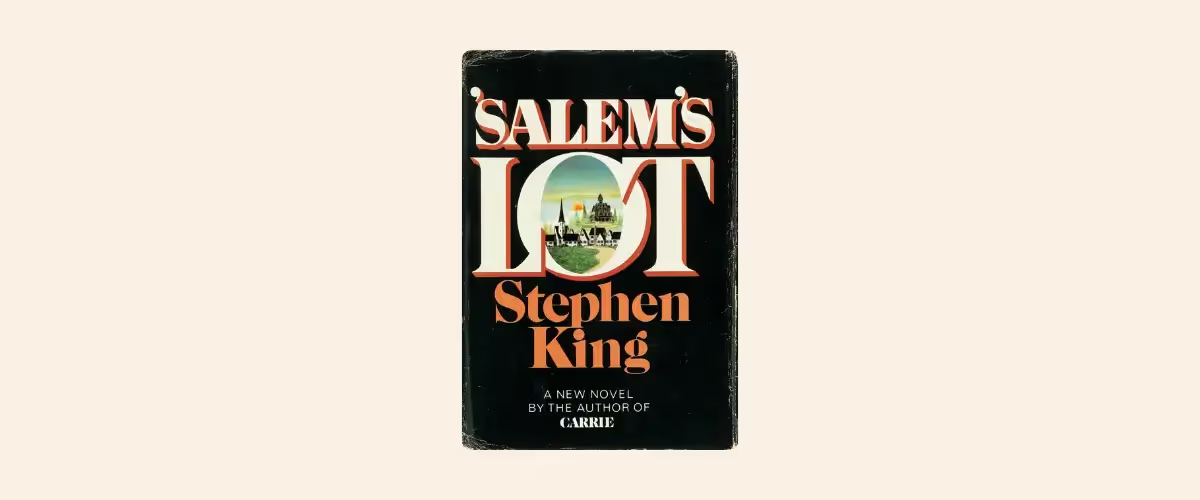
On the 50th anniversary of his iconic novel ’Salem’s Lot, it’s worth examining the stunning breadth and variety of Stephen King’s writing career. He’s a writer who’s plumbed the depths of horror and the macabre, but who has also brought readers stories of hope, justice, and redemption—as well as On Writing, one of the best books I’ve ever read about the craft of writing.
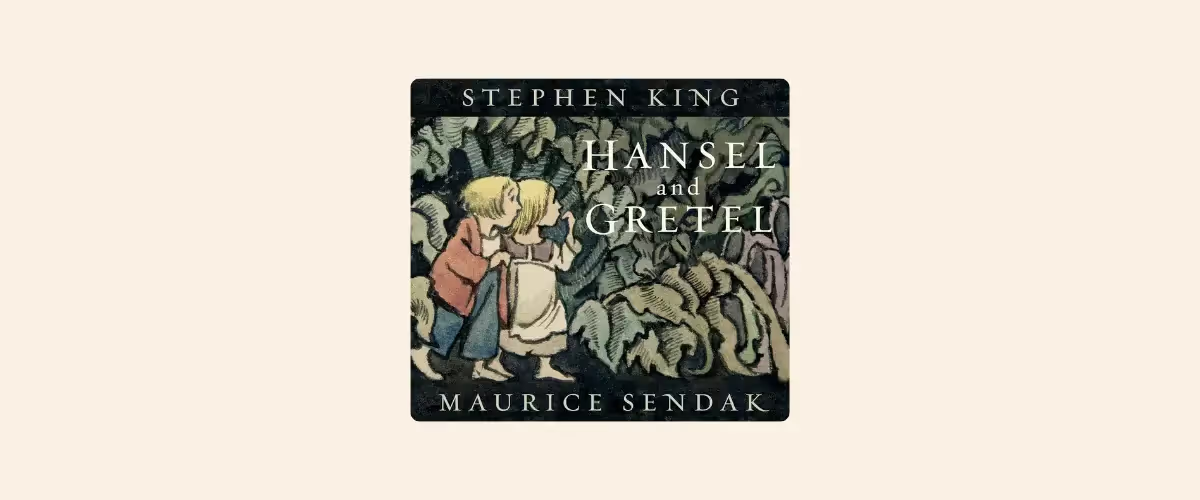
All told, he’s published 63 novels, over 200 short stories, a dozen graphic novels, 11 film and television scripts, five non-fiction books, and (yes, really) two children’s picture books, most recently a 2025 retelling of Hansel and Gretel, featuring previously unpublished illustrations by Maurice Sendak. Those numbers are accurate to this date, that is.
Good writing: tips from Stephen King
If you’re reading this while sitting at a stop along your writing journey, you might be wondering: how does he do it? Luckily, he’s taken the time to tell us.
On Writing contains both the story of Stephen King’s evolution as a writer and a wealth of advice for beginners, aspiring authors, and anyone looking for quick and helpful writing techniques. Many of our coaches and editors recommend it, whether you’re finishing up the revision of your second draft or staring at the white space of a brand-new page.
In thinking about King’s work, let’s start here—with a completely subjective, entirely personal compilation of my favorite words of wisdom from On Writing.
.avif)
1. Boredom is good for the imagination
Stephen King spent much of 1953 and 1954 ‘lying on tables,’ as he puts it. He was a kid, seven years old, and suffered from a number of severe ear infections and resulting tonsil inflammation, which led to surgery and a year spent at home in bed. During this period, when he should have been playing and learning in first grade with his peers, King ‘read his way through approximately six tons of comic books.’ He became so enamored of the stories he was reading that one day his mother suggested he create his own.
He writes:
I remember an immense feeling of possibility at the idea, as if I had been ushered into a vast building filled with closed doors and had been given leave to open any I liked. There were more doors than any person could ever open in a lifetime, I thought (and still think).
—Stephen King
A door closed is a door that can be opened
I distinctly remember reading those words for the first time because they expressed something that, up until that point, I hadn’t quite been able to articulate. King captured the best kind of feeling I experience when I sit down to write.
It doesn’t happen every time. There are days I think the doors are all locked, or, on the worst days, that only a finite number of doors exist and they’ve already been flung open by other, better writers. But then there are the days when the imaginative world feels vast and rich, a story on every corner, in every face I see, every bit of snatched conversation I happen to hear. The doors stretch down corridor after corridor, an endless number, and all I must do is turn the knob and step inside.
It’s interesting to wonder what Stephen King might have become if not for that prolonged period of illness. Without the removal of outside stimulation and activity, without that encouragement from his mother—most likely an offhand comment made in the hope of helping her son tolerate the boredom of illness—would we have those 63 novels today?
Of course, it’s impossible to say. I suspect King would have found his way to storytelling with or without the tonsillitis. But still, when my own children are complaining about a lack of adequate entertainment, I think of this story and I say to them: ‘Boredom is good for the imagination. Now go and open a door and imagine yourselves some fun.’
{{blog-banner-3="/blog-banners"}}
2. Ideas for novels come from the most unlikely places
Have you read King’s debut novel, Carrie, first published in 1974? Perhaps you’ve seen the 1976 movie starring Sissy Spacek, a movie that turned a poorly performing hardcover into a multi-million-copy paperback sensation. Thus began King’s long love affair with both film adaptations and soaking his heroines in blood.
.avif)
I first read Carrie somewhat later, in the early 1980s. At the time, I was a couple of years younger than Carrie, the book’s 16-year-old protagonist, but I knew the world where she lived. American high school gym classes and stinky cafeterias, school dances, the sharp dividing line between life at home and at school...
Two pivotal scenes remain fixed in my memory:
- First, when Carrie gets her first period in the girls’ locker room. Up until this point, she’s led an excessively sheltered life and doesn’t understand female biology. She sees the blood and thinks she’s dying. But as she screams and cries for help, the older, popular girls in the locker room only sneer at her innocence, taunting and ridiculing her.
- The second scene (and this one will be familiar) comes just after Carrie wins the vote for prom queen. She’s the perennially unpopular girl, the nerdy picked-on kid, and after her too-good-to-be-true (and it is) win, she’s doused in a bucket of pigs’ blood as a prank. The shock kicks her kinetic powers into action and—well, I won’t spoil the climax.
After I finished reading the story, I remember thinking: how could a young man (King was 26 years old when he wrote Carrie) understand the body horror of a teenage girl? How could he use blood—normal menstrual blood, benign pigs’ blood—to create such gruesome, indelible images?
.avif)
Being open to inspiration makes for a better writer
In On Writing, King tells the story of his inspiration for Carrie. The summer before college, he worked as a high school janitor alongside his brother Dave, and one day their task was to clean the girls’ locker room. The interior looked identical to the boys’ locker room, writes King, ‘and yet completely different.’ He saw a vending machine for tampons. He saw shower curtains to preserve the girls’ modesty (the boys’ room lacked this luxury). And inside that girls’ locker room, an idea came to him: an adolescent girl shocked by the arrival of her first period.
King knew from an early age that he wanted to be a writer. In high school and college, he took English lit and writing classes, worked part-time as a sportswriter for a local newspaper (where he earned $5.00 per week), but he was the son of a struggling single mother in small-town Maine. He didn’t know any novelists, he had no ways into the publishing industry, and no money for an MFA.
But that day on the job as a high school janitor, he imagined a story, he believed in the story, and that story went on to change his life.
.avif)
3. Art is a support system for life
It is well-known that Stephen King was an alcoholic and drug addict for many years. He wrote The Shining, The Tommyknockers, Cujo, and Misery all during his nearly 20 years of addiction.
In On Writing, he says he barely remembers writing Cujo, a novel about a man, his wife, and child who are trapped in a car, terrorized by a rabid Saint Bernard. I read Cujo in approximately two sittings, scaring myself witless and keeping my distance from our household pet—sweet, innocent Bessie—for at least a week afterward.
What would it be like, I wondered, to find yourself trapped with a sick, irrational monster trying to kill you?
.avif)
Each of these novels, King writes, can be seen as metaphors for the addiction that plagued him. Each ratcheted up the tension, the horror, the hero’s sense of isolation and imprisonment, one more notch. At the time, he didn’t think of himself as an addict. He used the ‘Hemingway Defense,’ which goes something like this:
I am an artist with a sensitive soul who must dull the existential horror of the world so that I can work. Without the dulling, without the booze or pills or blow, I can’t write, and so this is the deal I’ve made with the devil and myself.
—The Hemingway Defense theory
His wife Tabitha didn’t buy the Hemingway Defense. Neither did his children, brother, family, and friends, who staged an intervention in 1985. Tabitha presented him with the contents of the trash can he kept in his office: beer cans, cigarette butts, cocaine vials, coke spoons ‘caked in blood and snot,’ Xanax, Valium, Nyquil, and bottles of mouthwash that King would drink for the ethanol kick when he finally ran out of booze.
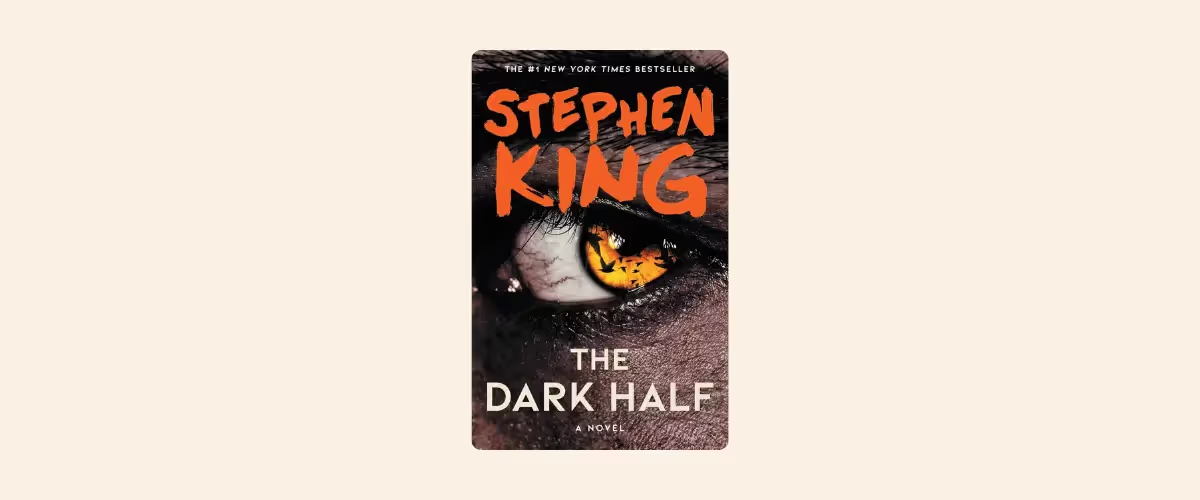
The Dark Half was written during the period when King first achieved sobriety. The protagonist, Thad Beaumont, is an author and alcoholic who writes literary fiction under his real name and gruesome crime novels under the pen name George Stark. As Beaumont finally achieves sobriety, he retires his murdering alter-ego and holds a mock burial, complete with headstone.
But Stark doesn’t want to stay dead. He returns to life as a real person who begins a bloody killing spree. In the end, Beaumont kills his doppelganger, the man who does nothing but destroy, the man who shares his fingerprints but not his soul.
Reading and writing to live
It doesn’t take much to see the symbolism in the two opposing sides of King’s protagonist. As King wrote The Dark Half, he was banishing his own darker self. He was using his fiction—what had long been the crutch to justify his addiction—as a vehicle to explore his burgeoning sobriety and to finally and conclusively bury Stephen King, the addict.
In On Writing, King doesn’t spend too much time discussing this period of his life. What he does say, and what I find both moving and instructive, is that the Hemingway Defense—and indeed the entire American romance with the tortured, self-destructive artist—allowed him to believe that he needed alcohol in order to write.

When his wife’s intervention presented a choice between substances and his family, King decided that writing was not the center. It did not define him. After the heady, unexpected success of Carrie, ’Salem’s Lot, and all that followed, I imagine that was a difficult conclusion to reach.
Writing was not the hill he wanted to die on. What he wanted most was to love his family, and if his ability to write evaporated along with the booze, so be it.
When King finally decided to commit to sobriety, he changed up his writing studio. He replaced the big, hulking monster of a desk that had sat in the middle of his study with a smaller, more modest one that he positioned in the corner of the room, under an eave. King writes that the job of writing:
...starts with this: put your desk in the corner, and every time you sit down there to write, remind yourself why it isn’t in the middle of the room. Life isn’t a support system for art. It’s the other way around.
—Stephen King
4. Don’t be afraid to tackle the big questions
There’s a lot more brilliant writerly advice in On Writing, and I urge you to read the whole book. It’s packed with advice for authors, with tips and tricks galore for his or her toolbox. His simple, no-nonsense instructions on such basic rules as needless words, dialogue paragraphs, first words, vocabulary, rejection slips, writing schedules, and all the things writers worry about (or temporarily forget) will make writing your first draft a much more clarifying experience than it sometimes is.
Even if you’re not a writer, it’s still a powerful memoir of the life, work, and mind of one of the most successful writers we have ever known. Not only that, but it’s a hoot to hear King’s voice in your ear (he’s profane and hilarious, as one would expect), and no matter what you think of his books, no one can argue that he is as prolific as they come. As a writer who averages about one book every five years, I reread King’s words regularly simply to spur myself into greater productivity (sadly, even King can’t help me there).
What I want to talk about now is my favorite book written by Stephen King—what it meant to me when I first read it in my late teens and what it means now, looking back as a writer who tries every day to write about things that matter to me and (holy cow, I hope) to others as well.
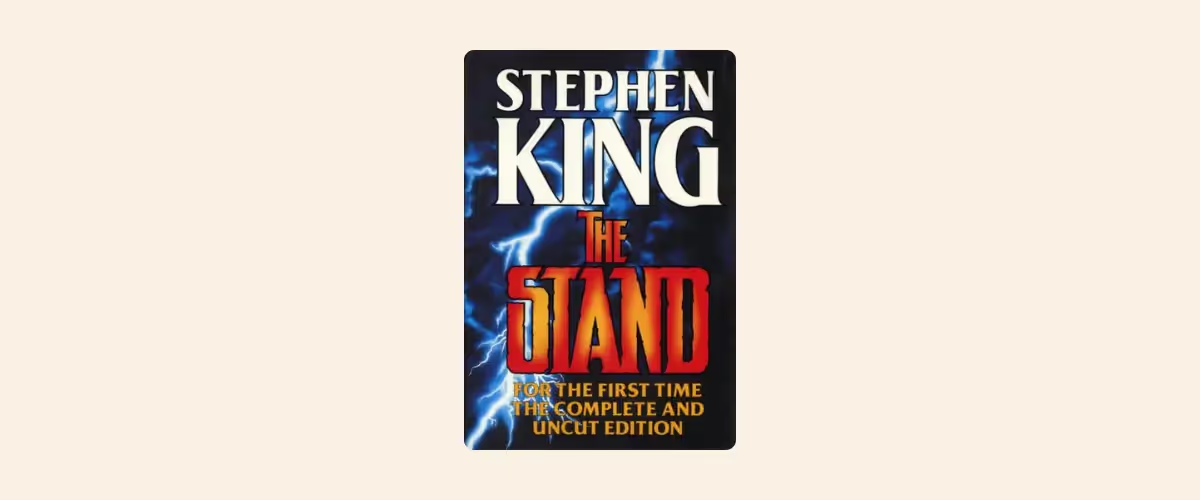
The Stand
That book is The Stand, a dystopian pandemic morality tale that follows a ragtag group of survivors through a blighted American landscape as they try to vanquish Randall Flagg, a false messiah holed up in Sin City itself, Las Vegas, with his own bunch of ragtag psychos.
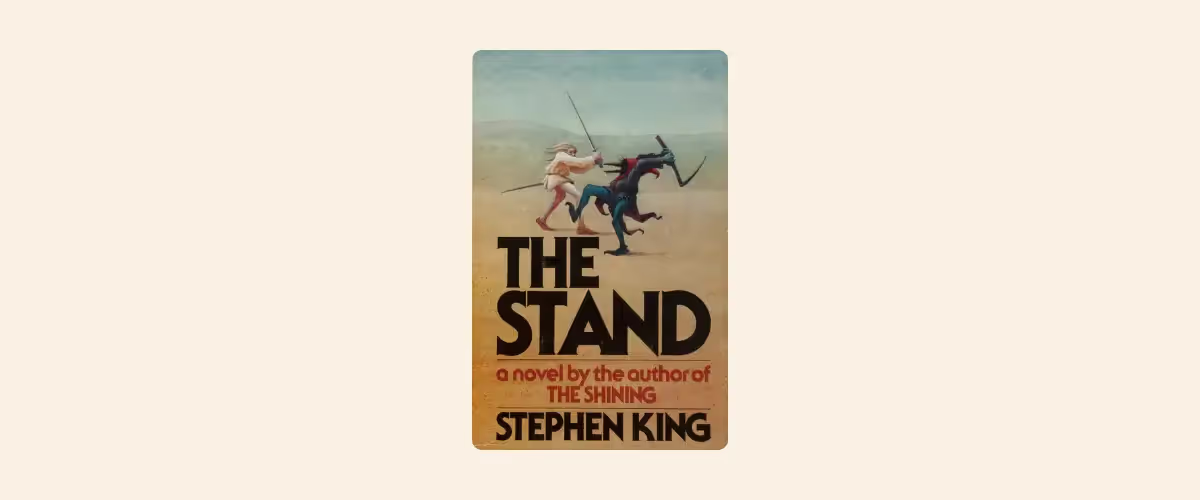
The Stand was first published in 1978, clocking in at 823 pages. A revised edition with 150,000 words of previously cut material was published in 1990 (making it a whopping 1,152 pages long), and that’s the version that blew my mind.
The construct of The Stand feels familiar to us now, but at the time, the idea was entirely new to readers of popular fiction: a deadly virus wipes out 99.4% of humanity, and the remaining few must struggle to survive.
Remember, this was pre-Walking Dead, pre-Hunger Games, pre-Swine Flu, and pre-COVID. The idea of a weaponized deadly flu virus was freshly terrifying—hell, everyone gets the flu. Where his previous books presented external threats of vampires, rabid dogs, aliens, killer clowns, or kinetic powers running out of control, in The Stand, the terror came from something that lived within us. Anyone, anywhere, might face this darkness.
Write a lot—but write a story that really matters
There’s a lot I could say about The Stand, and a quick Google search will yield reams of material written over the years by writers who revere this book (and its screen adaptations). But the most important lesson this book taught me was about permission and nerve.
Stephen King, known for genre horror and churning out a book a year, had written about Big Ideas: Good versus Evil, Right versus Wrong. He’d pushed the envelope as far as a writer possibly could, into a world where civilization had crumbled and human beings were left to their own base instincts.
- What would we do in such a situation?
- What reserves of morality would guide us?
- Is there truly a darkness within humanity’s core, and once the fragile constructs of society and government fall away, will the darkness inevitably prevail?
Today, these questions feel more urgent than ever. The Stand taught me that it’s every writer’s job to ask the hard questions, to tackle the big issues.
If you want to do this work well, you can’t shy away. And yes, it takes nerve to do it—it might even take 1,100 pages and hundreds of thousands of words. But Stephen King opened a door for me with The Stand. And I’m still exploring where it leads.

We invite you to dive back into the work of Stephen King, whether that’s one of his many novels, from decades ago to the present day, or his masterful advice in On Writing. Dip into a page, see what he can teach you, and then look at your own work-in-progress with fresh eyes. Are you asking a hard question in your first draft, or tackling a big issue?
Allow the words of a literary master to shepherd you through the writing of a good story, and you may well find there was a great story waiting there all along.
Wherever you are on your writer’s journey, we can offer the complete pathway from coming up with an idea through to ‘The End.’ Our novel writing programs include personal mentorship from published authors, live classes, and step-by-step self-paced lessons to inspire you daily, and we’ll help you complete your book with our unique one-hour-a-day method. Learn from bestselling authors and publishing editors to live—and love—the writer’s life. Sign up and start today. The Novelry is the famous fiction writing school that is open to all!
.avif)
.avif)


Tara Conklin
Writing Coach
New York Times bestselling author of The House Girl and The Last Romantics, selected by the Today Show Book Club, Barnes & Noble Book Club, Target Book Club, and as a No.1 Indie Next Pick and Amazon Best Book of the Month.
.avif)
Related Articles
The Secret to Concocting an Agatha Christie-Style Mystery
%20(1).webp)
Dear Writer, This is Why You Need a Deadline