Every writer knows the pull of backstory. You’ve spent months getting to know your characters’ pasts, the secrets their families keep, and the way their world works. And you want your reader to know all of it, right now, on page one.
It’s hard enough to balance your inner editor against the need to get words on the page. Add to that the warning we’ve all heard: info-dumping kills momentum and loses readers. So what are you supposed to do with everything you know?
When Leigh Bardugo joined our writers for a live Q&A, her approach surprised us. It starts with giving yourself permission, ends with a single line we’ve since pinned above our own desks, and works for whatever you’re writing, from epic fantasy to domestic thriller to literary fiction.
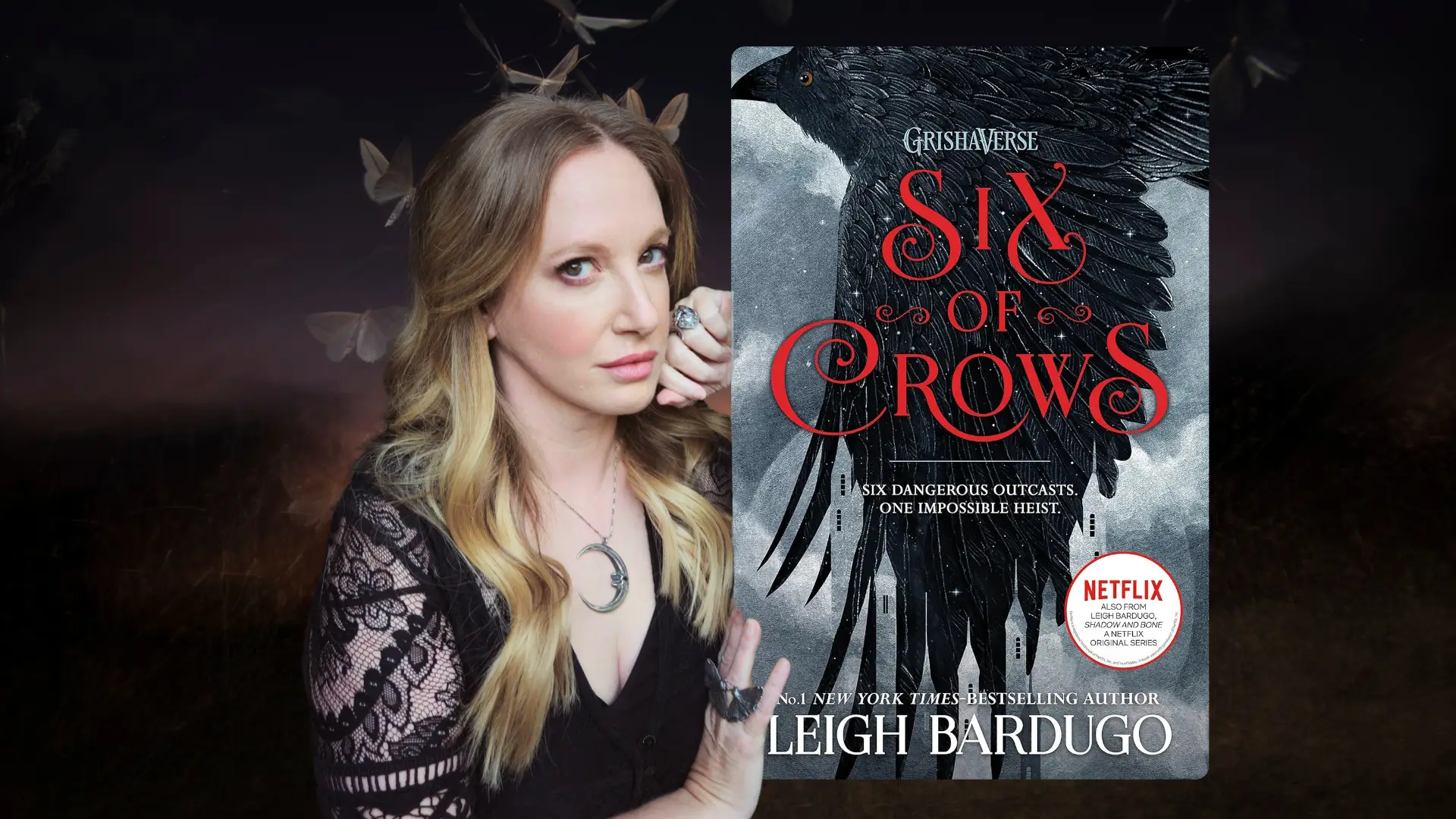
Leigh’s visit was part of The Novelry’s 2026 events program, which has also welcomed Cassandra Clare, Holly Black, and Charmaine Wilkerson. Leigh shared with our writers how she tackles these common writing conundrums and revealed a little more about the magic behind the Grishaverse.

Who is Leigh Bardugo?
Since her debut novel in 2012, Leigh Bardugo has published more than a dozen books, which have sold more than 20 million copies worldwide.
Leigh is the #1 New York Times bestselling author of The Familiar and Ninth House, and the creator of the Grishaverse. That debut, Shadow and Bone, was a New York Times bestseller and was nominated for the Romantic Times Book Award and the South Carolina Children’s Book Award. The Grishaverse — which spans the Shadow and Bone trilogy, the Six of Crows duology, the King of Scars duology, The Language of Thorns, and The Lives of Saints — was adapted by Netflix as Shadow and Bone, which ran for two seasons from 2021, with Leigh serving as executive producer.

Ninth House, her first novel for adults, was published in 2019. It won the 2019 Goodreads Choice Award for Best Fantasy, was praised by Stephen King and The New York Times, and has been optioned by Amazon for television. Dead Beat, the third and final book in the Ninth House series, was published on September 15, 2026.
It’s clear that Leigh Bardugo has secured her place as a leading voice in dark fantasy, and in an exclusive live Q&A with our writers, she shared some of the lessons she has learned along the way. One piece of advice stood out above all: how to handle info-dumping.

What is info-dumping?
Info-dumping is when we overwhelm the reader with lore and backstory — offering up the evidence of our painstaking nights of obsessive research and detailed planning. As writers, we’re often warned against it because it slows the story’s momentum and risks losing our reader’s attention.
For fantasy novelists in particular, it can be difficult to pinpoint when sharing essential background information tips over into info-dumping — especially when you’re trying to develop and enrich your novel’s world-building. So how can you tell the difference? And how should you approach it in your first draft?

In the first draft, info-dump away
Luckily for us, Leigh is a devoted proponent of the messy first draft. Her strategy? Include everything you want to in your first draft, purely to keep your momentum going. You now have permission to info-dump with glorious abandon — enjoy it! (For now.)
As Leigh put it:
“I want to make sure that when you’re writing a first draft, you’re allowed to info-dump. Info-dump everywhere. You’re solving the problems of that draft as you’re writing. You’re figuring out the parameters of the magic system.
Info-dump away in that first draft. That is for nobody but you, and will help you figure out what you’re trying to say. If you’re trying to moderate the release of information while you’re writing that draft, I think it will just blow your momentum.
So give yourself permission to be as clumsy and lecture-y and ridiculous as you want to be, and then go back, and refine that as you begin your revision process.”
— Leigh Bardugo
In revision, look for power and place
When you arrive at the next stage of editing and rewriting, you’ll need to distinguish between critical detail and superfluous exposition. To help, Leigh shared an excellent exercise — one you can try right now:
“Go find a book you love, read the first couple of pages, and look for places where you’re getting signs of power and place — where the author is leaving you markers of power and place.”
— Leigh Bardugo
As you read like a writer, you’ll notice that each depiction of power and place is rooted in the character’s experience of them.
Leigh offered The Hunger Games as an example. The reader doesn’t receive an elaborate explanation of the Capitol’s influence over the districts or the history of the Peacekeepers; instead, we see the impact of both through Katniss’s eyes, rooted in her experience. As Leigh explained:
“You are going to go into the personal and the specific. And if you can root the world-building that way, with a character, you’re not going to miss anything, right?
Because it matters to them, it matters to the narrative.
I love lore more than anybody, but that’s a way to keep it rooted and to keep the momentum of the story going.”
— Leigh Bardugo
“Because it matters to them, it matters to the narrative”
Imagine a friend asking how you spend a holiday such as Christmas Day, Leigh continued. Would you begin by explaining the historical origins of Christmas and sharing facts about the holiday as a global tradition? Probably not. Most likely, you would share the traditions unique to your family: whether you go out or stay in, when you sit down to eat, what’s on the table and what’s off-limits. You share the personal and the specific because that’s what interests your listener — and the same is true of your reader.
(We think “Because it matters to them, it matters to the narrative” is an excellent mantra to keep on a Post-it note above your desk.)
As you work through your manuscript, notice where exposition — or info-dumping — creeps in. Ask yourself:
- Does this matter to my character?
- Is this rooted in their experience?
- Or is this stalling the flow of my story?
Use research to get your momentum back
Leigh also offered wisdom for writers who find themselves losing momentum in the drafting stage. In keeping with her love of info-dumping in the first draft, Leigh finds that extensive research into the context of her story is the best way to defeat writer’s block. Rather than being a distraction, research reawakens her excitement for the novel and brings critical momentum back to the drafting process.
“Part of our job as authors is to understand ourselves and that we have a different relationship to writing. Each relationship is personal and different, and [your job is] understanding what works for you to maintain your momentum through the draft.”
— Leigh Bardugo

Leigh shared many more fascinating insights during her live session, and writers at The Novelry can watch the full recording in their Catch Up TV library. If you’re ready to write a story readers can’t put down, The Finished Novel Course will guide you from your first idea to a finished, edited manuscript — complete with a professional read from a Big Five editor and a year in our community of writers, cheering you on all the way to The End.