

We’re going to look at some practical techniques to find and assert your voice. A voice that will be there as a close comfort for you on the days the writing might otherwise come hard, and to drive the story harder and faster.
Done well, it feels like a real person is speaking directly to the reader. And in the age of AI, this becomes your trump card, if you do it right. Which means doing things wrong, like a human would, too. Take note: your voice is your antidote to accusations of AI, and that’s why you need to spend time on it and invest in it.
If you’re worried about voice, wondering if it’s too late to work it out now you’re on draft fifty-two, relax. It emerges, it rises like cream, and a little bit of whisking might just make it bolder. With voice, you hear it through the words at first, then you get to know the shape and rhythm of it and you finesse it, often toning it down in the last pass. So wherever you are, it’s never too soon or too late to think about voice in your writing.

I am using some of the novels on the Booker Prize shortlist 2026 to show you five techniques for voice in action.
John of John by Douglas Stuart is a novel about a young gay art school graduate, John-Calum, who heads back to his island home on remote Harris in Scotland to come to terms with his upbringing and his deeply religious father, John. Think brooding repressed sexuality, heavy Presbyterian dogma, and Gaelic language set on a rugged, almost lunar landscape with cold, biting winds. The novel became an instant New York Times bestseller and was shortlisted for the 2026 Booker Prize. Stuart previously won the Booker Prize (2020) with his novel Shuggie Bain, highly acclaimed for his use of voice.
The Things We Never Say by Elizabeth Strout is a novel about Artie Dam, a 57-year-old high school teacher and keen sailor who lives on the coast of Massachusetts with his wife Evie. His inner world emerges with themes of profound isolation, trauma, and estrangement from his adult son. Suicidal, he considers his manner of dying until an accident at sea and a near-drowning causes him to live again. Profoundly affecting, Strout circles the many sides of good Artie, and using a whirlpool effect, sends us deeper and deeper within, toward the universal. With eleven novels under her belt, Strout has been on the Booker longlist and the shortlist before, and she won the Pulitzer Prize for Fiction (2009).
Black Bag by Luke Kennard is a novel about an out-of-work young actor who takes an unusual role as a “black bag” for a university psychology experiment and discovers a curious sense of fulfillment through the erasure of his identity. Written in the first-person present tense, it’s a novel where voice is very much the driving force of the story, particularly when you consider that the narrator spends time physically concealed inside a black bag! Luke Kennard is best known as a poet, hence voice is a strong suit.
Why voice matters so much
Marianne Velmans, a doyenne of publishing at Penguin Random House and publisher of Lee Child, told us she acquired books based on “voice.”
Publishers take voice seriously. It’s major kudos to them to find one.
“Once I’ve dipped into the manuscript itself, I’m taking inventory: is this voice compelling?”
— Jeramie Orton, Executive Editor, Penguin Books, Pamela Dorman Books
Publishing editors often say this. Agents tell us too that after they check out your pitch in the cover email, they move to the first three chapters of your manuscript and want to hear your voice from the opening lines.
Why does it mean so much to the gatekeepers?
An assured voice signals a new talent. It’s the sign of someone who has got a lot of drafts out of the way and spent time honing their craft. It tells us you’ve cracked it. (Conversely, absence of voice, a bland voice, or a jarring or uneven voice, unreliably used, is the sign of someone with a lot more work to do. It’s obvious from the first lines.)
“Our job at the end of the day is to see through a bad pitch to find great material and great talent. People always have this idea that great books get lost in a slush pile because of a terrible query. This so rarely happens, because we can tell instantly from the voice on the page.”
— Chris Combemale, Literary Agent, Sterling Lord Literistic
Your voice makes the story stronger. It makes your story all-singing and dancing and carries the story over rough ground or little lapses in plot. You get a pass.
“Getting the voice and set-up right is 95% of the battle — you want to introduce us to your world, your central character, and establish the plot arc. It’s a lot to balance but if you can get it right, you’re on to a winner.”
— Hattie Grünewald, Literary Agent, The Blair Partnership
And it’s your brand. An author is known for their voice, and the reason readers come back to an author time and time again is not necessarily to do with genre, but because they like the voice and want more of it. It speaks to them.
Genre and voice are fairly closely linked, though not inextricable. An author can change genre and bring readers with them who like their voice. Once you have a brand voice, you can probably trespass into other adjacent genres.
Voice in fiction is very much to do with the personality behind the prose. Presented with a page of text, you can tell Jilly Cooper from Stephen King, Maggie O’Farrell from Lee Child. They’ve signed their work with their voice.
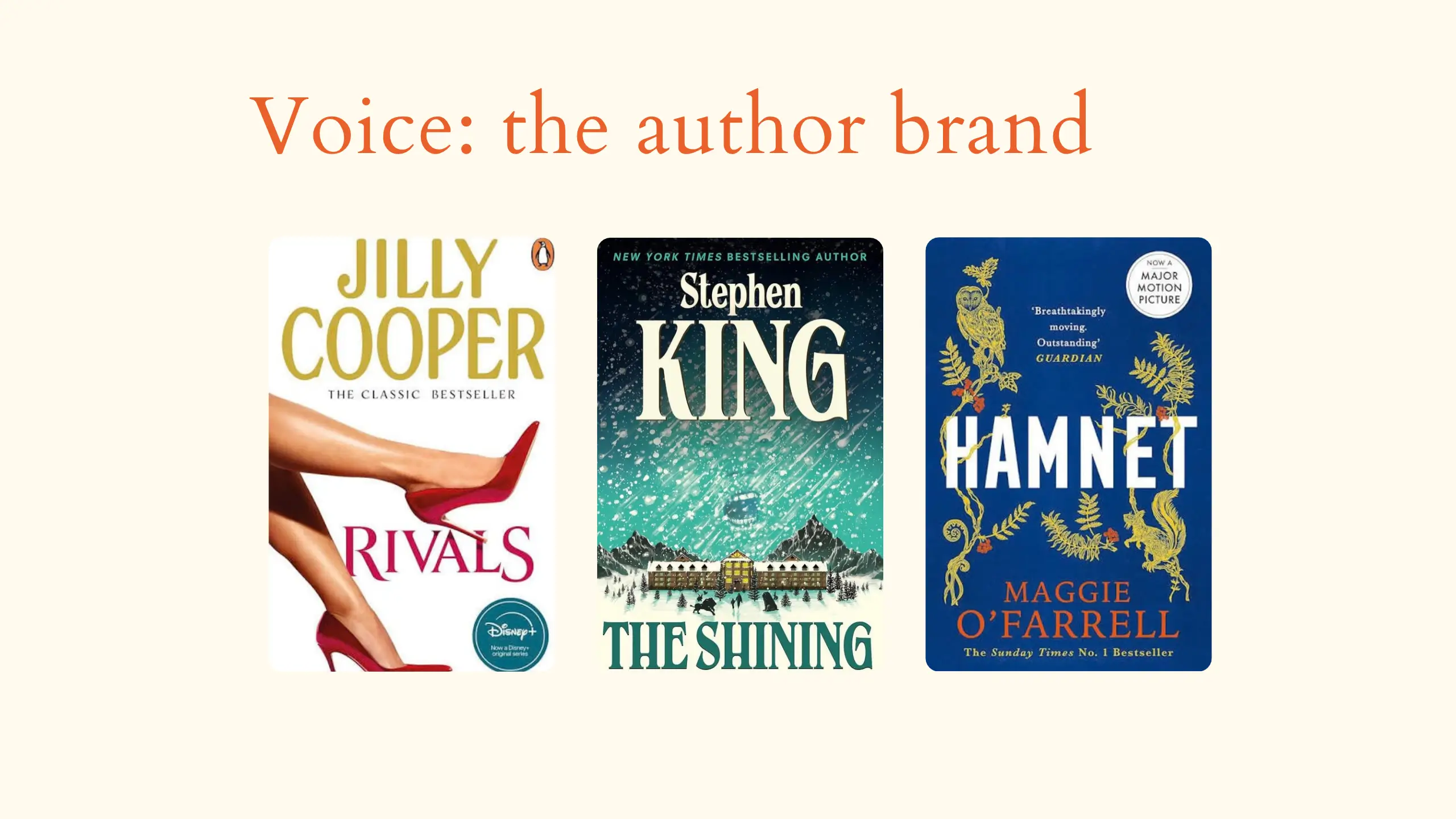
It follows too that readers have personal tastes in voice, and you can’t write to please ’em all.
Being yourself, only more so
“Every writer has a different, distinct voice and way of telling a story — your novel comes from you and how you see the world. Isn’t that interesting, rare and exciting in itself?”
— Marina de Pass, Literary Agent, The Soho Agency
Yes, it is exciting to be yourself, only more so (in other words, to lean into your flaws to find truth), but it’s also work.
Honesty is not a gift you have or you don’t have, it’s a practice, and it’s work you must do if you want to write well. Assume you don’t have it and all will be well. Most of us are near-sighted in this regard; after all, it’s hard to get through life with all the lights on.
Finding your voice requires patience and a little soul-searching. It probably comes easier to people who think little of themselves than those who think a lot, which is why gatekeepers are always appalled by vainglorious cover notes.
This can be accelerated with some close accounting of our own motives in any given exchange, by taking close account of the way you manipulate people with your voice, and choice of words and framing on a daily basis. Keep a record of your machinations step by step, and it will help you illuminate those of others. We’re not so different. From the individual to the universal, that’s the job of the artist.
We need your most selfish instincts to be known to you, alongside your capacity for tenderness and compassion. They hang together like awkward teenagers on a first date.
To be read, you must understand us and how we work, and be able to share that with the reader. So do some close accounting of how poorly you conduct yourself over just one or two days and you’ll have the scoop. Once you have that, you can treat yourself to the satisfaction of doing the same for others.
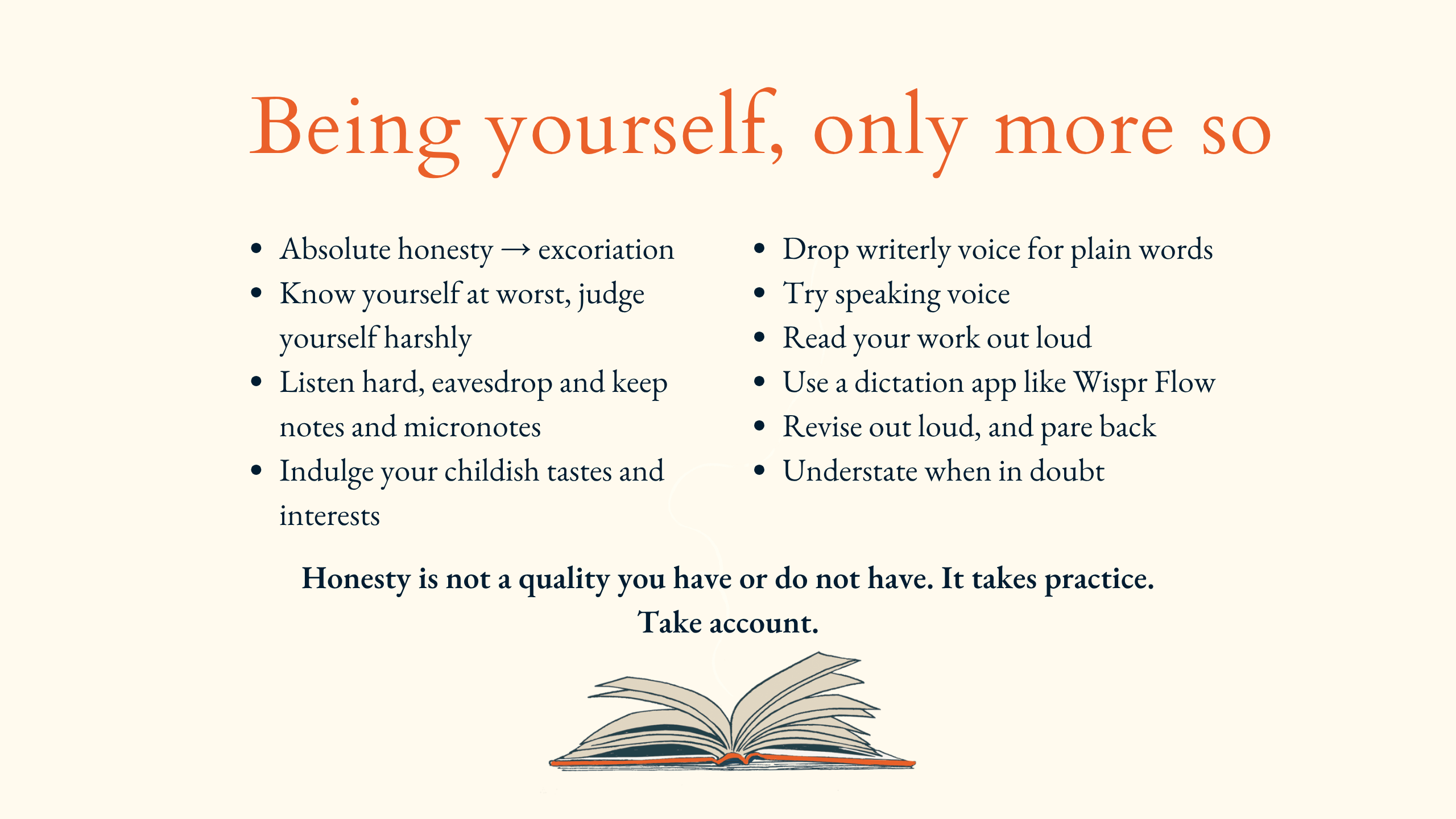
Be practical and work with your real voice. Record yourself, read aloud, use a dictation app like Wispr Flow (sign up for a free trial here, but before you dictate your manuscript, go to Settings › Data and Privacy and switch off Data Sharing and Context Awareness). Write to a close friend in an intimate style. Write to someone who is wiser than you.
Your voice may be a little blowhard and may be a little crass in its early iterations, but you can pare it back in the revisions.
Voice as a choice of where you stand
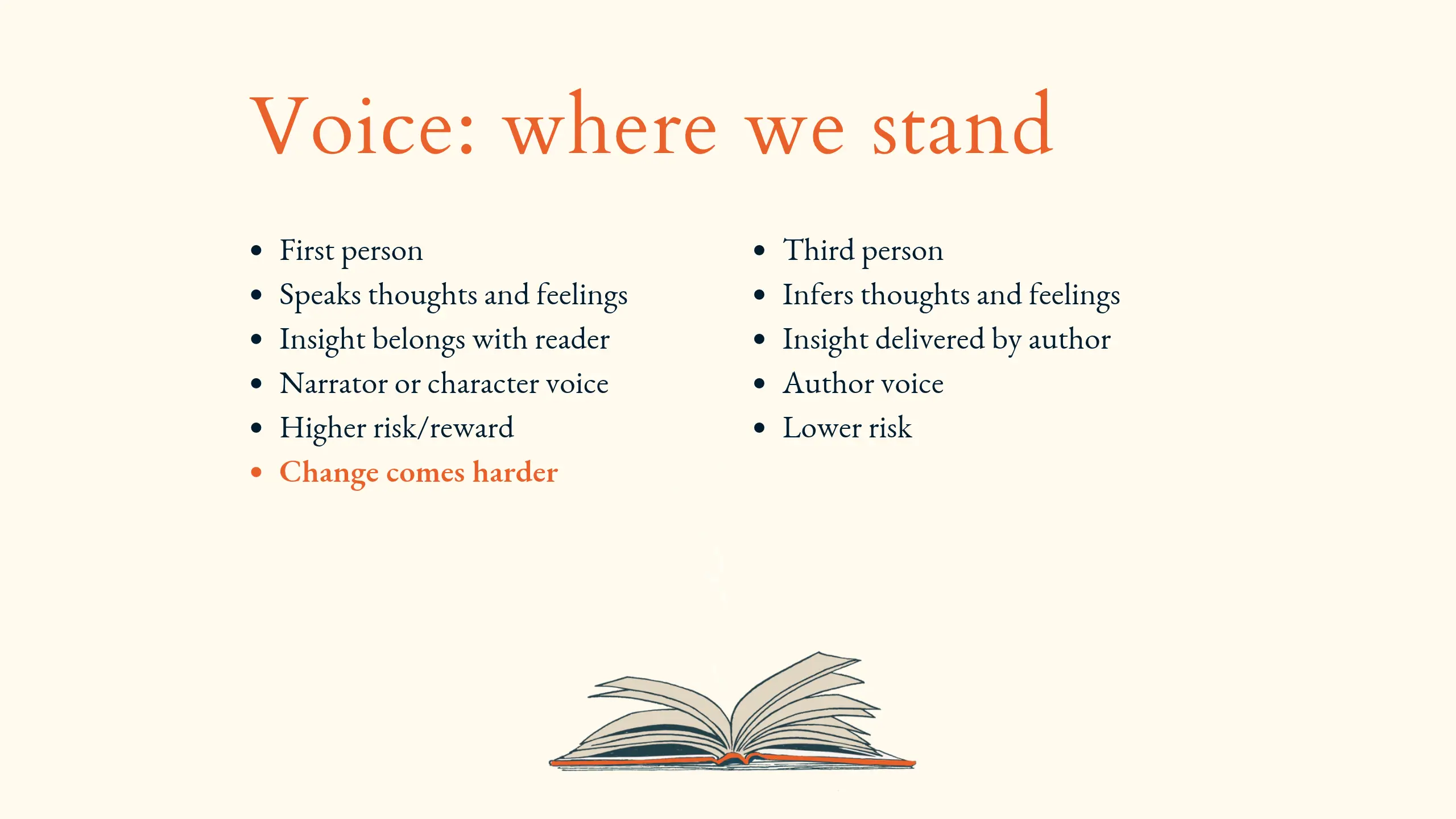
If you’re using a first-person voice, it’s a high-risk, high-reward strategy. As I mentioned, voice is highly personal and some readers may be put off by the squawking, whereas others may enjoy inhabiting another life readily. This gambit — because it’s so high-risk — will impress the gatekeepers quickly. If the voice sings for you, sing it!
However, the change upon which story depends comes harder when the voice is a constant. The voice of the narrator-cum-author-cum-main-character in a first-person novel will stay the same, and their appetite for insight will likely and realistically be less, so change has to come at them as major assaults to progress the plot. Things have to happen to them as much as they happen to things or the story risks being too slow. This is a major risk in literary fiction.
A way to mitigate risk is to use third person, where you use your voice to speak for the thoughts and feelings you infer to your characters. You will be composing their inner world and laying it bare to your design. You not only control their responses, you lay plain their internal change as you see fit, you masterplan their growth. You are the creator, and the interpreter. You are the ventriloquist.
Voice is concerned with how we defend our inner lives and hide our secrets, desires, and lies.
Secrets and lies. Remember: when we speak, we choose to share our hidden thoughts, selectively. Loose words sink ships.
Third person infers the feelings and thinking of the main character, assigning to them insights and change, moral development with great economy. It also goes beyond the main character and via the free indirect style allows the author to voice the feelings of anyone they wish, going wide and outside of the main character. The author voice becomes intimate with the reader by whispering secrets in their ears.
A first-person novel risks being solipsistic. We all suffer, and that is not so interesting to me when it’s the primary message as a wider terrain of relationships navigated, and the course of conflict charted less preciously. How we protect and defend our inner lives is always there as the driver for voice. Third person shows too how we make others suffer.
“A great storyteller is a voice that rings out around the campfire, telling us not to fear the shadows beyond. [...] What matters is that the voice... tells us that we are not alone and that others have felt or feel the same.”
— Yann Martel
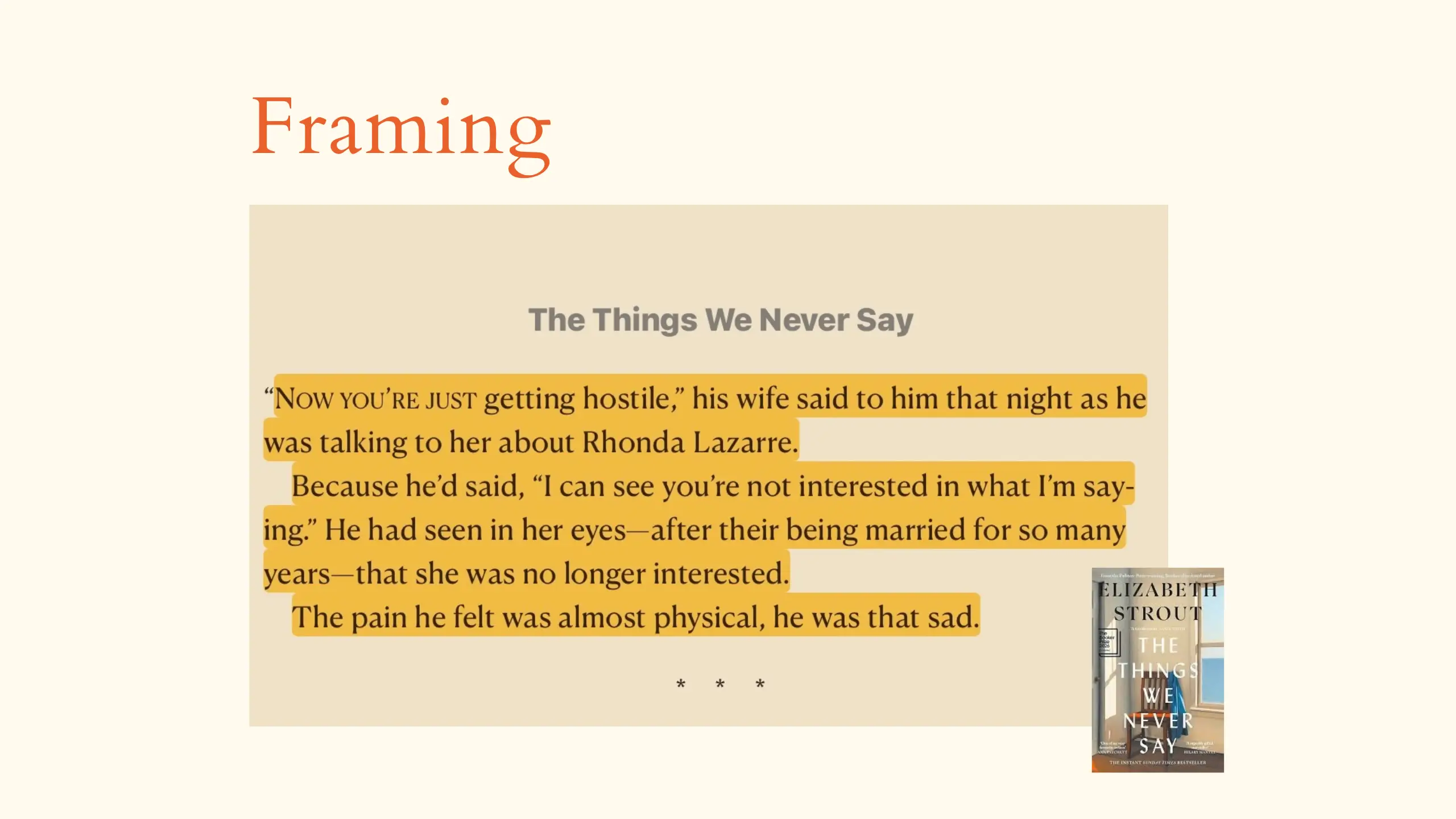
In The Things We Never Say, Strout describes a big unnamed fear pursuing Artie, chasing him to the brink of death, and as the author, she is saying in this work and others, “Look, these people are like me... and like you. Look what we share.”
“…the trepidation that had been instilled in him as a child did not recede. And in truth, these days it was getting worse. It was a full-blown fear now, and the fear was unnamed, a large and massive thing that hung in front of him that he had to move through all the time…”
— Elizabeth Strout, The Things We Never Say
You could also say that when an author writes, they’re reading us. For many, an author is a light in the dark, the lamp at the window, to bring us home.
Voice in sentence style
Here are the old chestnuts. You deliver voice as the author in your choices of words, sentence length, rhythm, perspective, and what you show and what you don’t. But probably your word and sentence pattern come uppermost in the list. Narrator voice and main character voice play their parts too.
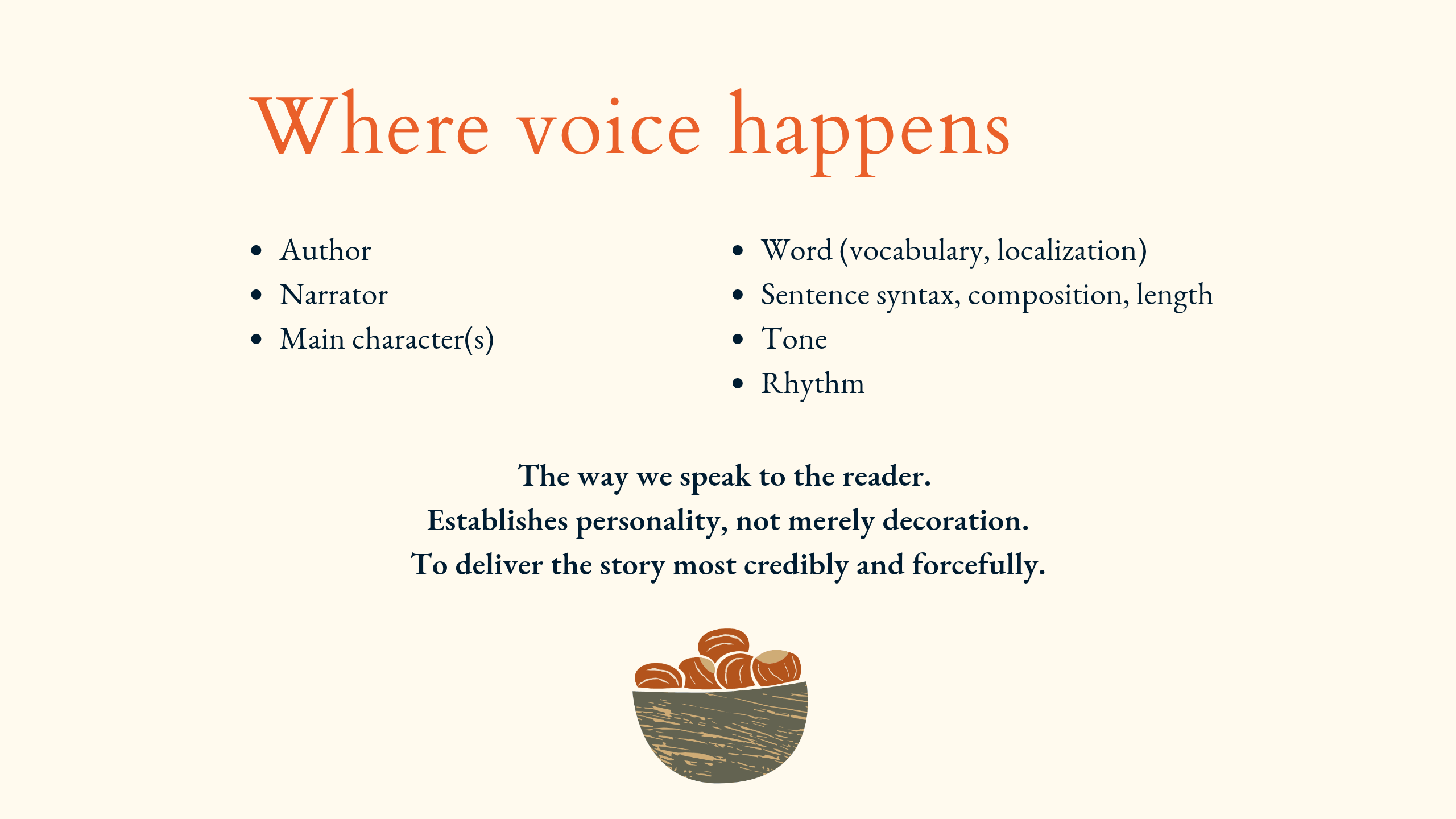
You need to let your characters speak as they do, not in ways convenient to the author. Being faithful to this maxim will take a lot of story development work off your hands.
“I had very thin descriptions of everyone physically. And that was on purpose. [...] the way you do that is to allow these characters to speak in their own voices and also put them in difficult situations where all their flaws come out, where they start behaving badly. And then, suddenly, you have very distinct people.”
— Bonnie Garmus
Moving past the chestnuts, some of your voice choices will sit within your genre, but most come from your taste and judgment, your values and approach. For example, how you frame a scene in terms of shifts of tone and mood. In literary fiction, an author who tends toward the poignant and affecting will frame a sentence to move from anger to sadness, whereas a thriller writer might choose to raise the heartbeat and end with anger.
Techniques to find and assert your voice
And what is voice, really, but a way to make people know us... yes, and love us.
I am not saying these techniques alone deliver voice. As we have seen, things like framing, sentence length, and word choice serve a purpose too. But you can forcibly apply these to leaven your voice to make it more endearing to the reader. So think of these techniques as tools of endearment.
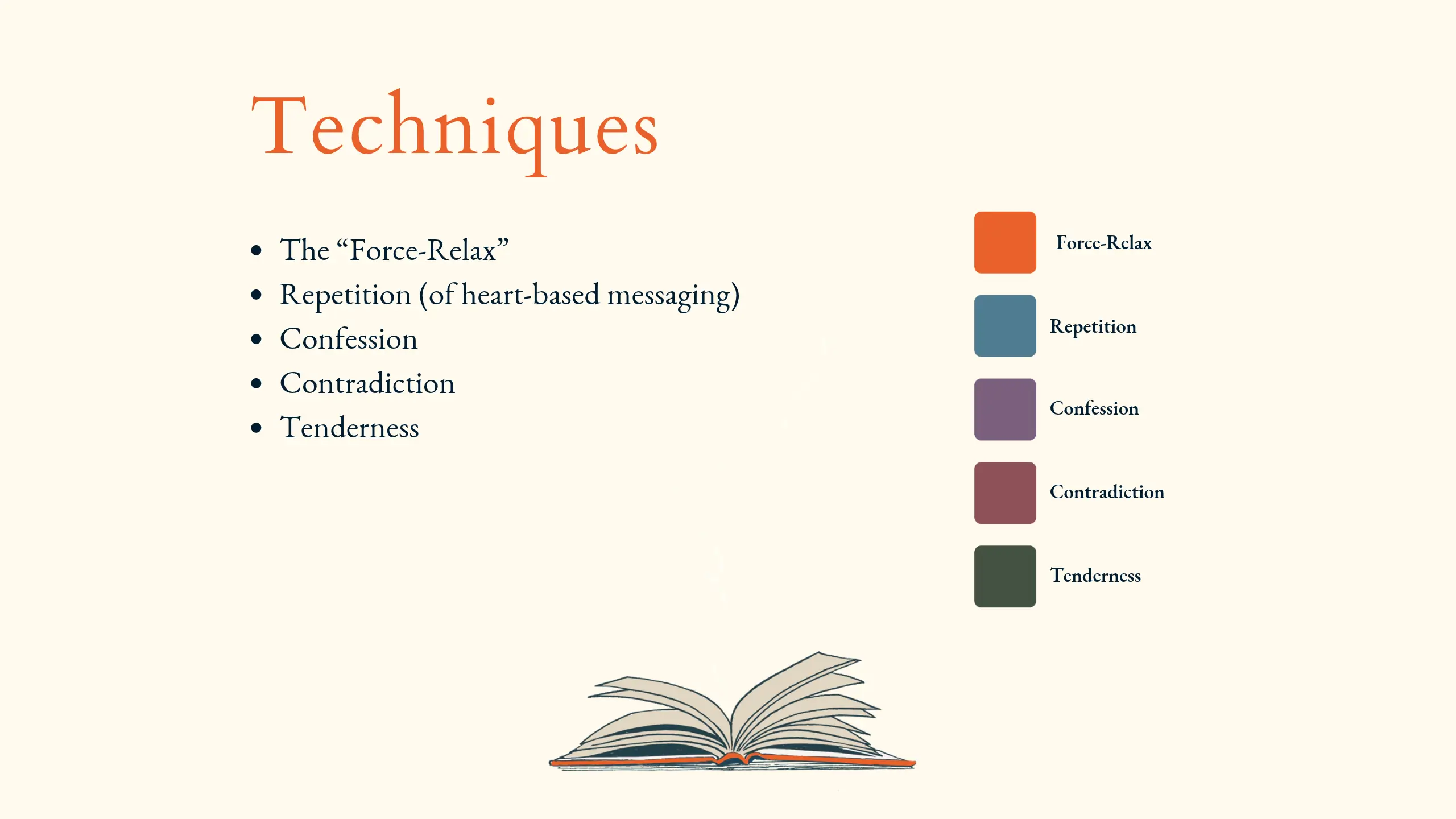
All of these techniques fall under the umbrella of “humbling ourselves.”
The Force-Relax
Go for understatement and the natural choice of words you use in conversation rather than bookish, corporate, or educated words. Casual tone of voice applied hard! Now that you can write and have craft skills, you need to return to the freedom of the uninitiated and be more playful with your skills. You don’t need to unlearn. You need to undo, and that has to be done deliberately.
Go from highbrow to lowbrow and you’ve nailed it.
Repetition
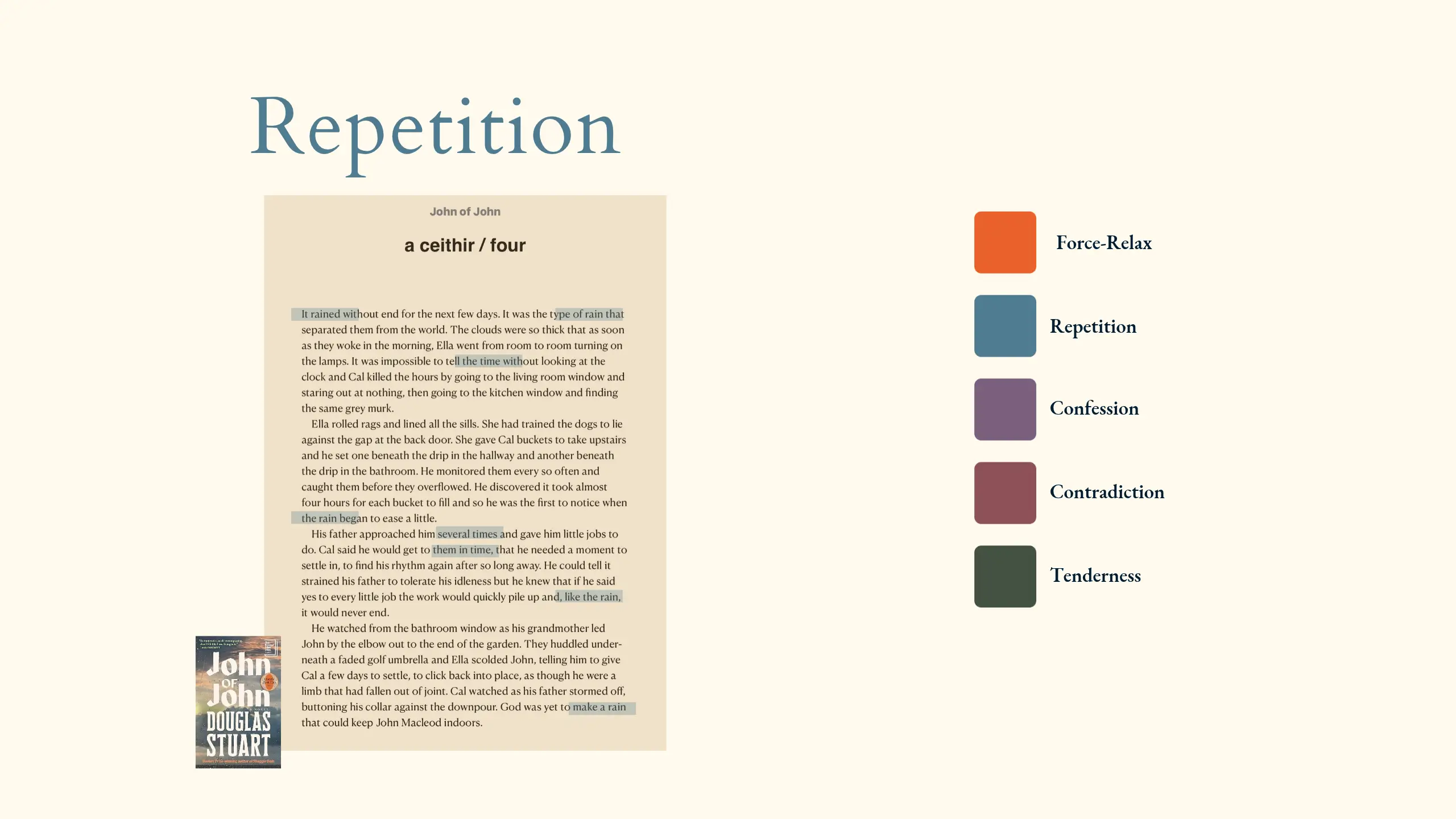
This is the motif of the message. What is it you really want to say? Say it more than once, just as we do in conversation. It makes it feel real. I know, we writers in English have a vast vocabulary. But so do your readers. No need to use it all up. So choose carefully, choose the more emotive words and phrases that speak your heart.
And use it to make them feel. (See this excerpt from John of John by Douglas Stuart below. Rain and time. Time and rain. For the remote Scottish isles.)
Confession
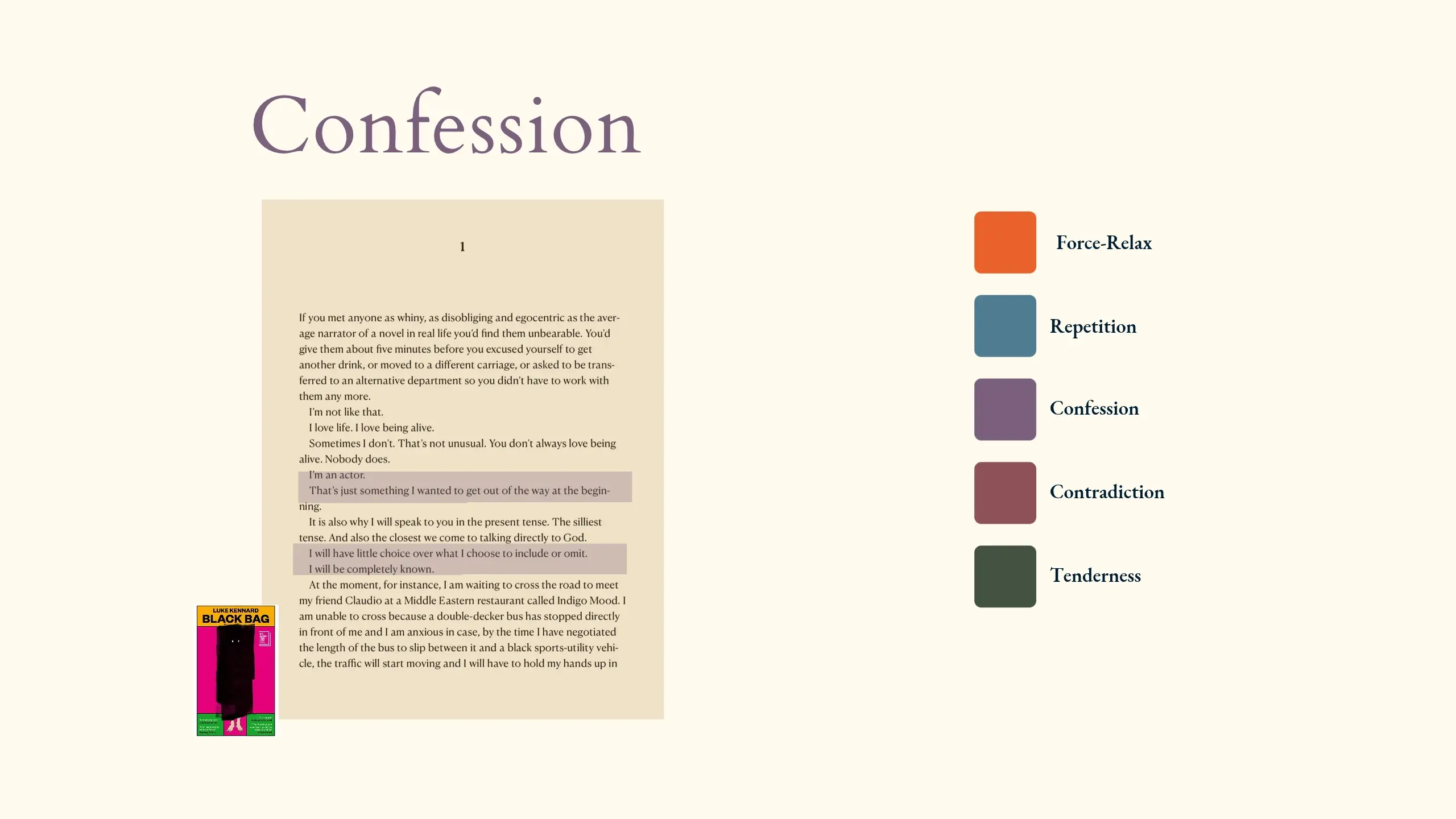
Confession is the basis of intimacy. Hard to be friends with someone who never tells you about their flaws and failings, right? You can even admit your doubts and uncertainties as to how to tell the story and thereby create an immersive mutual enterprise between you and the reader. A pact.
The sooner you give it up, the sooner you’ve got them on side.
Contradiction
Use paradox and oxymoron — working between two poles of meaning gives dimension and opens our minds to the range in between. This brings the third dimension of reality. As with confession, you’re making space for the reader. You don’t know it all. You need the reader. An author is always calling on the reader to help them out.
So invite them in to figure things out by showing them the problems. Poise and counterpoise gets their minds working.
“He loved her, but he was not remotely in love with her.”
— Elizabeth Strout, The Things We Never Say
“the closer he got to home, the more lost he felt”
— Douglas Stuart, John of John
“I am not important, but what I have to tell you is very important.”
— Luke Kennard, Black Bag
Tenderness
Where you surprise, do it with heart, be vulnerable, be tender. This is how you keep them reading you as a human, the way we are always reading humans in every interaction we have. We look for the weak spots.
We come to fiction to feel feelings.
“The pain he felt was almost physical, he was that sad.”
— Elizabeth Strout, The Things We Never Say
“I need you to keep me human. [...] You’re the most human guy I know.”
— Luke Kennard, Black Bag
“It was impossible to look at the unforgiving beauty and not feel the hand of God. [...] John had once told Cal that the Moon and the Earth were joined as lovers, and that when they parted, this quarry is where the Moon had kissed the Earth goodbye.”
— Douglas Stuart, John of John
The Shipping News
Annie Proulx wrote her first novel, Postcards, in 1992, when she was 56. Postcards won the PEN/Faulkner Award for Fiction, and she was the first woman to win it. The Shipping News (1993) won the National Book Award (1993), the Pulitzer Prize for Fiction (1994), the Irish Times International Fiction Prize, and the Chicago Tribune Heartland Prize too. I saw her speak in New York in 1997 and became a devoted student, but I teach from her work with trepidation because it is intimidatingly good and enough to make any debut novelist want to have a lie-down and a little cry.
Look carefully at the very first page of The Shipping News and you will see all five techniques in play.
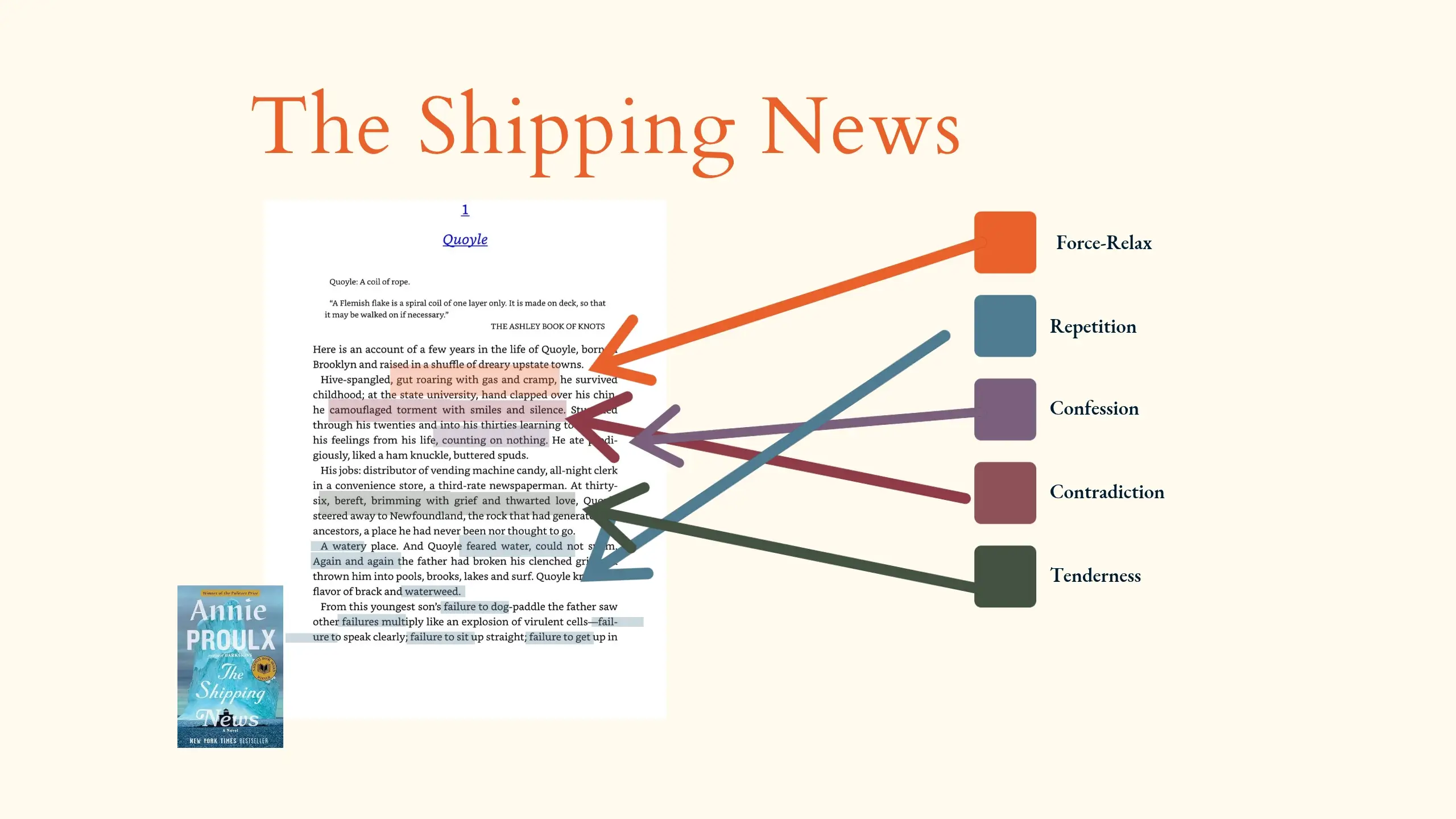
Apply the techniques from the first pages, and to quote Mr. Dickens, work at being so very ’umble in your fiction prose voice.
You’re going to find it a great relief not to have to be great. Just be human.
(This is the abridged version of a recent session given by Louise for members of The Novelry. Members will find the full presentation in their Catch Up TV Library, along with tasks, exercises to apply the techniques, and a download.)