
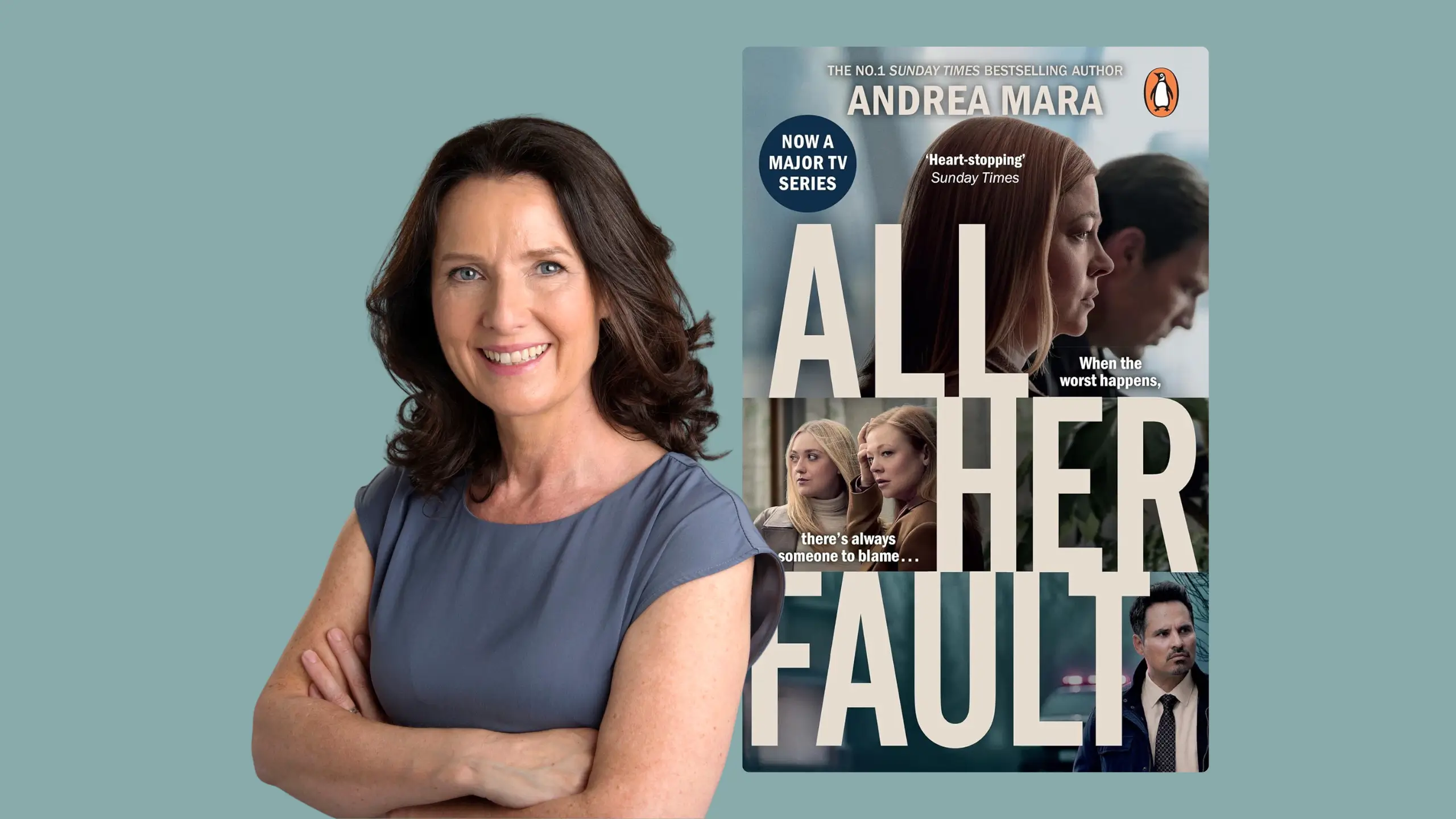
The “Fizzy Feeling” of Writing a Hit: Andrea Mara’s Top Tips
.avif)





What does it feel like when your manuscript becomes a book, and that book becomes a Golden Globe-nominated TV series featuring Succession actress Sarah Snook?
Irish novelist Andrea Mara has perfected the art of the delightfully twisty thriller. Her 2021 novel All Her Fault was adapted for television and became a Sunday Times bestseller, and her latest novel, Such a Nice Girl, further cements her status as one of fiction’s top contemporary writers of the genre. Her books have now sold more than one million copies worldwide.
So, how did Andrea feel while drafting All Her Fault — could she tell it might be a hit?
At a special event for writers at The Novelry, Andrea sat down with her former editor at Penguin Random House (now The Novelry’s editorial director), Tash Barsby, to unpack her unique spin on crime fiction and trace her journey from small Irish indie books to global bestsellers.
Discover how Andrea Mara creates unforgettable hooks, propulsive plots, and builds tension in her work, and read on for her behind-the-scenes insight into working with international editors and how to make peace with writing your first draft.
The Big Idea
Our ultimate writing course for beginners.
For those writing fiction for the very first time.
On the “fizzy feeling” while writing crime thriller All Her Fault
I just kind of had a good feeling about this.
— Andrea Mara
Andrea’s bestselling book All Her Fault tells the story of every parent’s worst nightmare, with a missing child storyline that quickly becomes a deeply unsettling page-turner. As the shocking truth gradually unravels, the book transcends mystery and horror, casting doubt on the characters’ motives.
Known as she is for writing psychological thrillers and domestic noir, Andrea’s novels often tap into the anxieties of modern life, exploring motherhood, family, and the darker side of everyday life while channeling the sinister edge of Stephen King with her own modern-day take.
From No One Saw a Thing to Hide and Seek, her female-centered thrillers turn familiar fears into contemporary cautionary tales.
And while All Her Fault may have catapulted Andrea to fame, it was actually her fourth book — but one that felt special to her right from the very start.
I don’t love writing first drafts, but with that first page of All Her Fault, I did feel a kind of fizzy feeling. I remember even sending it to my sisters, who are big crime readers and big crime watchers, and I don’t normally send anything to anyone. But I just kind of had a good feeling about this, and I wanted them to tell me it was good, and they’re like, “Yeah, that seems good...” I felt like it was a good hook as well. The idea of a playdate that’s not a playdate and a child has gone missing. So I did have a good feeling when I went out looking for an agent.
— Andrea Mara
On choosing book titles
Despite the “fizzy feelings,” Andrea experienced the same challenges in conceiving her novel that all authors do, even with the book’s title. Her original title, The Playdate, had to be changed after seeing a book with the same name advertised in the paper.
I was a little bit gutted at the time, because [my book] had always been The Playdate. Now, ten books in, my editor picks the titles and I’m like, “Whatever, sounds great!” Because he’s really good at picking titles and I’m not particularly good at titles. But I think when you’re starting out, you get really hung up on your baby, and your title, and your main character’s name and all that kind of stuff.
— Andrea Mara
After bouncing ideas back and forth with her editor, they landed on All Her Fault. And although it took some time to get used to, the title change actually helped emphasize some of the story’s key elements and bring out certain themes.
Around publication time, I think we reverse-engineered a few things into the book at that point, so it tied a little more with the title. It was nominated for Emmys and Golden Globes as All Her Fault, and I just love where that went in the end. It all works out okay, and it was good as it made us focus in a bit more on those themes about blame, about the elements they really pulled out in the TV show as well. About the emotional labor of parenting.
— Andrea Mara
On the twists and turns of finding the right agent
Naturally, before All Her Fault hit the heights of success and a TV adaptation, Andrea sent the manuscript to several agents with mixed results.
I think I spoke to eight agents and four were interested in representing me. Four asked for more, for a full manuscript, which wasn’t really fully written at the time, but I sent them what I had. So, four said yes and four turned it down. I do wonder if they watched the show and what they thought!
But I do understand that an agent might potentially think a book has commercial appeal and might be of interest to a publisher, but it still might not be to their taste. And that’s fine, that’s just how it is.
— Andrea Mara
Learn more here about literary agents and how to pitch to them.
.webp)
How it feels having a book turned into a TV adaptation
Adapted for screen by Megan Gallagher and starring Succession’s Sarah Snook as the central protagonist, the TV adaptation of All Her Fault transported Andrea’s original Ireland-set story to Chicago (“It’s a fairly universal story, so it still works”), where it won critical acclaim and award nominations. But did this success inspire Andrea to try making her future books more TV-friendly, or even to write her own screenplays?
I think most of us don’t really know exactly what it is that makes [a certain novel] interesting to TV producers. I think we all read books and go, “My God, this would be such a good TV show. I wonder why no one’s made a TV show.” And then we wonder why they do the same ones over and over again, remaking this, that, and the other. “Why aren’t they doing this fabulous book over here?” But I think TV producers can see something that the rest of us can’t. They can see what makes a book turn into a good TV show.
I think if you’re trying to please everybody and anticipate what the market wants, or what might work for TV, you could just tie yourself up in knots and write something that’s maybe very uneven. But if I had the magic secret sauce, I would absolutely do it.
— Andrea Mara
On defeating the first draft... and then editing
How wonderfully relatable that Andrea, an accomplished novelist with years of craft under her belt, still finds first drafts as daunting as the rest of us!
One top tip Andrea shared with the writers at The Novelry is to try writing your “messy” ideas on physical paper first:
I do find writing first drafts very hard work, but the pen and paper plotting — where I’m like, okay, what’s going to happen next? — [means] I have this idea that if I just write it down in a notebook, I’m free to scribble down anything, no matter how silly it is, because it’s never going to be seen by anyone but me. It’s not on my laptop, it’s not in a Word doc, it’s just some scribbled notes on a page.
— Andrea Mara
Starting the editing process can be emotionally taxing (“First, I cry a bit and then close my laptop”), but ultimately, most writers will agree this is the moment you start seeing the light at the end of the tunnel.
Andrea found herself in the unique situation of having multiple editors: an Irish editor, a British editor, and then an American editor. Naturally, each editor had very different feedback...
My previous Irish editor wasn’t so much into the nice things. But [my British editors] get to the end of the chapter and put a note going, “Wow, I love this, this is working really well,” just to keep me going.
But the American notes can be very critical without so much of that “you’re doing great.” I had documents with three different colors of font!
So you’ve got three different people telling you all the things that are wrong with your book, which is much harder than one person telling you all the things that are wrong with your book. So I definitely found that quite challenging.
— Andrea Mara
.webp)
On writing thrillers that are dependent on twists
Many of Andrea’s books are psychological thrillers that feature “normal people” in extraordinary circumstances. This comes with the responsibility of crafting unpredictable twists. So, after ten novels, how does Andrea play with key thriller elements to keep readers guessing?
I would start with the premise and work out what the ending is. As in, who did it, and hopefully that who-did-it is a twist of sorts, or a good reveal in its own right. Then, after that, I’ll make an outline that’s maybe about four pages long.
I’m always pushing, “Can I start writing?” and my editor says, “Not yet! We need to figure out why that happens.” And I’m like, “But can’t I figure that out on the way?” And he’s like, “No!” So we usually try and have the big things mapped out.
But a lot of the smaller twists come along the way as I’m writing. And that’s the funnest part, I think — just working away, and then you suddenly think, “Oh, but what if, along with everything else, that’s happening...?” That‘s the part I really enjoy.
— Andrea Mara
Another occupational hazard for Andrea is knowing all the twists as she writes, so she tests her rug-pull moments on other employees at her publisher, Transworld.
I asked my editor if he could ask someone else at Transworld who doesn’t know [the twist] and give them the outline to read. They read it and they didn’t guess. I’ll just have to keep finding willing victims to reach...
— Andrea Mara
Fellow suspense writer Kate Riordan has more ideas for thriller writers here.
.webp)
On writing in Ireland and setting stories back home
Born in Mallow, County Cork, Andrea sets many of her novels in her home country, often creating fictionalized versions of places she knows.
After starting out with an indie Irish publisher (“It was really nice, on the one hand, that all my books would be in every single bookshop in Ireland, but in terms of long-term career possibilities, I realized it wasn’t really going to be enough”), she eventually branched out. Andrea continues to be a household name back home, winning Irish Crime Novel of the Year with It Should Have Been You.
Despite her international success, she still loves setting her stories around her home turf, playing around with different classes of believable characters from book to book.
I started out with The Other Side of the Wall, and I wrote it literally based in a fictional version of where I lived, because that was the easiest thing I could do. And that’s, I think, where the whole “write what you know” thing comes in.
With All Her Fault, I wanted the characters to be wealthy because it’s a kidnap story — or is it? Who knows? So I put the characters in an area of South Dublin. Again, a fictional version of a real road where there are beautiful big houses behind electronic gates and all of that, and I had so much fun Googling expensive kitchens and that whole aspirational wealth!
I really do like a beautiful setting, where there’s lots of rich people doing bad things!
— Andrea Mara
.webp)
The Novelry members can watch more than 350 writing classes and guest sessions with bestselling authors like Andrea in our Catch Up TV library.
Andrea’s session was part of The Big Write Challenge 2026: our community’s annual 90-day sprint to finish a novel before Christmas. Learn more about the challenge and all the other exciting events we have in store.
The Novelry is the fiction writing school for serious writers, guiding you along a clear, proven path from first idea to a finished, publishing-ready novel. Sign up for classes, one-to-one sessions with editors, and join a vibrant community of fellow writers.
The Finished Novel Course
The complete writing journey. Follow a clear, proven path from first idea to a finished, publishing-ready novel.
.avif)
.avif)


The Novelry
Founded by award-winning author Louise Dean, The Novelry is the fiction writing school with courses, coaching, and community to help you create, write, and finish your novel. Our graduates’ novels have gone on to become New York Times and Sunday Times bestsellers, as well as Reese’s Book Club and Read With Jenna picks.
.avif)
Related Articles
The “Fizzy Feeling” of Writing a Hit: Andrea Mara’s Top Tips
The Secret to Concocting an Agatha Christie-Style Mystery
.avif)