
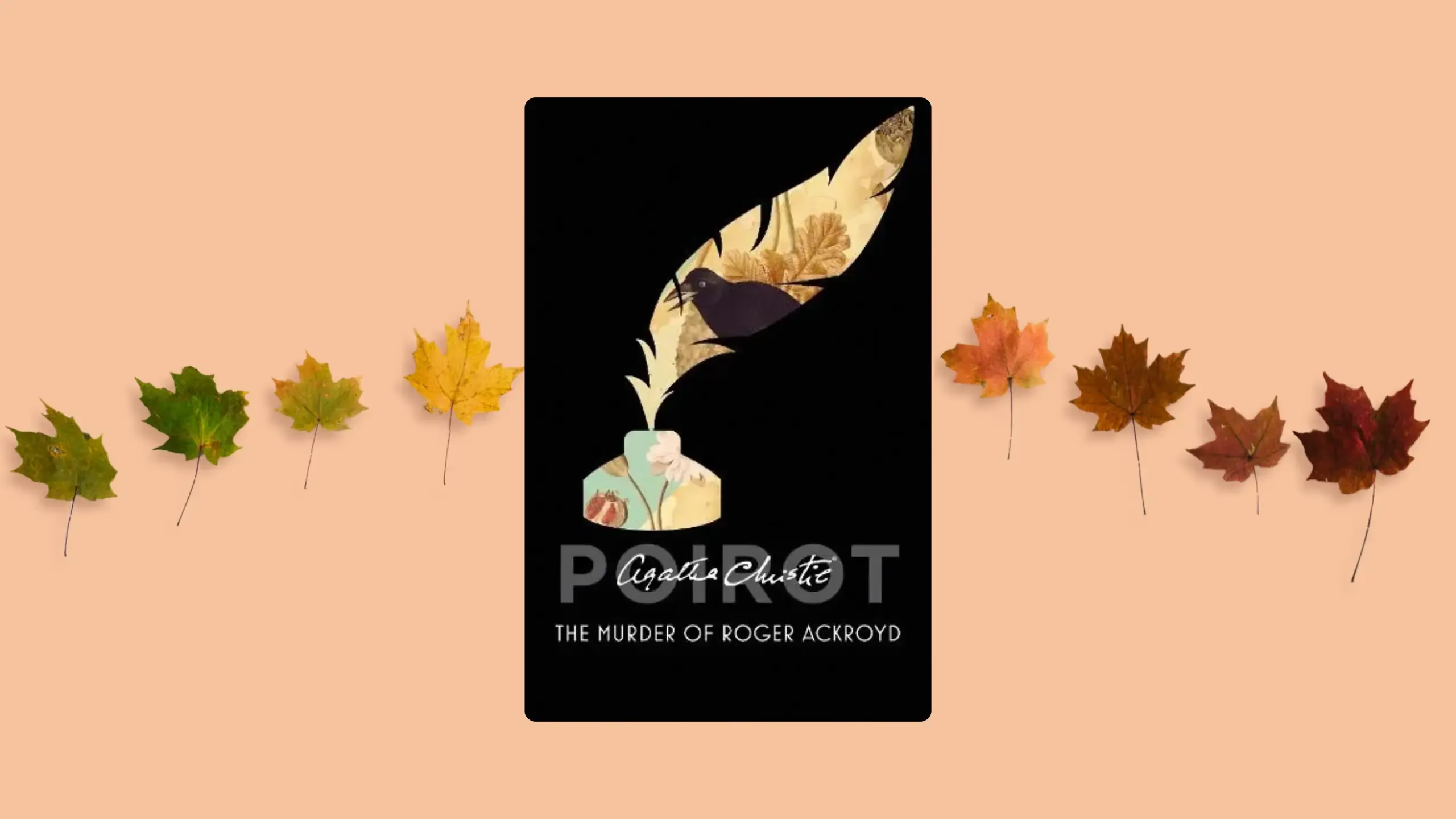
Plotting a good mystery that will keep your reader on their toes? This calls for unreliable characters, shocking rug pulls, and gasp-inducing plot twists, all woven together seamlessly.
Since Agatha Christie published her first novel in 1920, the mystery genre has continued to enthrall readers and authors alike. Even as we hit the 100th anniversary of one of Christie’s biggest books, The Murder of Roger Ackroyd, it’s clear these classic stories are still inspiring a new generation of mystery writers.
Richard Osman, Lucy Foley, and now... you?
In this article, you’ll discover ideas for crafting murder plots, breadcrumbing cryptic hints, and even more sneaky literary techniques to write your own mysteries, from British author and TV executive Samuel Burr. Samuel’s mystery novel, The Fellowship of Puzzlemakers, became an instant top-five Sunday Times and USA Today bestseller — read on to see how Agatha Christie’s work influenced Samuel, and pick up some expert tips on how to weave your own narrative webs as we salute the ultimate sleuth in style.
The ever-enduring power of Agatha Christie, from Hercule Poirot to Roger Ackroyd
In the midst of life, we are in death.
― Agatha Christie
There is a timeless and universal quality to mystery novels. Just look at the Queen of Crime herself, Agatha Christie. In the centenary year of one of her most celebrated reads, The Murder of Roger Ackroyd (published in 1926!), the OG remains the most-translated individual author in the world, published in an astonishing 103 languages.
Take a trip into the West End and you’ll pass Agatha Christie’s record-breaking masterpiece, The Mousetrap, the world’s longest-running play, with over 30,000 shows under its belt. From The Mysterious Affair at Styles (featuring Hercule Poirot for the first time) to Murder on the Orient Express (generally considered to be one of the greatest of the genre), Agatha Christie’s novels transformed murder mysteries and detective stories forever.
So, what’s the secret to concocting a killer mystery (with or without a dead body), why are we so drawn to stories that keep us on our toes — and how, with all the many millions of mysteries already out there in the world, can we continue to confound our readers?
.avif)
Writing my first mystery novel
In 2024, I published my debut novel, The Fellowship of Puzzlemakers. It’s the story of Clayton Stumper — a young man who was abandoned at birth in a commune made up of some of the smartest minds in the country. Among them are a mazemaker, a quiz setter, and a jigsaw artist, to name just a few. But there’s a mystery at the heart of the Fellowship and that’s how Clayton came to be there, and where he came from.
When the founder of the Fellowship — an esteemed cruciverbalist (or a crossword compiler) called Pippa Allsbrook — passes away, she bequeaths her final puzzle to the young man she’s raised as her own. And so we follow Clayton on a quest, as he pieces together the clues of his past and finds himself at the same time. With real puzzles infused into the prose, it’s about a bunch of brilliant, eccentric geniuses and a young man at the heart of their community, desperately trying to find his place in the world.
It was during the research of this book that I took a magnifying glass to some of my favourite mysteries, trying to decide what compelled me to keep turning the pages.
Below are my findings. I like to call them my Elements of Mystery.
%20(2).avif)
My five major elements of mystery
Think of it as a game. Cover your trail but show your workings. No one likes a cheater.
― Samuel Burr
Creating a character with a secret
Very few of us are what we seem.
― Agatha Christie, The Man in the Mist
Whether we choose to wear our quirks on our sleeve or not, it’s our hidden depths, buried traumas and strange idiosyncrasies that make us human, and it’s also what turns two-dimensional characters on the page into fully-fleshed ones.
A character withholding a secret is given an alluring quality, a magnetism almost. In real life, when we sense someone withholding something from us, our natural curiosity kicks in. Tell us, we want to say. Tell us what you’re keeping from me.
To divulge a secret, or expose a vulnerability, is a quick-fire way of building a bond with another person, and it’s no different in the pages of a book. When a character or protagonist opens up, we feel an emotional connection to them (whether or not we “like” them) and become more invested in their internal and external journey. For example, if your main character is a detective, giving them a personal struggle that connects to the mystery can help the reader root for them.
When we give our characters these emotional roots, we can finally understand their motivation.
.avif)
Whodunnit vs Whydunnit
It’s easy to fixate on landing a killer twist no one will see coming, but (as I’ll explain later) a “Whodunnit” is only as good as the “Whydunnit.” Here lies the greatest payoff.
Building a contained world with a locked room mystery
You may have heard of the locked room mystery (a subgenre of the mystery novel, wherein a narrative unfolds within the literal four walls of a venue) and though these stories are at the extreme end of the scale, it’s fair to say all mysteries tend to be set in contained worlds. I liken it to a jigsaw puzzle. Imagine trying to solve a jigsaw without having all the pieces in front of you. It wouldn’t just be difficult but completely unsatisfying. Show us the world, take us to its edges, and let us fill in the gaps.
Dropping clues and playful plotting
A mystery novel is more than a story to read; it’s a puzzle to solve. It’s this “invitation to play” that sets the mystery novel apart from all other genres, turning a passive pastime into something active, engaging and addictive.
One method I like to apply as a writer is to engage with my manuscript as a reader might, i.e.: knowing only what is written on the page, what’s the most obvious “solution” to this mystery, and — crucially — how I can reinforce the idea that this might be the solution, while secretly seeding clues to what the truth really is. Controlling the information flow helps build suspense with your pacing.
Think of it as a game. Cover your trail but show your workings. No one likes a cheater.
Hiding plot points in plain sight
It’s extraordinarily intriguing, the whole thing. Every new development that arises is like the shake you give to a kaleidoscope — the thing changes entirely in aspect.
― Agatha Christie, The Murder of Roger Ackroyd
In an ideal world, each major twist or red herring should have a sense of inevitability, which is usually achieved by deftly applied foreshadowing (hints at or clues toward something that is going to take place later in the plot). Remember, if this is a game between writer and reader, it would be unfair for the writer to be withholding information that would help solve the game. You want your readers to slap their hand on the table and say, “The clues were there all along! How did I miss it!”
There we have it. Simple, really, isn’t it? About as easy as pulling off a murder and not getting caught for it (...so I hear!).
If there’s one thing we can take comfort from in this increasingly fickle market, where trends come and go and it can feel like no one knows what the Next Big Thing might be, it’s that stories that challenge, captivate and mystify readers are going nowhere.
So, as we say happy 100th birthday to The Murder of Roger Ackroyd, one thing is crystal clear: mysteries are here to stay.
%20(1).avif)
A handy glossary on the murder mystery genre
- Red herrings: A rogue idea to drop into key scenes of your story, to lead the reader astray. These work especially well when a murderer needs to be discovered, and you need to pull the wool over your reader’s eyes!
- Chekhov’s Gun: Inspired by Anton Chekhov, this is a plot device that is introduced early in the story, only to return later with far-reaching consequences. Read our blog all about Chekhov’s Gun here.
- MacGuffin: Often associated with Alfred Hitchcock, this technique is common in thrillers, where an object/character/device gives the characters’ motivation, but soon becomes pointless to the overall arc.
- Breadcrumbs: The act of foreshadowing, dropping hints or breadcrumbs across your chapters to help the reader solve the mystery. Or, indeed, to lead them in the wrong direction. This will help lead to a satisfying climax, tying up all the loose ends. Agatha Christie often hid objects in plain sight.
- Unreliable narrator: A protagonist who isn’t giving you the full story. Agatha Christie frequently enjoyed playing with the trustworthiness of her characters, including the main ones. Layer your characters with complex motives.
- Closed circle mystery: A storytelling trope, often used by Agatha Christie in her literary works, where a limited amount of suspects feature. Give at least three distinct suspects with visible motives when concocting your own mysteries. Books such as And Then There Were None use this set-up to great effect.
- Impossible crime: A criminal event — more often than not a murder — which seems physically impossible, making the mystery to be solved even more elusive. For example, Agatha Christie had a lot of her victims poisoned, using her medical knowledge from volunteering in World War I.
- Hard-boiled: A crime subgenre stemming from 1920s pulp detective stories, often showing the grittier side of a mystery, usually involving a street-smart private eye with a bit of darkness.
- Smoking gun: An obvious piece of proof that blows the mystery wide open. In Agatha Christie’s The Unexpected Guest, there is quite literally a smoking gun!
Further reading to inspire your mystery book writing from The Novelry
Writing a compelling mystery requires a delicate balance of logic and suspense, characters with complex motives, and vivid settings that reinforce the mood. Try some of our other blogs to learn how to build yours:
- For a general, holistic guide, check out Robin Stevens’ top 10 tips on writing a mystery
- Learn about locked room mysteries. Lucy Foley casts a magnifying glass over the matter
- Looking for something a bit gory? Emylia Hall has some ideas for you on murder mystery writing
- And if you’re interested in building suspense in your fiction, try these 5 tips from Kate Riordan
The Novelry is the fiction writing school for serious writers, guiding you along a clear, proven path from first draft to a finished, publishing-ready novel. Sign up for classes and one-to-one sessions with editors, connect with literary agents, and join a vibrant community of fellow writers. Find a course that’s right for you.

.webp)
.webp)